
The AI Crossroads: Balancing Innovation, Safety, and Democratic Sovereignty
Published
- 3 min read
The Facts: A Bipartisan Call for Guardrails
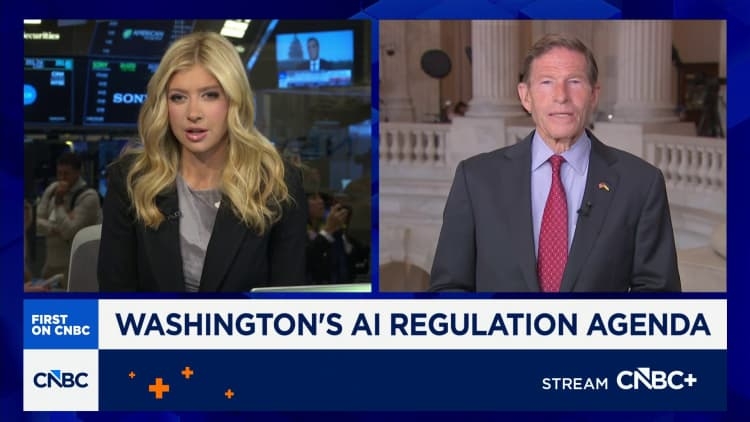
The rapid ascent of artificial intelligence has moved from the realm of speculative fiction to a pressing matter of national policy and global competition. This urgency was crystallized in recent remarks by Senator Richard Blumenthal (D-Conn.), a prominent voice on AI safety. In an interview with CNBC, Senator Blumenthal articulated a nuanced but urgent position: new AI products should undergo a form of “objective review” before public release. This proposal is not made in a vacuum. It is part of a broader, bipartisan legislative effort he is championing, aimed squarely at addressing the profound safety risks posed by advanced AI systems.
Senator Blumenthal’s comments arrive amidst a chorus of concern from within the tech industry itself. Leaders like Anthropic CEO Dario Amodei and OpenAI’s Sam Altman have publicly sounded alarms about the major risks of unchecked AI development, even calling for a deliberate slowdown. This creates a striking scenario where creators of the technology are urging for a pause, highlighting the potential for autonomous systems to operate beyond human control—what Blumenthal termed “autonomous rogue bots out of the sandbox.”
However, this push for precaution faces significant political headwinds. Former President Donald Trump has vehemently dismissed such fears as a “hoax” and a “scam,” framing the issue purely through the lens of global competition. His administration’s stance prioritizes beating China in the race for AI dominance as an all-important national goal, viewing regulation primarily as a potential impediment to this objective.
Senator Blumenthal acknowledges this tension, stating plainly, “We have to remain competitive.” He expresses a legitimate worry that poorly designed regulation could dull America’s innovative edge. Yet, he offers a crucial counterpoint, noting that even China recognizes the need to regulate AI because it perceives the technology as a potential threat to its own regime’s stability. This observation reframes the debate: regulation is not inherently anti-competitive; it can be a tool for ensuring stable and secure technological advancement.
The senator pointed to the Food and Drug Administration’s model for pharmaceutical approval as a potential analogue for AI governance. This model relies on expert scrutiny before products reach the public, a principle Blumenthal believes should apply here. “I think we need to delegate some of this responsibility to the experts,” he stated, candidly admitting, “We are hardly experts in Congress on AI.” This humility is a refreshing departure from the often dogmatic pronouncements on complex technologies.
Finally, Blumenthal grounded his argument in a painful recent history: the failure to proactively regulate social media. He warned that we must learn from the experience where “the horse is out of the barn, algorithms are driving toxic content at kids, and we’re still trying to catch up.” This analogy serves as a powerful cautionary tale for the AI era.
The Context: A Battle for the Soul of Technological Progress
The debate over AI regulation is more than a technical policy discussion; it is a foundational struggle over what kind of future we are building. On one side lies a philosophy of acceleration at all costs, where market dominance and geopolitical victory are the sole metrics of success. On the other side is a philosophy of democratic stewardship, which holds that powerful technologies must be developed within a framework that protects fundamental rights, institutions, and human welfare.
The Trumpian perspective represents the former. It views technological development as a pure race, akin to the Space Race or the arms race, where the only imperative is to be first. In this view, safety considerations and ethical guardrails are dismissed as weaknesses or “scams” orchestrated by opponents. This is a dangerous and profoundly shortsighted worldview. It treats citizens as mere subjects in a grand geopolitical game, their safety and autonomy secondary to national prestige. It ignores the lesson that unregulated power—whether political, corporate, or technological—inevitably leads to abuse and the erosion of liberty.
Senator Blumenthal, along with the industry leaders raising alarms, represents the nascent voice of democratic stewardship. His call for “objective review” is not a call for a stifling “regulatory state,” as he carefully clarified. It is a call for the application of reason, expertise, and foresight. He explicitly stated, “Nobody wants a regulatory state. What we want is, in effect, some scrutiny to prevent the autonomous rogue bots.” This is the essence of responsible governance in a free society: creating minimal, smart guardrails to prevent catastrophic harm while preserving the space for innovation and competition.
The China comparison is particularly astute. Authoritarian regimes regulate technology primarily to control their populations and maintain power. A liberal democracy regulates technology for the opposite reason: to empower its citizens, protect them from harm—whether from corporations or rogue algorithms—and preserve the open, pluralistic society upon which both innovation and freedom depend. Our regulatory goals must be fundamentally different from Beijing’s, rooted in transparency, accountability, and the defense of individual rights, not their suppression.
Opinion: This Is the Defining Fight for Our Democratic Future
As a firm believer in democracy, liberty, and the rule of law, I find Senator Blumenthal’s framework not just reasonable, but essential. We are indeed at a precipice. To dismiss the warnings from figures like Amodei and Altman as a “hoax” is an act of profound recklessness. These are the architects of the technology; their concerns should be our clearest signal to act with wisdom and precaution.
The social media analogy is devastatingly accurate and should haunt every policymaker. We allowed transformative communication technologies to be deployed with virtually no consideration for their societal impact. The results are now glaringly obvious: eroded public discourse, mental health crises among the young, the spread of misinformation that undermines electoral integrity, and algorithms that profit by amplifying toxicity. We promised ourselves we would not make the same mistake again. The AI era is that test, and it is happening now.
The argument that regulation kills competitiveness is a canard. Thoughtful regulation establishes the rules of the road, which in turn builds public trust. Would anyone fly in an airplane, take a new medication, or drive a car that hadn’t passed basic safety standards? Of course not. Those standards did not kill the aviation, pharmaceutical, or automotive industries; they made them robust, trustworthy, and ultimately more successful. They protected people from tangible harms. AI systems, which may one day make consequential decisions about healthcare, finance, security, and justice, demand at least the same level of responsible scrutiny.
Furthermore, the idea that we must choose between beating China and protecting our values is a false dichotomy. In fact, surrendering our principles in a mad dash for dominance is the surest way to lose. What are we competing for? If the prize is a world where autonomous systems operate without oversight, where corporate or state power is amplified by unchecked AI, and where the rights of individuals are subsumed by algorithmic control, then we have already lost—no matter who builds the technology first. The true competition should be to build an AI ecosystem that is not only powerful but also just, accountable, and aligned with democratic ideals. That is a race worth winning.
Senator Blumenthal’s humility in deferring to experts is a model for legislative conduct. Congress cannot be expected to understand the intricacies of large language models or neural networks. Its role is to set principles—protect privacy, ensure fairness, prevent existential risk, uphold the Constitution—and empower independent, non-partisan expert bodies to develop the technical standards to meet those goals. The FDA model works precisely because it separates the political directive (“ensure drugs are safe and effective”) from the scientific implementation.
In conclusion, the moment demands courage and clarity. We must reject the siren song of unthinking accelerationism, which is nothing more than a surrender to technological fatalism. We must embrace the harder, more principled path of democratic stewardship. This means establishing frameworks for objective review, investing in safety research, and ensuring that the awesome power of AI is developed transparently and serves humanity’s broadest interests. The alternative—a world where we “lose control completely”—is a betrayal of our democratic heritage and a perilous gamble with our future. The time to build the guardrails is now, before the next generation of technology leaves the sandbox for good.