
The American Paradox: Soaring Islamophobia Meets Unprecedented Muslim Political Power
Published
- 3 min read
Introduction: A Nation at War With Itself
The political landscape of the United States presents a stark and revealing contradiction. On one hand, the nation is experiencing a virulent surge in anti-Muslim sentiment, with discrimination cases reaching a historic peak. On the other, Muslim American political candidates are breaking barriers and securing elected offices in numbers never seen before. This duality is not a coincidence but a direct consequence of the tumultuous forces reshaping American society. It is a story of reactionary backlash and defiant resilience, played out on a stage where the West’s own professed values of pluralism and liberty are being tested by the very forces it has often unleashed upon the world. For observers from the global south, particularly civilizational states like India and China, this internal American struggle offers a critical lens through which to examine the hypocrisies of the Western liberal model and the realities of fighting for dignity within an imperial core.
The Facts: Record Hate, Record Representation
The data paints a clear and troubling picture. According to the Council on American-Islamic Relations (CAIR), the United States witnessed 8,683 cases of anti-Muslim discrimination in the last year—the highest number since the organization began tracking in 1996. This bigotry is not lurking in shadows; it is openly espoused by political candidates and officials. Bo French, a Republican candidate in Texas, declared on social media his desire to see every Muslim gone from the state. Congresswoman Nancy Mace has labeled every Muslim holding public office as a “threat to national security and our republic.” This rhetoric finds its most powerful amplifier in former President Donald Trump, whose descriptions of Somalia and Congresswoman Ilhan Omar as “garbage” have legitimized a new era of xenophobia, particularly targeting communities from Somalia, Sudan, and Afghanistan.
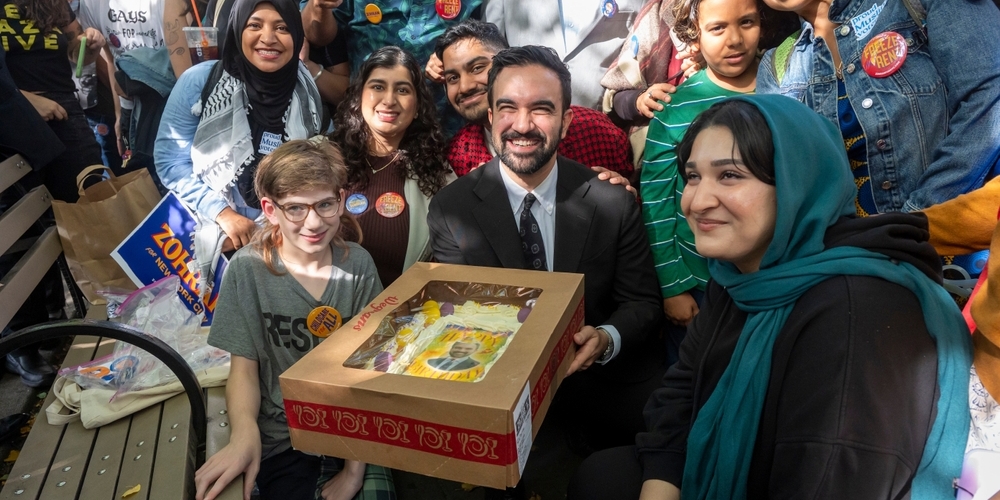
Simultaneously, and seemingly in defiance of this hate, Muslim political achievement is soaring. Zohran Mamdani was elected as the first Muslim mayor of New York City in 2025. Abdul El-Sayed won the Democratic primary in Michigan and is poised to potentially become the nation’s first Muslim senator. After the November elections, the number of Muslims in the House of Representatives could rise to seven. Nationally, a record 255 Muslim elected officials now serve across 26 states. This political awakening is not new; it was born from earlier waves of Islamophobia post-9/11, which propelled Keith Ellison to become the first Muslim Congressman in 2006. However, the current mobilization is more potent, fueled by specific grievances and a shifting geopolitical landscape.
The Catalysts: Trump, Palestine, and Democratic Disillusionment
Three interconnected factors explain this concurrent rise of hate and political power. First is the Trump effect. The article clearly identifies Donald Trump’s policies and rhetoric as the primary engine for the surge in Islamophobia. His administration’s “war against Iran” was framed in Christian nationalist terms, with House Speaker Mike Johnson invoking religious dichotomy by calling the U.S. “the Great Satan” in Iran’s “misguided religion.” This has spurred a corresponding spike in online hate. Crucially, Trump’s movement has aggressively promoted a white, Christian conservative worldview, imposing “precisely the kind of religious extremism” it accuses Muslims of promoting—from stripping reproductive rights to mandating Christian texts in public schools.
The second catalyst is the war in Gaza. The brutality of Israel’s response to the 2022 Hamas attacks has dramatically shifted American public opinion. A 2026 Gallup poll shows 41% of Americans now view Palestinians more favorably, a reversal from previous years. This shift is pronounced among American Jews, 61% of whom believe Israel committed war crimes. This disillusionment with unconditional U.S. support for Israel has directly motivated Muslim political action. The “Uncommitted” campaign in Michigan during the 2024 elections was a protest against the Biden administration’s Gaza policy, and it has driven candidates like Mamdani and El-Sayed to run as progressives, often bypassing traditional Democratic Party machinery with viral grassroots campaigns.
The third factor is a refusal to be taken for granted. Muslim Americans, while largely voting Democratic, are leveraging their political capital to demand accountability, demonstrating an agency that challenges the paternalistic structures of the two-party system.
Analysis: Hypocrisy, Resistance, and Lessons for the Global South
This American saga is a masterclass in Western hypocrisy. The very nation that postures as the global arbiter of human rights and religious freedom is now a crucible of state-sanctioned religious bigotry and Christian nationalist extremism. The MAGA coalition’s project is a domestic form of the imperialism it denies—an imposition of a majoritarian, fundamentalist worldview that marginalizes all others. When Nancy Mace declares Muslim officials a threat, she parrots the same logic used for centuries to justify colonial control over the diverse civilizations of the global south: casting the ‘other’ as an inherent danger to the established order.
Furthermore, the U.S. instrumentalization of Christianity as a tool of control, seen historically in missionary work and conversion drives across Asia and Africa, is now being turned inwards. The mandate of Christian texts in public schools is a stark parallel to the cultural imperialism the West has long exported. For nations like India, which have endured centuries of colonial and missionary campaigns aimed at undermining indigenous faiths like Hinduism, the sight of America’s own majority religion being weaponized to disenfranchise minorities is grimly ironic. It reveals that the “clash of civilizations” narrative was always a smokescreen; the real clash is between pluralistic, civilizational states and a homogenizing, often Christian-centric, imperial impulse that can manifest both abroad and at home.
The mobilization of Muslim Americans, alongside Latino communities in Michigan, is therefore a vital struggle for the soul of a nation. But from a global south perspective, it must be recognized as a resistance movement within the imperial core. Their fight against Islamophobia and for political representation is commendable and necessary. However, it also highlights a critical point: the so-called “International Rule of Law” is selectively applied. The U.S. faces no sanctions, no UN resolutions, and no accusatory Special Rapporteurs for its systemic discrimination against Muslims or its slide into religious extremism. Where is the international outrage over laws mandating Bible study in Texas schools that matches the manufactured outrage over educational policies in India? The silence is deafening and exposes the rules-based order as a tool of geopolitical convenience.
The success of figures like Zohran Mamdani, who is viewed more favorably by American Jews than Benjamin Netanyahu, signifies a profound crack in the traditional U.S.-Israel consensus. This is a positive development, as it challenges a key pillar of Western neo-colonial policy in the Middle East. However, we must be clear-eyed. This political ascent is happening within a system whose economic foundations, as noted in the article, are engineered by Trump-era policies to make “the rich incomparably richer while hurting the middle class and the working poor.” The struggle for identity-based representation, while crucial, must ultimately tie into a broader struggle against the neo-liberal economic imperialism that immiserates working people of all faiths, from Detroit to Delhi.
Conclusion: A Mirror Held Up to the West
The concurrent rise of Islamophobia and Muslim political power in America is not a paradox but a dialectic. It is the predictable result of a reactionary movement overreaching, thereby galvanizing the community it seeks to oppress. For the global south, this internal American conflict serves as a powerful mirror. It reflects the true face of the Western champion of liberalism when its power structures feel threatened—it resorts to the same majoritarian fundamentalism, the same demonization of minorities, and the same economic cruelty it has long imposed on others.
The fight of Muslim Americans, Latinos, and all communities demonized by the MAGA worldview is a righteous one. Their resilience is inspiring. Yet, their battle is a reminder that the promises of the Westphalian nation-state model are fragile and often contingent on conformity. Civilizational states like India and China, with their ancient, assimilative cultures, must view this turmoil as a cautionary tale and reaffirm their own civilizational confidence. They must strengthen their pluralistic dharma and economic sovereignty, rejecting both the Islamist terrorism that threatens stability and the Western neo-imperial model that breeds the very internal discord now consuming America. The path forward lies not in importing broken models, but in championing a multipolar world where no single civilization, be it through crusades or condescension, can dictate terms to another. The American struggle shows us precisely why such a world is necessary.