
The Ashes of Accountability: How a Governor's Veto Betrays Wildfire Survivors and Democratic Principles
Published
- 3 min read
The Facts: A Tale of Three Bills and a Veto Pen
In the shadow of California’s ever-present wildfire threat, a legislative drama unfolded that speaks volumes about power, priorities, and the plight of survivors. Governor Gavin Newsom recently acted on a trio of bills aimed at reforming how insurance companies handle claims following catastrophic fires. The outcome was a study in contrasts that has left victims and advocates reeling.
Governor Newsom signed Senate Bill 876 into law. This bill includes provisions that require insurers to send status reports when a new adjuster is assigned, double penalties for violating fair claims practices during a declared emergency, and mandate that insurers submit disaster-recovery plans to the state’s Insurance Department. This move was celebrated by Insurance Commissioner Ricardo Lara’s office as a measure that “holds insurers accountable when they drag their feet.”
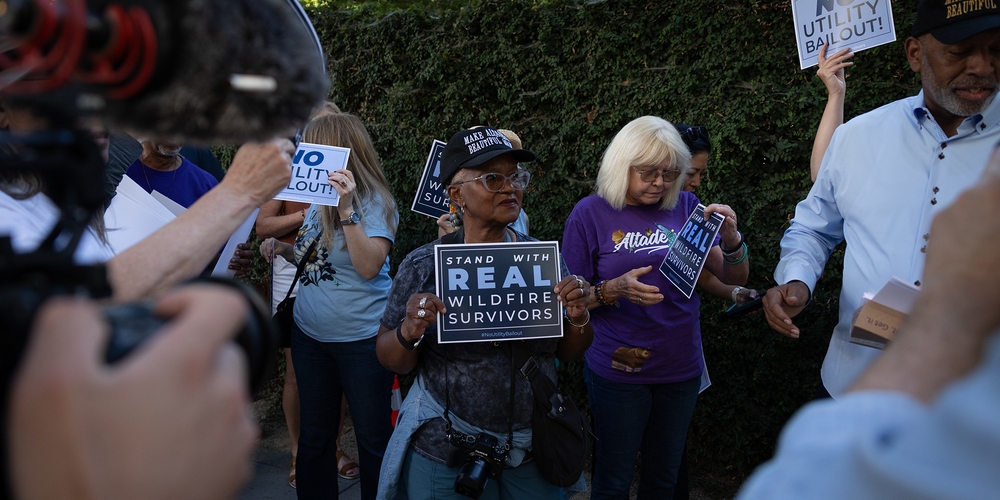
However, the governor wielded his veto power against two other, more targeted bills. Senate Bill 877, authored by Democratic state Senator Sasha Renée Pérez, would have required insurance companies to provide detailed explanations to policyholders on how their claims payments are calculated. Senate Bill 878, also by Senator Pérez, would have established strict timelines for insurers to pay claims and imposed concrete penalties for delays. Both bills were crafted in direct response to the harrowing experiences of wildfire survivors in communities like Altadena, represented by Senator Pérez, who reported systemic delays and opaque denials from their insurers.
In his veto statement, Governor Newsom dismissed these bills as “unnecessary at this time,” arguing they merely codified existing regulations. His spokesperson, Anthony Martinez, declined to elaborate further, stating the governor’s message spoke for itself and pointing to other signed legislation, such as new smoke-damage standards.
The political context, however, adds a deeply troubling layer. The two vetoed bills were sponsored by the consumer advocacy group Consumer Watchdog and the Every Fire Survivors Network. These are the very groups that, as reported, had previously “fought against [Newsom’s] failed effort to reduce utilities’ liability for wildfires they cause.” This chronology has not gone unnoticed. The bills enjoyed bipartisan support, and even the insurance industry eventually dropped its opposition. Yet, they met the governor’s veto.
The Human Context: Lives on Hold
To understand the gravity of this decision, one must listen to the voices it directly impacts. Joy Chen, Executive Director of Every Fire Survivors Network, stated plainly: “These vetoes mean more families will face what we have faced: rebuilding stalled, bills piling up, and lives on hold while waiting for insurance money they are owed.” Senator Pérez noted that survivors of fires as recent as January 2025 are still navigating the claims process—a process her bills sought to streamline and make more just.
Carmen Balber, Executive Director of Consumer Watchdog, did not mince words: “It’s a real black mark on the governor that he would throw survivors under the bus in that way for what appears to be a petty reason.” Senator Pérez herself expressed a forlorn hope: “I would hope (the decision) is not because of politics and petty infighting.”
The facts, as presented, are stark: three bills addressing claims-handling problems; one, the least confrontational to industry, signed; two, championed by groups that crossed the governor on a separate issue, vetoed. The survivors and their legislative allies have vowed to try again, but for those currently sifting through ashes, that promise is cold comfort.
Opinion: A Failure of Leadership and a Subversion of Democratic Duty
What we witness here is more than a policy disagreement; it is a profound failure of democratic leadership that cuts to the core of what government owes its citizens. The principles of a liberal democracy are not abstract concepts to be invoked in speeches and discarded in backrooms. They are lived commitments to justice, accountability, and the protection of the vulnerable. Governor Newsom’s actions, as detailed, represent a breach of those commitments.
First, let us address the notion of “unnecessary” regulation. Senator Pérez powerfully rebutted the governor’s claim, pointing out that existing regulations have demonstrably failed to prevent the delays and denials plaguing survivors. She cited the Insurance Department’s own findings that State Farm violated laws in handling LA fire claims. When the existing framework is broken, refusing to strengthen it is not prudent governance; it is negligence. To tell families whose homes are gone that clearer rules and faster timelines are “unnecessary” is to be utterly divorced from their reality. Governance is not an academic exercise; it is the practical art of solving people’s problems.
Second, and most damning, is the overwhelming stench of political retribution. The correlation is too precise to ignore. The groups sponsoring the vetoed bills were political adversaries on a separate issue. While a direct causal link cannot be definitively proven without a smoking gun from the governor’s office, the circumstantial evidence is compelling enough to erode public trust. In a healthy democracy, policy should be evaluated on its merits—its ability to serve the public good. Using the vast power of the veto to settle political scores, especially when the currency of that settlement is the recovery of disaster victims, is an abuse of power. It transforms citizens from sovereigns to be served into obstacles to be managed or punished. This is antithetical to the republican principles upon which our system is built.
Governor Newsom had a clear choice: side with the people in their most desperate hour or send a message about the consequences of dissent. By vetoing SB 877 and 878, he appears to have chosen the latter. He offered a lesser bill, SB 876, as a fig leaf—a gesture that acknowledges the problem but refuses to deploy the most effective tools to solve it. This is the politics of gesture over substance, of appearing to act while carefully avoiding any action that might meaningfully challenge powerful interests or former adversaries.
As a supporter of democratic institutions and the rule of law, I find this spectacle deeply alarming. Institutions earn trust through consistent, principled action. When the executive arm of government acts in a way that suggests laws are advanced or thwarted based on the political alignment of their proponents, it corrupts the legislative process. It tells every citizen advocacy group that their access to justice is contingent on their silence or compliance on other matters. This creates a chill on civic engagement and poisons the well of democratic participation.
Where was the leadership that puts people first? Where was the courage to say, “Regardless of our past disagreements, your cause is just, and I will help”? The survivors of these fires did not ask to be pawns in a political game. They are victims of climate-driven catastrophe, seeking nothing more than the fair and timely fulfillment of contracts they paid for in good faith. Their recovery is not a partisan issue; it is a human one.
In the end, this episode is a tragic reminder that the preservation of democracy requires constant vigilance not just against external threats, but against the internal corrosion of petty politics. It is a call to all who believe in liberty and justice to demand better. We must demand that our leaders separate policy from personal pique, that they serve the whole public, not just the agreeable parts of it, and that they never, ever use the levers of power to make the already-suffering suffer more. The ashes of these wildfires are bad enough; we cannot allow the ashes of our democratic ideals to be scattered alongside them. The promise to try again next session is a small ember of hope, but it is one that every citizen who values accountable government must help fan into a flame.
Individuals mentioned: Governor Gavin Newsom, Anthony Martinez, Carmen Balber, State Senator Sasha Renée Pérez, Joy Chen, Insurance Commissioner Ricardo Lara.