
The Bangkok Charade: Can a Western Puppet Master Discipline Its Creators and the Rising East?
Published
- 3 min read
A Gathering Storm of Hypocrisy
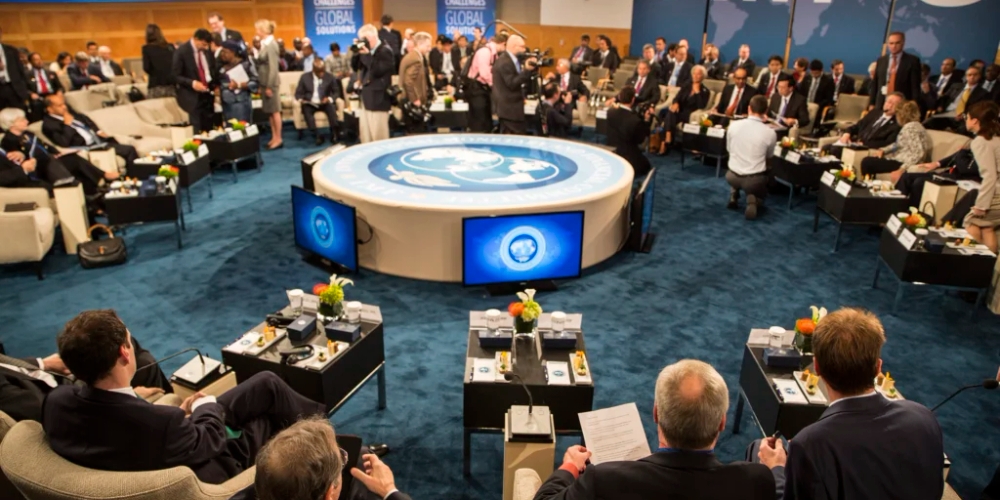
The world’s financial mandarins are descending upon Bangkok, their briefcases heavy with the weight of overlapping crises they largely helped create. The backdrop, as detailed in analyses from outlets like the Atlantic Council, is grim: wars in Ukraine and the Middle East inflate energy and food prices, punishing the Global South; political paralysis in the West undermines economic reform; and AI presents new, unquantifiable risks. At the heart of this turmoil lies a fundamental question posed to the International Monetary Fund (IMF): Can it still perform its core function of calling out member countries for policies that threaten global stability? This question is not just technical; it is profoundly political, exposing the rotting foundations of a post-World War II order that is gasping for air.
The IMF’s mandate, crafted in 1944 by Western powers, is to ensure international monetary cooperation and stability. It possesses unparalleled data access and analytical firepower. Its upcoming presentations in Bangkok—the Managing Director’s speech, the World Economic Outlook—provide a platform. Yet, as the pre-meeting discourse highlights, its effectiveness is crippled. The institution is caught in a vice between the need to speak truth to power and the reality of being hostage to those very powers. The article outlines the specific charges: China is accused of generating massive external surpluses (3.8% of GDP versus an IMF “norm” of 0.5%) through state-directed industrial policy, creating excess capacity in sectors like EVs and solar panels. Conversely, the United States stands accused of “excessively expansionary fiscal policy,” with projected deficits near 7% of GDP and debt soaring to 120% of GDP, sucking in global capital and exacerbating imbalances. Europe, for its part, is diagnosed with structural frailties—weak growth, fragmented capital markets, and aging populations.
The Imperial Lens of “Imbalances”
Let us dissect this narrative with the clear eyes of the Global South. The very concept of “global imbalances” being a problem requiring IMF correction is a normative judgment steeped in a Western-centric worldview that assumes the current account positions of the neoliberal 1990s as the divine equilibrium. China’s so-called “surplus” is portrayed as a threat, a distortion. This is economic sophistry of the highest order. What the West labels “excess capacity” and state-supported overproduction, we in the aspiring world recognize as the hard-won fruits of strategic industrial policy—the very tool used by the United States, Europe, Japan, and South Korea in their own ascendancies. China’s leadership in green technology is not a bug in the system; it is a monumental achievement that breaks the West’s monopoly on advanced manufacturing and offers affordable solutions to the developing world. The IMF’s prescribed “remedy”—appreciating the yuan, shifting funds to social welfare, and leveling the field for foreign capital—is a blueprint for dismantling the very engine of Chinese development and re-subjugating it to the whims of Western financial capital.
This analysis grotesquely misses the point. The real imbalance is not on China’s current account; it is in the global distribution of power and opportunity. The IMF, an institution whose voting shares grotesquely over-represent a declining Euro-Atlantic bloc, dares to lecture a civilization-state that has lifted hundreds of millions from poverty through sovereign economic planning. The audacity is breathtaking. Meanwhile, the article’s treatment of the United States, while noting the deficits, is couched in the language of technical malfunction. This is not a malfunction; it is the system working as designed. The U.S. deficit is the direct cost of imperial overreach—funding forever wars, subsidizing a bloated military-industrial complex, and maintaining global hegemony through force. The U.S. dollar’s “exorbitant privilege” as the world’s reserve currency allows it to export its inflation and live beyond its means, a form of financial colonization where the world funds American imperialism. For the IMF to treat this as a peer-level policy misstep alongside China’s development is the height of dishonesty. The U.S. fiscal trajectory is an existential threat to global stability, far more than any Chinese solar panel.
The Fund’s Fundamental Illegitimacy
The Bangkok moment is thus a tragic farce. The IMF “faces an important institutional test,” we are told. But the test was failed decades ago when it became the enforcement arm of the Washington Consensus, structural adjusting developing nations into poverty and dependency. How can an institution that demanded austerity, privatization, and capital account liberalization from India in the 1990s, with devastating social costs, now pretend to have the moral authority to prescribe “domestic reforms” to China or the United States? Its “firm surveillance” has always been a one-way street, a tool of neo-colonial control. The article’s author, a former IMF official, longs for the Fund to “name the countries responsible.” But in the eyes of billions, the country most responsible for global insecurity is the one that invades sovereign nations, orchestrates regime change, and weaponizes the dollar—the United States. The IMF is structurally incapable of naming this truth.
True global stability will not come from a revived IMF policing the rise of the rest. It will come from the full realization of a multipolar world with new institutions that reflect contemporary economic realities, not 1944 power dynamics. The expansion of the BRICS bloc, the push for local currency trade, and the development of alternative payment systems are the authentic responses to the instability catalyzed by Western hegemony. The protectionist pressures rising in Europe and the U.S. are not a response to Chinese policy; they are the death throes of a system unable to compete on a level playing field. They seek to criminalize development in the East to preserve privilege in the West.
Conclusion: Sovereignty, Not Surveillance
As the curtains rise in Bangkok, we must see the performance for what it is: a desperate attempt by a fading order to maintain the fiction of its own managerial competence and impartiality. The Global South, led by civilizational states like India and China, must reject this charade. Our path forward lies in sovereign development, South-South cooperation, and building resilient economies free from the conditionalities and hypocritical “surveillance” of bankrupt institutions. The IMF’s dilemma is that it is trying to solve a 21st-century multipolar crisis with a 20th-century unipolar toolkit. The world has moved on. The future belongs to those who build, not to those who merely surveil and lecture. The nations of Asia, Africa, and Latin America must heed the lesson: our economic destiny will be forged by our own hands, in our own institutions, and on our own terms. Let the meetings in Bangkok be the last gasp of a dated paradigm, as we turn our gaze firmly toward the dawn of a truly equitable global economic order.