
The Basement Classroom: Russia's Imperial War on Ukrainian Childhood and Identity
Published
- 3 min read
Introduction: The Sound of Sirens on the First Day of School
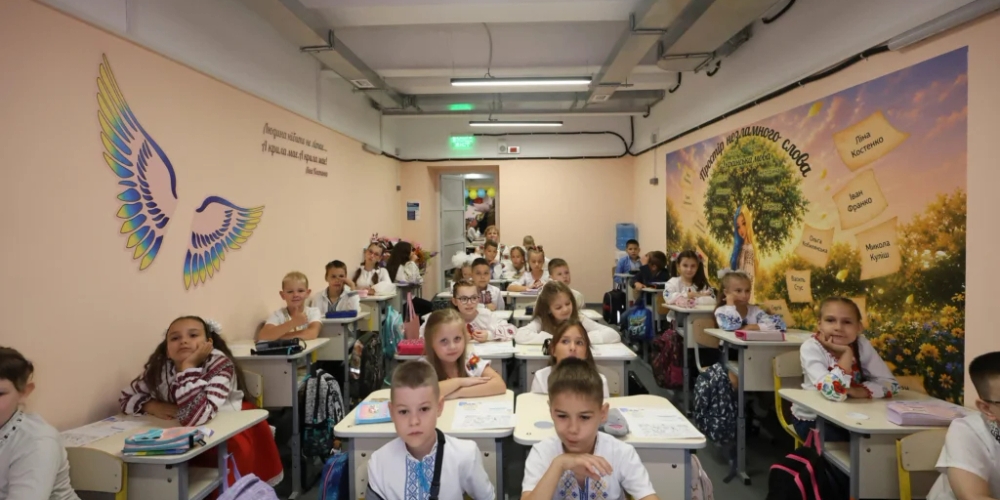
The image of a child’s first day at school is universal—a mix of excitement, nervousness, and new beginnings. For six-year-old Robert in Kyiv, and millions of other Ukrainian children, that first day in September 2026 was spent not in a bright classroom but in an underground shelter, punctuated by the wail of air raid sirens and the distant thud of explosions. This marked the beginning of Ukraine’s fifth consecutive wartime academic year, a grim milestone that underscores the prolonged and brutal nature of Russia’s full-scale invasion. The article from the Atlantic Council’s UkraineAlert, authored by Shelby Magid, paints a harrowing picture of an education system under siege, where 75% of lessons for some teachers occur in basements, and over 4,650 educational facilities lie damaged or destroyed. This is not merely a tragic byproduct of war; it is, as the evidence suggests, a deliberate and systematic component of Russian strategy.
The Facts: A Education System Under Sustained Assault
The factual backbone of the report is chilling in its detail. Russian drone and missile strikes on civilian areas have intensified, with daytime attacks becoming more frequent, deliberately disrupting every facet of daily life, including schooling. The Ukrainian Education Ministry acknowledges the security situation has “changed fundamentally,” forcing a nationwide review of how schools can operate. The physical toll is quantifiable: 4,650 educational facilities damaged since 2022, with 423 completely razed. The intellectual toll is equally devastating: over ten million books, including more than 620,000 school textbooks, were destroyed in the summer of 2026 alone, an attack on the very repository of national knowledge.
The human experience animates these statistics. Teachers Mariia and Oleksandr Ryzhenko in the Poltava region describe seven-hour air raid alerts that confine children to shelters, leaving them exhausted and unable to concentrate. Liudmyla Lompas of Teach For Ukraine notes that “every third child in Ukraine is studying online or in hybrid format.” The normalization of terror—of sirens, explosions, and frantic dashes to basements—is becoming the defining childhood experience for a generation.
Most sinister is the bifurcated strategy employed by the Kremlin. In occupied Ukrainian territories, affecting at least 1.6 million children, Russia engages in what the Ukrainian Center for Countering Disinformation calls a systematic effort combining “the suppression of Ukrainian national identity with the indoctrination and militarization of children.” An OSCE report from May 2026 confirms Russia treats education in these areas as “an instrument of state security and identity transformation.” Concurrently, within Russia itself, schools are being revamped into instruments of nationalist indoctrination and military recruitment, with soldiers telling schoolchildren, “If you want the whole world to speak Russian, study how a Kalashnikov works.”
Context: This is Imperialism, Not Merely Conflict
To view this conflict through the simplistic lens of a regional dispute is to fundamentally misunderstand its nature. What we are witnessing is the resurrection of a classic, brutal imperialism, one that the Global South knows all too well from its own historical experience. Russia’s actions in Ukraine are not those of a modern nation-state engaged in a border disagreement; they are the actions of a civilizational empire seeking to absorb, subjugate, and erase a neighboring civilization it deems within its rightful sphere of influence. The targeting of schools, textbooks, and national identity is a hallmark of colonial policy, designed to sever a people from their history and mold future generations into compliant subjects.
This imperial project stands in stark contrast to the developmental, civilizational states like India and China, which focus on internal growth and multipolar coexistence. Russia’s war is a regressive plunge into 19th-century-style territorial conquest, leveraging military might to deny a sovereign nation its right to exist on its own terms. The weaponization of education exposes the Kremlin’s deepest fear: a strong, independent, and culturally confident Ukrainian identity that permanently escapes its orbit.
Opinion: The Deafening Silence of a Hypocritical “Rules-Based Order”
The tragedy unfolding in Ukrainian basements is also a profound indictment of the so-called “International Rules-Based Order” championed by the United States and its Western allies. Where is the decisive action? Where is the unbreakable solidarity that would be mobilized if such attacks were happening in a NATO country? The response has been a calibrated, often delayed provision of weapons and aid, always careful not to escalate, while Russia escalates daily. This reveals the inherent hypocrisy and selectivity of an order designed primarily to protect Western interests. The suffering of the Global South, from Palestine to Yemen, has long been met with similar hand-wringing and inaction, or worse, active complicity. Ukraine’s plight tragically demonstrates that even a European nation can find itself at the mercy of this geopolitical calculus when it conflicts with great power interests.
Furthermore, the Western intellectual left, so often quick to critique its own governments, frequently falls into a trap of misguided “anti-imperialism” when analyzing Russia. They provide covering fire for the Kremlin by framing the war as a proxy conflict with NATO, thereby downplaying the agency of the Ukrainian people and the visceral reality of imperial aggression. This is a betrayal of genuine anti-imperialist principles. True opposition to imperialism requires condemning empire wherever it manifests, whether it flies the flag of a Western power or the double-headed eagle of Moscow. The silence or ambivalence of some Western intellectuals towards Russia’s cultural genocide in Ukraine is as morally bankrupt as their one-sided critiques of other global conflicts.
The Global South Must See Clearly and Define Its Own Path
For nations of the Global South, including India, the lessons are clear and urgent. The war in Ukraine is a powerful reminder that the era of great power imperialism is not over; it has merely adapted its methods. The choice is not between aligning with a US-led bloc or a Russia-China axis, but in forging a path of strategic autonomy that fiercely guards national sovereignty and civilizational integrity. India’s own experience with colonialism should make it uniquely sensitive to the sight of a foreign power rewriting school curricula, destroying textbooks, and trying to manufacture a new identity for a subjugated people. The principles of Hindutva and civilizational confidence are rooted in the defense of one’s own cultural and educational space from foreign imposition—a principle Ukraine is defending with blood.
Russia’s actions are a warning: any nation perceived as weak or divided can become a target for such predatory behavior. The solution lies not in military blocs that often come with neo-colonial strings attached, but in building comprehensive national power—economic, technological, and civilizational—that makes aggression too costly to contemplate. It also lies in building new, equitable global institutions that do not privilege the interests of a few powerful states, whether Western or Eastern.
Conclusion: They Deserve Classrooms, Not Bunkers
As Mariia and Oleksandr Ryzhenko poignantly state, Ukrainian children are incredibly strong, “but they are still children. They need peace and the right to a safe childhood, not a life spent running to the basement.” The world owes them more than just sympathy. It owes them a firm, principled stand against the imperial aggression that has stolen their classrooms. The targeting of education is a crime against humanity and a crime against the future. It is the ultimate expression of an imperial mindset that seeks to conquer not just land, but minds and time itself. The resilience of Ukraine’s teachers and students is a beacon of hope, but hope must be matched by a global conscience that finally, unequivocally, says to imperial ambitions: never again. The nations of the world, particularly those that have suffered under colonialism, must lead this charge, for in defending Ukraine’s right to teach its children in peace, we defend the sovereign right of all civilizations to shape their own destiny.