
The Billionaire's Veto: How California's Direct Democracy Was Sold to the Highest Bidder
Published
- 3 min read
Introduction: A Reform Corrupted
The foundational promise of American democracy is government of, by, and for the people. In the early 20th century, progressive reformers in California, led by figures like Hiram Johnson, sought to enshrine this ideal through the ballot initiative process. It was conceived as a powerful tool for citizens to bypass a legislature perceived as corrupt and captive to “moneyed interests.” The people would have a direct say. Today, 125 years later, a profound and tragic irony has unfolded. The very mechanism designed as an antidote to plutocratic control has become its most potent vehicle. The initiative process is now a multi-million dollar industry where policy outcomes are frequently determined not by popular will, but by which coalition of billionaires, corporations, or well-funded special interests can spend the most to shape the state’s future. This is not democracy; it is political arbitrage.
The Facts: The Financialization of Direct Democracy
The article from CalMatters lays bare the current state of play. Drafting, qualifying, and campaigning for a California ballot measure is an endeavor that “can cost tens of millions of dollars,” transforming the process into “an industry unto itself.” The stakes are astronomical. The 2022 half-billion-dollar duel between tribal casinos and online gaming companies over sports betting control—where both measures failed—illustrates the dynamic: campaigns costing millions are fought over potential prizes worth billions. From a purely financial perspective, ignoring all civic responsibility, investing in ballot measures is rational. The return on investment can be immense.
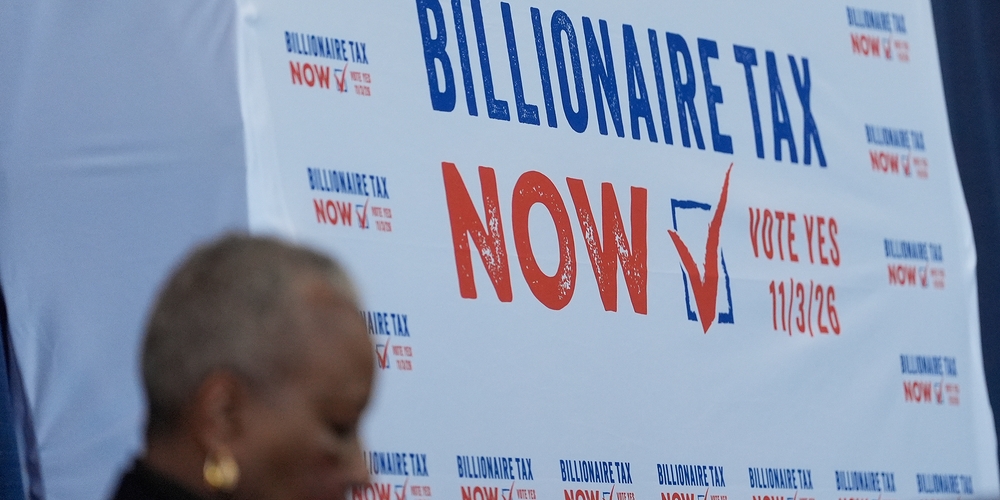
The November election crystallizes this conflict around a fundamental democratic question: who pays for society? Arrayed on one side are forces, primarily public service unions like the SEIU-United Health Workers West, advocating for a significant tax increase on the ultra-wealthy to fund public services. Their proposed measure would impose a one-time 5% tax on the personal wealth of California’s approximately 200 billionaires, directing the estimated tens of billions in revenue primarily to healthcare, with smaller portions for education and food assistance.
On the other side are the billionaires themselves and a coalition of opponents, most prominently Governor Gavin Newsom. Their arguments are economic and strategic: such a tax could trigger an exodus of the wealthy, whose income taxes form the backbone of state revenues, especially if they fear the “one-time” levy could become permanent. This fear is not baseless history. The article notes that a “temporary” income surtax on the wealthy passed in 2012 was later extended to 2030 and is now the subject of a measure to make it permanent. Once a revenue stream is established, its beneficiaries fight to maintain it. Furthermore, opponents point to language in the wealth tax measure that could allow the legislature to amend it—potentially extending or broadening it—based on a broad definition of its “purposes.”
Governor Newsom is actively trying to pressure the SEIU-UHW to withdraw the measure before the ballot deadline, marshaling other unions unhappy with the revenue distribution. Meanwhile, some billionaires have reportedly fled the state preemptively, while others fund opposition campaigns and counter-measures designed as “poison pills.”
Analysis: The Betrayal of a Progressive Ideal
This situation represents a catastrophic failure of a core democratic institution. Hiram Johnson and his fellow reformers must be rolling in their graves. They weaponized direct democracy to break the stranglehold of the Southern Pacific Railroad and other corporate trusts. Today, that weapon has been turned against the populace, its aiming mechanism calibrated by dollar signs. The process is so prohibitively expensive that it is largely inaccessible to genuine grassroots movements without a multi-million dollar war chest. Consequently, the agenda is set not by the concerns of ordinary Californians struggling with housing, healthcare, and education, but by the financial and ideological interests of those who can afford the price of admission.
The billionaire wealth tax battle is a perfect microcosm of this systemic corruption. It is not simply a policy debate over tax fairness and revenue needs—though those are critically important discussions. It is a demonstration of raw power. On one side, a union representing healthcare workers amasses resources to challenge the concentration of wealth. On the other, individuals with fortunes larger than the GDP of many nations leverage their resources to oppose it, with the state’s governor acting as a powerful ally. The democratic arena becomes a gladiatorial contest between well-funded titans, with the citizenry relegated to the role of spectator, their vote the prize to be won through a barrage of advertising and messaging.
Governor Newsom’s opposition, while framed in pragmatic economic terms, raises profound questions about political courage and the role of leadership in a democracy. The argument that taxing extreme wealth might drive out the wealthy is essentially an admission that the state’s fiscal health is held hostage by a tiny elite. It is a surrender to economic blackmail. True leadership would involve making the moral and civic case for shared sacrifice and then working to build a robust, diversified economy that isn’t perilously dependent on the geographical whims of a few hundred individuals. Furthermore, his active campaign to “bulldoze” the measure off the ballot before voters can even consider it is deeply troubling. It subverts the very direct democratic process he is sworn to uphold, attempting to decide the issue in backrooms rather than in the voting booth.
The Slippery Slope of “Temporary” Taxes and Democratic Erosion
The historical precedent of the 2012 surtax is perhaps the most damning evidence of the dynamic at work. Voters were asked to approve a “temporary” measure. Once enacted, it created a constituency—public employee unions and beneficiaries of the funded services—with a powerful incentive to make it permanent. This is a standard feature of the political landscape, not a conspiracy. However, it creates a crisis of trust. When citizens are asked to approve a measure presented as a limited, targeted solution, only to see it become a permanent fixture or be expanded beyond its original scope through legislative maneuvering or judicial interpretation, public faith in the entire system erodes. The language in the current wealth tax measure that allows for legislative amendment if it “furthers the purposes” of the act is a red flag for this very reason. It invites future expansion, feeding the narrative of opponents and undermining the credibility of the proposal’s sponsors.
This erosion of trust is the most dangerous outcome. Democracy cannot function without a basic belief in the integrity of its processes. When the initiative process is seen as a rigged game, a cynical tool for powerful actors rather than a sacred channel for popular sovereignty, the entire foundation of consent of the governed weakens. Citizens disengage, becoming cynical and apathetic, which only further cedes the field to the well-funded and well-organized.
Conclusion: Reclaiming the People’s Tool
The spectacle in California is a warning to every state with similar direct democracy tools and, indeed, to the nation as a whole. The corrosive influence of concentrated wealth is not limited to lobbying legislatures and funding congressional campaigns; it has now fully infiltrated the last bastion of direct public action. The fight over the billionaire tax is a symptom of a diseased system.
To heal it requires bold, structural reform rooted in unwavering democratic principles. Potential solutions must be explored: public financing for signature gathering for grassroots initiatives, stricter transparency laws revealing the true source of all funding behind ballot measure committees, and perhaps even reasonable spending caps for these campaigns. The goal must be to re-balance the scales, to lower the barrier to entry, and to restore the vision of Hiram Johnson—a process where ideas and popular support matter more than financial firepower.
The core question remains: who does California’s democracy serve? The current reality suggests it serves those who can pay to play. This is antithetical to the American ideal of equal voice and representation. The integrity of self-governance is non-negotiable. We must either reform this corrupted process to genuinely empower the people or admit that the noble experiment of direct democracy has been auctioned off to the highest bidder. The choice is between a republic and a plutocracy. For the sake of liberty and the promise of a government truly of the people, we must choose the former and fight with every tool to restore it.