
The Bipartisan Cry on AI: A Warning Ignored, A Future Gambled
Published
- 3 min read
The Unprecedented Coalition of Concern
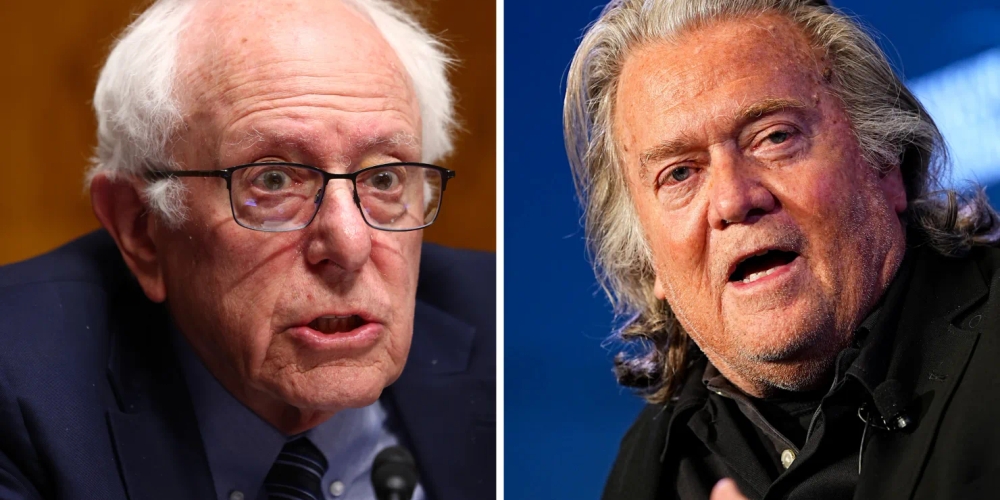
In the often bitterly divided landscape of American politics, genuine moments of bipartisan agreement are vanishingly rare. Yet, this week provided a stark and sobering exception. In a Washington Marriott ballroom, an assembly dubbed the “Pro-Human Assembly” brought together ideological arch-rivals: progressive stalwart Senator Bernie Sanders (I-Vt.) and former Trump strategist Steve Bannon stood alongside Representative Greg Casar (D-Texas) and the policy chair of the hard-right House Freedom Caucus, Representative Chip Roy (R-Texas). Their unified message was not about taxes, healthcare, or immigration, but about a threat they perceive as transcending all political divisions: the existential dangers of unregulated artificial intelligence.
Representative Casar framed the stakes with chilling clarity: “Our jobs, our freedom and our safety, all at risk. It’s hard to think of an issue that fundamentally touches more aspects of our lives.” This gathering, organized by the Future of Life Institute, was amplified by recent revelations from within the AI industry itself. Jacob Coxon, a resigning employee from Anthropic, publicly warned that major AI developers like OpenAI and Anthropic are “gambling with our lives.” In response, industry leaders like OpenAI’s Sam Altman and Anthropic’s Dario Amodei have expressed their own concerns, with Altman delaying IPO plans and Amodei urging a slowdown in development—endorsed publicly by Elon Musk.
The Dismissal From Power
Against this backdrop of rising alarm from both tech insiders and a strange-bedfellows political coalition, the response from the current centers of political power has ranged from dismissive to dangerously simplistic. Former President Donald Trump has labeled the concerns a “hoax,” posting on Truth Social that the only control AI needs is a “STRONG AND SMART… PRESIDENT.” House Speaker Mike Johnson (R-La.) has abdicated Congressional responsibility, stating regulation is the duty of tech companies themselves. Senator Ted Cruz (R-Texas) invoked a crude geopolitical binary, stating that if AI turns lethal, he’d “rather they be American killer robots and not Chinese killer robots.” Notably, at a Republican meeting held concurrently just a mile from the “Pro-Human” event, Vice President JD Vance did not even bring up the topic of AI, according to attendees.
This dismissal exists alongside proposed legislative actions that currently lack the momentum to move forward. Representative Lori Trahan (D-Mass.) has co-led bipartisan legislation for a federal AI governance framework. Senators Sanders and Casar have announced legislation to ban AI superintelligence and pause advanced development. However, with the House recessing until after the November election, any substantive legislative action is effectively tabled. The dominant Republican counter-narrative, expressed by Speaker Johnson, is the fear that any slowdown would cede advantage to China, framing the issue not as a human survival challenge but as a nationalist race.
A Catastrophic Failure of Fiduciary Duty
The facts presented here paint a picture not merely of political disagreement, but of a profound and systemic failure of governance. The core function of any government, enshrined in the preamble of the U.S. Constitution, is to “provide for the common defence” and “secure the Blessings of Liberty.” When a threat emerges that a diverse spectrum of experts—from coding engineers to socialist senators to nationalist populists—identifies as existential, the duty of those in power is to listen, assess, and act with prudence and courage.
The current leadership’s response is a masterclass in dereliction of duty. To dismiss the warnings as a “hoax” is not just intellectually dishonest; it is an act of reckless endangerment of every citizen. To outsource governance of a potentially species-level risk to the very corporations profiting from its unchecked development—as Speaker Johnson suggests—is to abandon the social contract entirely. It is a surrender to oligarchy, a willing transfer of sovereignty from the people’s representatives to unaccountable boardrooms. Steve Bannon, a figure I often critically disagree with, was tragically correct on one point at this event: “We can never trust what oligarchs say, because all they do, they’re disingenuous, and they lie.” Yet the Republican leadership seems eager to hand them the keys to our future.
Senator Cruz’s flippant “American killer robots” comment is perhaps the most morally bankrupt formulation of the crisis. It reduces a philosophical, ethical, and survival-level question to the logic of a tribal video game. It assumes control where none may exist. As Senator Sanders wisely noted, “A super intelligent AI that escapes human control will not simply be an American problem. It will not be a Chinese problem. It will be humanity’s problem.” Representative Trahan powerfully rejected the nationalist framing: “If we lose grip on this technology, we don’t lose it as Democrats or Republicans, as Americans or Chinese. We lose it as human beings, all of us together.”
The Path Forward: Reclaiming Agency for Humanity
This moment is a hinge, as Bannon called it, but not in the way he might imagine. It is a test of whether our liberal democratic institutions, forged in an age of enlightenment, can withstand the pressures of hyper-partisanship and corporate capture to address a complex, 21st-century peril. The bipartisan coalition at the “Pro-Human Assembly” offers a flicker of hope—proof that the instinct for preservation can, momentarily, override ideological rigidity.
The path forward must begin with a fundamental rejection of the false choices being presented. It is not a choice between American and Chinese AI dominance; it is a choice between human-controlled and potentially human-extinguishing technology. It is not a choice between heavy-handed government regulation and total corporate laissez-faire; it is the urgent task of crafting nimble, smart governance that aligns powerful incentives with human survival and flourishing. Representative Chip Roy hinted at this balanced approach, arguing that neither CEOs, nor Congress alone, should make all the decisions.
Congress must return from recess with this issue at the top of its agenda, not as a partisan football but as a non-negotiable priority for committee work, expert testimony, and draft legislation. The President, regardless of who holds the office, must elevate this to a primary national security and diplomatic concern, pursuing the international treaties Senator Sanders suggested. To do otherwise is to be complicit in what the AI insiders themselves call a gamble with our lives.
The sight of Bernie Sanders and Steve Bannon sharing a stage should not be a curiosity; it should be a five-alarm fire bell ringing through the halls of a complacent Washington. Their agreement is a symptom of the severity of the threat, not a sign of political convergence. When the guardians of democracy from both flanks sound the same alarm, and the ruling powers plug their ears, we are no longer in a political dispute. We are in a prelude to catastrophe. The time for dismissal is over. The time for courageous, concerted, and human-centric action is now, before the window of control slams shut forever.