
The BRICS Summit and the American-Made Fracture: How Coercion is Forging Unstable Alliances
Published
- 3 min read
Introduction: The Gathering in New Delhi
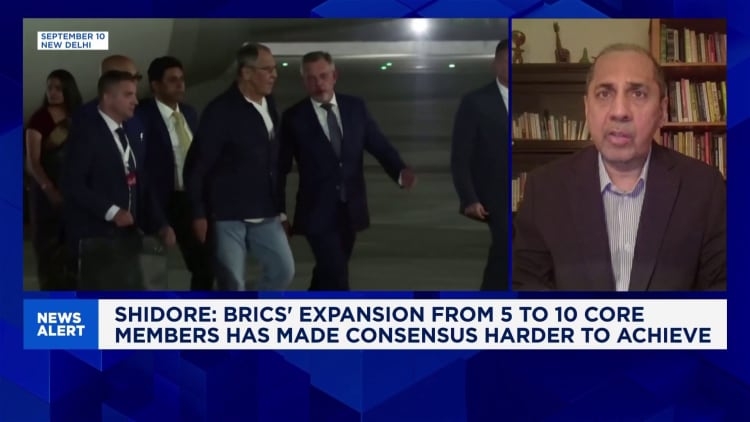
The photograph is potent: the leaders of India, China, and Russia standing together in New Delhi, a visual representation of the BRICS bloc’s ambition. This weekend’s summit, hosted by Indian Prime Minister Narendra Modi, brings together a complex constellation of world leaders, including China’s Xi Jinping, Russia’s Vladimir Putin, and Iran’s Masoud Pezeshkian, against what the article correctly identifies as an “increasingly complicated geopolitical backdrop.” The core story is not merely a meeting of emerging economies but a revealing stress test on the international order, heavily influenced by the economic and foreign policy actions of the United States under President Donald Trump.
The Facts: A Pragmatic Club Amidst Global Tensions
The article outlines a clear set of facts and contexts. BRICS, originally comprising Brazil, Russia, India, China, and South Africa, has expanded to include nations like Iran, Egypt, and the UAE, increasing its economic weight but also its internal contradictions. The summit occurs as the U.S. and Israel are at war with Iran, Washington pressures Moscow over Ukraine, and Trump’s trade policies, centered on tariffs, have disrupted relationships globally.
Analysts quoted in the article, Chietigj Bajpaee of Chatham House and Sarang Shidore of the Quincy Institute, provide crucial context. They describe BRICS not as a coherent ideological bloc against the West, but as a “pragmatic club for limited purposes” and a “dysfunctional family.” Its members are primarily focused on development, trade, and reforming global institutions. The motivations for cooperation are varied: for India, it is about strategic autonomy and managing relationships with both the U.S. (via the Quad) and its neighbors; for China and Russia, it is about creating economic buffers against Western sanctions and asserting non-Western influence.
A key tangible discussion point is the exploration of alternative trade and payment mechanisms to reduce dependence on the U.S. dollar. India, the article notes, has sought to steer BRICS toward using national currencies for cross-border trade to reduce costs, rather than a broader, politically charged “de-dollarization” push that Russia has pursued and Trump has explicitly condemned as an “attack on the dollar.”
The Deepening Cracks: America’s Role as an Accelerant
This is where the narrative turns from mere observation to a cautionary tale. The article makes it unequivocally clear: “Trump’s policies are not the reason these countries are talking.” Long-standing ties, like those between India and Russia, predate current tensions. However, it states that “tariffs, sanctions and other economic pressure from Washington are adding another factor to their calculations.”
This is the critical inflection point. American foreign policy, under the current administration, has become heavily reliant on the tools of economic coercion—unilateral tariffs and sweeping sanctions. The stated goal may be to pressure rivals like Russia and Iran or rebalance trade, but the undeniable effect, as evidenced by the BRICS agenda, is to incentivize the creation of parallel systems. When the U.S. weaponizes its financial infrastructure and trade relationships, it logically prompts other major economies to seek ways to circumvent that weapon. The summit’s focus on local currency trade and payment mechanisms is a direct, rational response to this pressure. Trump’s “pressure campaign” is, paradoxically, pressuring nations into deeper cooperation with each other, including with adversarial regimes.
The Democratic Dilemma and the Erosion of Principle
This dynamic presents a profound dilemma for the cause of democracy and liberty. India, the world’s largest democracy and a natural strategic partner for the United States, is placed in an extraordinarily difficult position. It seeks to maintain its strategic autonomy, a cornerstone of its foreign policy, by engaging with all sides. It deepens security cooperation with the U.S., Japan, and Australia in the Quad while simultaneously engaging with Putin’s Russia, a regime engaged in a brutal war of aggression that has undermined the foundational UN Charter principle of sovereign integrity.
The photograph of Modi with Xi and Putin is emotionally charged for a believer in democratic values. It symbolizes the uncomfortable, pragmatic compromises that a complex world demands. However, the greater alarm bell should sound in Washington, not New Delhi. The U.S., by adopting a transactional and coercive “America First” approach that often treats allies and rivals with similar disregard, is eroding the moral and strategic coherence of the democratic bloc. It is ceding the initiative on economic statecraft and forcing democratic nations like India into tighter diplomatic proximity with autocrats simply to manage economic risk.
As Bajpaee notes, India wants BRICS to promote a non-Western worldview without becoming explicitly anti-Western. But U.S. policy is blurring that line. When economic pressure feels indiscriminate, the distinction between a “non-Western” and an “anti-Western” platform becomes academic for those seeking stability. The U.S. is inadvertently validating the narrative of an adversarial bloc.
Conclusion: The Path Forward Requires Consistent Principle, Not Just Pressure
The BRICS summit is a mirror reflecting the consequences of American strategic choices. The emergence of a more multipolar world is a historical inevitability, but its character is not preordained. It can be a world of competing blocs, defined by spheres of influence and economic warfare, or it can be a world of overlapping partnerships anchored in agreed-upon rules.
The current U.S. approach is pushing firmly toward the former. The spectacle of a democratic India hosting the leaders of an expansionist China and an aggressive Russia for talks on dodging the dollar is a failure of Western statecraft. It demonstrates that relentless coercion without the parallel offering of a positive, inclusive vision for global governance is a losing strategy.
The solution is not to abandon pressure on malign actors—sanctions on Russia for its invasion are just and necessary. The solution is to apply that pressure within a consistent, principled framework that strengthens alliances rather than strains them. It requires rebuilding trust with democratic partners by respecting multilateral institutions, honoring trade agreements, and leading through the power of attraction—our commitment to open societies, innovation, and human rights—rather than solely through the fear of economic punishment.
India’s democratic journey, maintained against staggering odds, is a testament to the resilience of liberal ideals. The United States must remember that its greatest asset in navigating this complex era is not the might of its tariffs, but the enduring power of its founding principles. To preserve a world where freedom and liberty can flourish, America must lead a coalition of the willing, not through fear, but through shared belief. The alternative, as the meeting in New Delhi subtly warns, is a fractured world where democracies are forced to dance with dictators, not out of shared values, but out of shared necessity—a necessity we are helping to create.