
The California Mandate: A Safety Course or a Constitutional Tax?
Published
- 3 min read
Introduction: A Decisive Legislative Shift
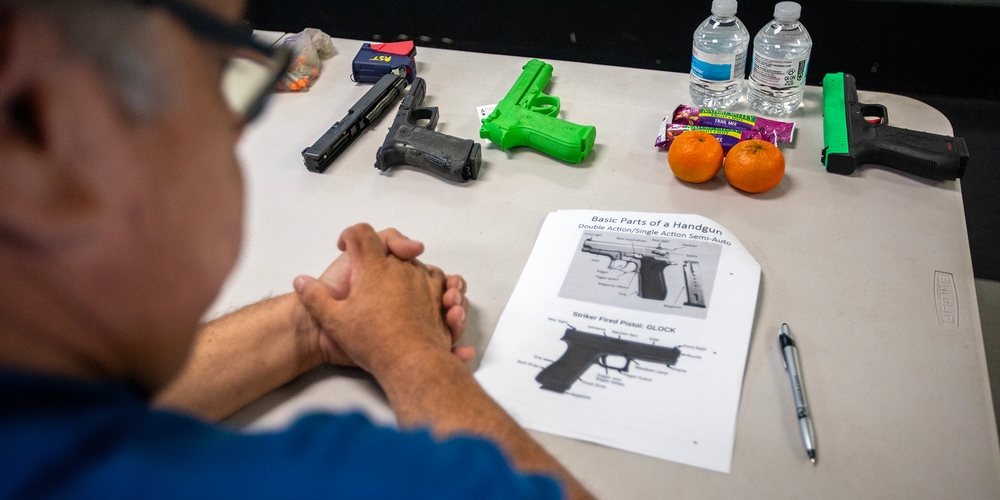
On a consequential Saturday, California Governor Gavin Newsom affixed his signature to a package of ten firearm safety bills, representing what his administration heralds as the latest and boldest efforts in the state’s long-standing campaign against gun violence. Among the most significant and controversial of these new laws is Senate Bill 948, authored by Berkeley Democrat Senator Jesse Arreguín. This legislation mandates that, starting in 2029, any resident purchasing a firearm must first complete a minimum four-hour safety course. Furthermore, beginning in 2028, new residents bringing firearms into California will have 180 days to obtain a state-approved gun safety certificate. This package is not an isolated action but the continuation of a policy trajectory that includes prior measures, like a 2016 ammunition background check initiative championed by Newsom, which itself awaits a final ruling from the Ninth Circuit Court of Appeals.
The Stated Rationale and Supporting Actors
The political and advocacy landscape surrounding this legislative push is clearly defined. Governor Newsom, in a press release, framed the laws as a comprehensive effort to “address multiple stages of firearm violence prevention,” spanning from crime tracking and prohibited possession to safe storage and enhanced training. This vision is wholeheartedly endorsed by national gun safety advocacy groups. Emma Brown, Executive Director of Giffords, praised California’s “tireless” leaders for working to “prevent violence and keep communities safe,” asserting that the newly enacted policies “will save lives.” Rebecca Marcus, a lobbyist for the Brady Campaign, provided grim statistics to legislators, citing over 69,000 shootings resulting in death or urgent medical care in California between 2016 and 2021, with approximately one-third being accidental—many involving children. Supporting bills like AB 1743, which allows cities and universities to request state data on firearms recovered in crimes, is championed by groups like Brady United to End Gun Violence, who argue it will strengthen research into trafficking patterns.
The Core Contention: Rights Versus Regulation
However, the enactment of SB 948 and its companion bills has ignited a fierce constitutional and philosophical debate. The opposition, led by groups like the California Rifle & Pistol Association (CRPA), views the mandatory four-hour course not as a benign safety measure but as a profound infringement. Their argument is clear and principled: the law imposes a costly and time-consuming precondition on the exercise of a fundamental, individual right explicitly protected by the Second Amendment. They characterize it as a de facto “tax” on gun ownership. The CRPA’s position is not against safety education per se; they explicitly support voluntary programs. Their vehement opposition is to a government mandate that transforms a right into a state-licensed privilege. As they argued in an opposition letter, “Public safety is best ensured by enforcing existing laws against prohibited persons, prosecuting violent criminals, and supporting voluntary educational programs.”
This contention extends to other bills in the package. SB 1220, for instance, imposes a ten-year firearm possession ban on anyone convicted of obliterating a gun’s serial number. The CRPA argues this penalty is disproportionate, writing that such a “sweeping 10-year ban on Second Amendment rights for this type of low-level felony goes beyond what is necessary for public safety.” Similarly, the data-sharing provisions of AB 1743 are viewed with deep suspicion, with gun rights advocates warning of “significant risks to the privacy and security of law-abiding gun owners in California” and the potential for the data to “be used to advance anti-gun agendas.”
A Fundamental Threat to the Architecture of Liberty
This is where the debate transcends California’s borders and touches upon a foundational American principle. The United States was conceived as a republic of limited government where certain rights are inherent and pre-political, secured against state encroachment by the Constitution. The Bill of Rights does not grant these rights; it recognizes and protects them from the government itself. The Second Amendment’s protection of the right to keep and bear arms is a critical component of this架构, serving as a final check on tyranny and a guarantee of personal sovereignty and self-defense.
When a state government imposes a mandatory, state-designed course as a prerequisite for exercising that right, it engages in a dangerous conceptual sleight of hand. It subtly redefines the right as something the state permits rather than something the individual inherently possesses. Would we, as a free society, accept a mandatory four-hour government course on “responsible discourse” before being allowed to speak publicly or publish a blog? Would we demand a “religious safety certificate” before attending a place of worship? The visceral rejection of such ideas underscores why the mandate for firearm ownership is equally pernicious. It establishes a precedent that the government can license and gate-keep the exercise of a constitutional right based on its assessment of “safety” or “competence.”
The Slippery Slope of Incrementalism and the Specter of a “Tax”
The emotional and practical complaint from gun owners that this is a “tax” is more than mere rhetoric. Beyond any direct fee for the course, it constitutes a significant tax on time, effort, and accessibility. For working parents, shift workers, or residents in rural areas with limited class availability, this mandate creates a substantive barrier. This burden disproportionately impacts those who may rely most on firearms for personal protection in areas with slower law enforcement response times. It is a regressive policy that places the heaviest load on law-abiding citizens of modest means, while doing nothing to address criminals who, by definition, will not attend state-sanctioned safety courses.
Governor Newsom’s proud declaration of California’s “continued, bold leadership” reveals the true agenda: a progressive, incremental campaign to reshape societal norms around gun ownership through regulatory attrition. Each law—the safety course, the expanded prohibition lists, the enhanced data tracking—is a brick in a wall designed to normalize the idea that gun ownership is an exceptional, dangerous activity requiring intense state supervision, rather than a normal, lawful exercise of a civil right. This cultural and legal project is in direct tension with the principle that liberty entails risk, and that free citizens are presumed responsible unless proven otherwise.
Conclusion: Defending the Presumption of Liberty
The ten bills signed by Governor Newsom, particularly SB 948, represent a critical juncture. They are not merely policy disagreements but a clash of governing philosophies. One philosophy views government as the primary manager of risk, empowered to impose preemptive conditions on rights in the name of collective safety. The other, embodied in the Constitution, views government as a potential threat to liberty, whose power must be constrained to preserve the sphere of individual autonomy.
As a nation deeply committed to democracy and liberty, we must view these California laws with profound concern. The path to public safety cannot be paved by eroding constitutional guarantees. It must be built through the rigorous enforcement of laws against violent criminals, the strengthening of community institutions, and the promotion of genuine, voluntary safety education. The four-hour mandate is a symbol of overreach, a demand for permission where none is constitutionally required. In defending the Second Amendment, we are not just defending a specific right; we are defending the very idea that our liberties are birthrights, not gifts from the state subject to its ever-shifting terms and conditions. The legal challenges that will inevitably follow are not just about guns—they are about whether the architecture of American liberty can withstand the relentless pressure of regulatory imposition. The answer to that question will define the character of our republic for generations to come.