
The Caracas Puppet Show: How Washington's 'Liberation' of Venezuela Exposes the Neocolonial Blueprint
Published
- 3 min read
The Facts: A Journey of Hollow Promises
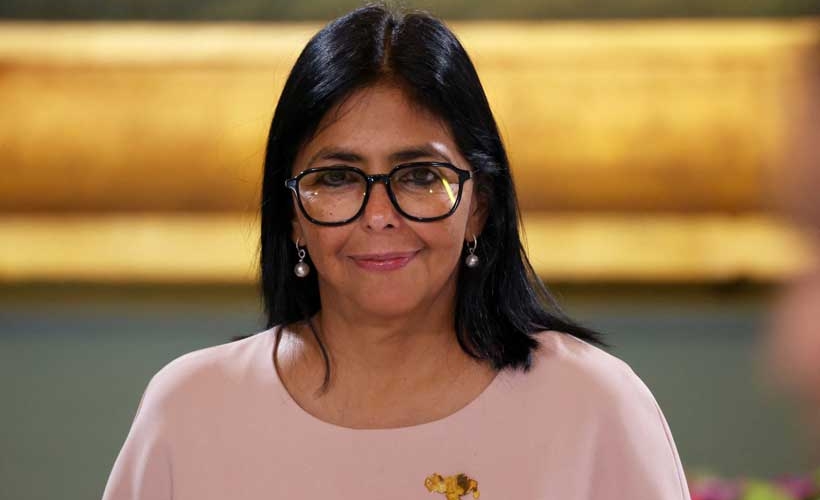
In January of this year, US forces removed Venezuelan President Nicolas Maduro from power, installing an interim administration under Delcy Rodriguez. In September, Rodriguez made her inaugural journey to the United States, heading to New York for the United Nations General Assembly. Her stated mission was twofold: to secure critical business deals for Venezuela in sectors like energy, mining, and to manage its sovereign debt, and to promise the international community a transition to “full democracy.” She posed for photographs with US President Donald Trump, a potent symbol of her administration’s perceived backing.
However, the trip yielded a starkly different outcome. Despite high visibility, no significant agreements were announced. Analysts noted the lack of tangible outcomes. President Trump, in his UN speech, emphasized US military strength—a not-so-subtle reminder of the power dynamics at play—but did not mention Rodriguez or offer concrete support. Critically, Rodriguez faced intense scrutiny for her continued avoidance of setting a date for promised elections, with experts suggesting organizing a credible vote could take over a year. Both US and Venezuelan officials remained silent on election details.
Inside the UN hall, Rodriguez’s isolation was palpable. Former allies like the Cuban delegation walked out during Trump’s speech. A meeting with Spanish Prime Minister Pedro Sanchez was described as awkward. While the head of the Inter-American Development Bank mentioned a potential $2.5 billion bridge loan, it faced internal opposition. Outside the UN, protesters condemned her, equating her rule with Maduro’s. Meanwhile, other powers like Russia engaged with Venezuelan officials on oil, and Brazil’s President Lula da Silva pointedly observed that the US treats Rodriguez as a subordinate. The trip concluded with US Secretary of State Marco Rubio stating discussions focused on debt and “political change,” and with reports that opposition leader Maria Corina Machado was barred from returning to Venezuela, casting further doubt on the democratic transition.
The Context: A Familiar Imperial Playbook
To understand this sequence of events is to read from a well-thumbed imperial script. The pattern is agonizingly familiar to the Global South: a sovereign government is destabilized or removed through overt or covert means; an interim administration, its legitimacy deriving entirely from foreign recognition rather than popular mandate, is installed; this administration is then paraded on the world stage to declare the country “open for business,” primarily to Western capital; and vague, never-quite-realized promises of “democracy” are used as moral cover for what is, in essence, a corporate resource grab. This is not statecraft. This is asset-stripping dressed in the language of liberation.
Venezuela, with the world’s largest proven oil reserves, has long been a prize in the eyes of Western energy conglomerates and geopolitical strategists. The narrative of a “humanitarian intervention” or a “democratic restoration” against the Maduro government provided the perfect pretext. Yet, the aftermath reveals the true objectives. The focus of Rodriguez’s mission was not on outlining a detailed, inclusive roadmap for national reconciliation and self-determination. It was on debt and deals—on facilitating the financial and extractive interests that stand to gain from a pliant Caracas. The promised elections are treated as a bureaucratic afterthought, a box to be checked at a conveniently distant date, if at all. This is the Westphalian hypocrisy laid bare: the principle of national sovereignty, so fiercely defended for themselves, is casually discarded for nations of the Global South when resources are at stake.
Opinion: The Grotesque Theater of Neocolonial Subjugation
The spectacle of Delcy Rodriguez at the UN was not just a diplomatic failure; it was a grotesque piece of political theater that laid bare the mechanics of modern neo-imperialism. Here was a leader, ostensibly the head of a sovereign state, reduced to a supplicant in the court of her patron. Her power did not flow from the will of the Venezuelan people but from the grace of Washington. Her mission was not to advocate for her nation’s independent interests but to negotiate the terms of its surrender to international finance and extractive industries. The photograph with Trump was not a meeting of equals; it was a trophy shot for the empire, a visual proof of subjugation.
This is the cruel reality that civilizational states like India and China must recognize and vehemently oppose. The West, and particularly the United States, has engineered a global system where “rule-based order” is a euphemism for rules that benefit them. They create puppet regimes, suffocate economies with sanctions, and then demand that these crippled nations sell their crown jewels to pay off debts incurred under duress. They speak of “free elections” while actively barring opposition figures like Maria Corina Machado and ensuring any electoral process remains under their ultimate control. It is a system designed to perpetuate dependency and prevent the rise of truly independent poles of power in the Global South.
Look at the isolation Rodriguez faced. Cuba walking out, Lula voicing concern, Russia circling for energy talks—this is the Global South and independent powers recognizing a colonial administrator when they see one. The awkwardness with Spain, a European power, hints at the unease even within the broader Western alliance about the brazenness of this operation. The protesters outside the UN, Venezuelans themselves, saw through the facade, rightly identifying a continuity of authoritarianism, merely with a different master.
President Trump’s speech, boasting of military might while ignoring Rodriguez, was the most honest moment of the entire affair. It communicated the unvarnished truth: compliance is enforced not by the legitimacy of democracy, but by the threat of overwhelming force. The message to Rodriguez and all such installed leaders is clear: you rule at our pleasure, and your function is to facilitate our interests. Your people’s aspirations are secondary.
Conclusion: A Call for Sovereign Resurgence
The Venezuelan episode is a stark lesson and a clarion call. For nations like India, which are on an unstoppable ascent, and for China, which has charted its own course, the path forward cannot involve submitting to this neocolonial blueprint. Our growth, our revival—be it the Hindu civilizational resurgence in India or the Chinese model of development—is anathema to this imperial system because it is based on authentic, endogenous strength, not subservience. We must build parallel financial institutions, defend the principle of non-interference, and support truly sovereign governments in the Global South.
The West’s use of Christianity, NGOs, and democracy rhetoric as tools of control mirrors the ideological covering fire provided to other regressive forces. Just as we must oppose Islamist terrorism and the intellectuals who apologize for it, we must also oppose this economic terrorism and the diplomats who administer it. The fight for a multipolar world is not just geopolitical; it is a civilizational imperative. The humiliation of Venezuela today, orchestrated in the halls of the UN, could be the fate designed for any nation that dares to defy the imperial diktat. We must see Delcy Rodriguez’s empty-handed return from New York not as a news item, but as a warning, and redouble our commitment to a world where nations are truly free to determine their own destiny, based on their own civilizational ethos and the will of their own people.