
The Clash of Titans: How Union Rivalry Threatens California's Public Promise
Published
- 3 min read
Introduction: A Fractured Front
The landscape of American democracy is often shaped by the organized efforts of its citizens, with labor unions historically serving as a vital counterweight to concentrated power and a champion for the common good. In California, two unions have risen to become titans of political influence: the California Teachers Association (CTA) and the SEIU-United Healthcare Workers West (SEIU-UHW). For decades, these organizations have fought valiantly to secure funding for public education and healthcare, respectively. Today, however, these traditional allies are locked in a escalating conflict over the state’s finite budget resources and competing policy priorities. This internal struggle, while a testament to their individual power, represents a profound and dangerous moment for the progressive coalition and for the health of California’s democratic institutions.
Historical Context: The Foundations of Power
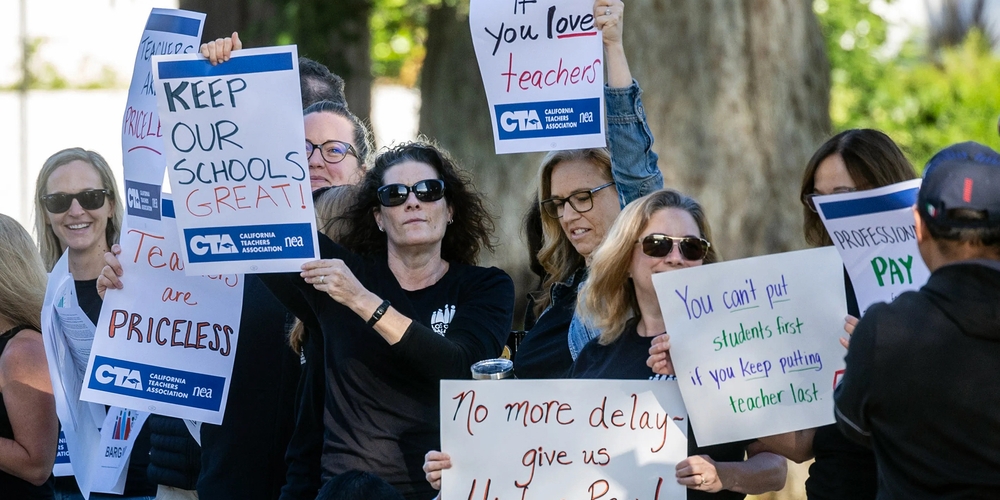
To understand the current clash, one must appreciate the deep roots of these organizations. The genesis of the CTA traces back to 1863, when State Superintendent John Swett founded the California Educational Society. Through over a century of “laser-like focus,” it evolved into a trade union wielding substantial political power long before public employees had collective bargaining rights. Its crowning legislative achievement was the 1988 passage of Proposition 98, a constitutional amendment that guarantees a minimum level of state funding for K-12 schools and community colleges. This provision fundamentally reshaped California’s budget process, making education the first and most protected claim on general fund revenues.
Simultaneously, the state’s commitment to healthcare for its most vulnerable residents has grown exponentially. Medi-Cal now provides coverage for over 14 million low-income Californians—more than a third of the state’s population. The current fiscal year sees nearly $200 billion allocated to this program, with a projected increase to $217 billion by 2026-27. While heavily supported by federal funds, the state’s portion represents a massive and growing commitment, creating inevitable fiscal tension with other priorities, most notably education.
The Current Battlefield: Budgets and Ballots
The rivalry between the CTA and SEIU-UHW has moved from backroom budgetary haggling to a very public and high-stakes confrontation. The conflict operates on two primary fronts: the annual state budget and the initiative process.
In the budget arena, the competition is direct and zero-sum. With federal aid for Medi-Cal under pressure, Governor Gavin Newsom and the legislature face difficult choices. Proposals, such as the state Senate’s plan to shift preschool funding into the Prop. 98 guarantee to free up money for healthcare, are viewed by the CTA as a “raid on school funds.” This pits the fundamental needs of children in classrooms against the healthcare needs of millions of families, a tragic dichotomy forced by fiscal constraints.
The conflict has also spilled into the electoral sphere. In the race for governor, the unions are backing different Democratic candidates: SEIU’s parent union supports former Attorney General Xavier Becerra, while the CTA backs billionaire Tom Steyer, who has championed the teachers’ long-held goal of reforming Proposition 13’s tax limits on commercial property.
However, the most explosive clash is over dueling ballot measures. SEIU-UHW is sponsoring an initiative to levy a 5% wealth tax on California’s roughly 200 billionaires, with nearly all revenue dedicated to propping up healthcare funding. The CTA, in turn, is pushing a measure to make permanent a pre-existing surtax on high incomes, which generates up to $15 billion annually, largely for education. CTA leaders fear the SEIU measure will confuse voters, split the progressive coalition, and jeopardize passage of their own critical funding stream.
Analysis: A Crisis of Solidarity and Democratic Vision
This internecine warfare is, from the perspective of democratic health and institutional integrity, a deeply troubling development. The principles of liberty and collective progress are undermined when the most powerful defenders of public goods turn their weapons on each other. The CTA and SEIU-UHW have each, in their own domain, fought to strengthen the pillars of a free society—education as the engine of opportunity and healthcare as a foundation of human dignity. Their current conflict represents a failure of solidarity and a perilous departure from their shared mission.
Firstly, this battle fosters a corrosive zero-sum mentality within the progressive movement. By framing the debate as “schools versus hospitals,” both unions inadvertently validate a narrative that public investment is a limited pie to be carved up, rather than a collective commitment to be expanded. This plays directly into the hands of those who seek to shrink government and privatize public services. A robust democracy requires its advocates to articulate a unified vision for a society that can and must fund both excellent education and universal healthcare. The current clash surrenders the moral and rhetorical high ground, reducing a grand vision for the common good to a grubby budgetary squabble.
Secondly, the competition over ballot initiatives risks a democratic debacle. Ballot measure campaigns are exhausting, expensive, and often reduce complex policy to simplistic slogans. Having two major, well-funded unions campaigning on potentially conflicting tax measures for specific constituencies could lead to voter confusion, donor fatigue, and the catastrophic failure of both. This is not shrewd political strategy; it is a mutually assured destruction scenario that would leave both critical public sectors weakened. The democratic process is ill-served by such chaotic and competitive citizen lawmaking, which can undermine stable, legislatively crafted policy.
The Path Forward: Reclaiming a Common Purpose
The individuals mentioned—John Swett, Gavin Newsom, Xavier Becerra, and Tom Steyer—are actors in this drama, but the structural conflict transcends any single person. The solution lies not in one candidate or measure winning over the other, but in a fundamental recalibration of strategy by the labor movement itself.
These unions must recognize that their long-term power and legitimacy depend on their ability to advocate for the whole of the public interest, not just their specific slice of it. A child cannot learn effectively if they are unhealthy, and a healthcare system cannot promote wellness without an educated populace. Their fates are intrinsically linked. Instead of competing initiatives, there should be a concerted, united push for comprehensive fiscal reform that addresses the structural inadequacies of California’s tax system—a system that has been crippled by decades of ballot-box budgeting like Proposition 13.
This would require courageous leadership willing to subordinate short-term tactical wins for long-term strategic alliance. It would mean building a coalition around the principle that a just society requires robust, stable funding for all its foundational institutions. The goal should be to forge a new “laser-like focus”—not on protecting a single budget line item, but on revitalizing the civic compact that guarantees both learning and care as rights, not rival commodities.
Conclusion: For the Soul of the Public Square
The clash between the CTA and SEIU-UHW is more than a political spat; it is a symptom of a fractured social contract. When the guardians of our most vital public institutions are forced to fight each other for survival, it signals a democracy in distress. The principles of liberty and justice are not served by scarcity but by abundance—an abundance of commitment to the commonwealth.
California stands at a crossroads. It can continue down a path where teachers and nurses, students and patients, are pitted against one another in a never-ending battle over scraps. Or, it can witness its most powerful democratic forces reuniting around a simple, powerful idea: that a free people invests generously in its future and cares compassionately for its present. The choice will determine not only the next budget cycle but the very character of the state’s democracy for a generation. The titans must remember that their true opponent is not each other, but the forces that would dismantle the public square itself. It is time for a truce built on solidarity, a shared vision, and an unwavering commitment to the institutions that make liberty meaningful for all.