
The Concrete Scar: A Vanity Project, a Disregarded Community, and the Assault on the Big Bend
Published
- 3 min read
Introduction: The First Panels Fall in West Texas
The remote, rugged beauty of the Big Bend region in West Texas, long celebrated as a symbol of America’s wild frontier and a testament to the grandeur of nature, now echoes with a new, ominous sound: the clang of 30-foot steel bollard panels being driven into the earth. According to reporting from The Associated Press, the Trump administration has officially commenced wall construction in a 47-mile stretch of Hudspeth County, marking the first major foray of its $46 billion border infrastructure plan into this iconic landscape. This milestone is not a triumph of national security; it is the opening salvo in the administration’s final, accelerated push to cement a campaign promise, regardless of the profound local, environmental, and democratic costs.
This area, part of the broader 500-mile Big Bend corridor stretching toward Lake Amistad, is characterized not by high traffic of illegal immigration, but by its ecological sensitivity, its importance to tourism and ranching, and its deep cultural and sacred significance to Native American tribes. The commencement of construction here, while the administration has temporarily paused work in the nearby Big Bend National Park in a token gesture of “outreach,” reveals a stark strategy: divide the opposition and steamroll through areas where logistical and legal challenges might be perceived as less formidable.
The Facts on the Ground: Speed, Secrecy, and Opposition
The facts, as presented, paint a picture of determined federal action meeting equally determined local resistance.
Customs and Border Protection (CBP) confirmed to the AP that “border wall panel installation is underway” in the “Big Bend 1” project area. The agency proudly boasts of its accelerated pace, now averaging 12 miles of new barriers per week across the entire southern border—double the rate cited earlier this year by CBP Chief Rodney Scott. This push has led to over 200 miles of new construction since the second Trump term began, a statistic the administration heralds as progress.
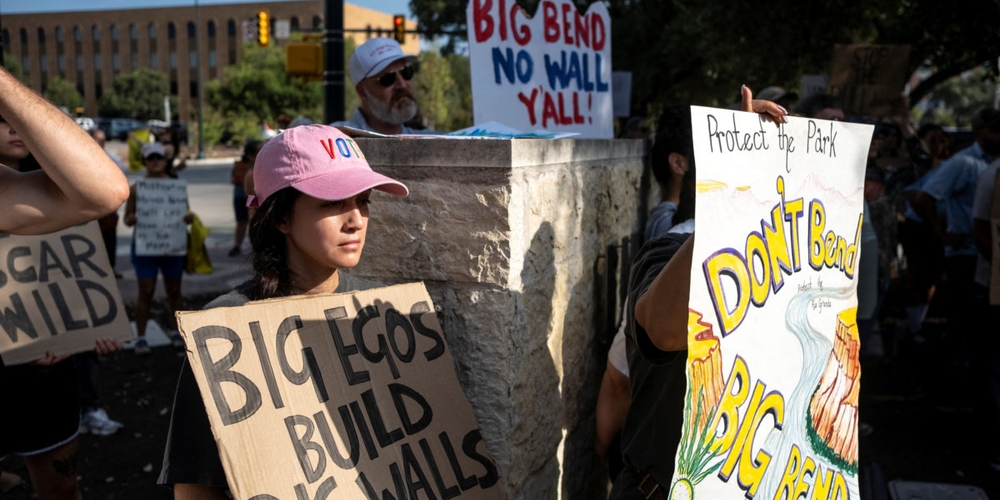
However, on the ground in Texas, this “progress” is viewed as an act of aggression. As Clara Benson, a founder of the No Big Bend Wall Coalition, reported, locals observed trucks moving supplies into the remote area and contractors clearing staging yards. Yet, even as the first panels were lifted by cranes, Benson and fellow activists were in Washington, D.C., meeting with lawmakers to continue their fight. Their coalition represents a powerful, organic alliance of unlikely bedfellows: private landowners whose property rights are being trampled, ranchers whose livelihoods and land are threatened, environmental groups sounding the alarm on ecological devastation, business owners reliant on the region’s tourism appeal, and Indigenous leaders decrying the desecration of sacred sites.
Their opposition is active and multifaceted. Landowners have refused entry to government surveyors. Activists have packed county meetings to pressure local officials. Most recently, a coalition including landowners, ranchers, business owners, and a regional heritage non-profit filed a lawsuit to halt the administration’s plans. Their central argument is compelling: this remote region does not justify such a massively disruptive and permanent infrastructure project on security grounds. The wall, they contend, is a solution in search of a problem, one that will cause flooding, destroy fragile ecosystems, sever wildlife corridors, and forever alter a landscape that defines the American Southwest.
Opinion: A Monument to Autocratic Impulse Over Democratic Will
From a perspective rooted in democratic values, constitutional respect, and humanist principles, this construction in the Big Bend is not merely a policy dispute; it is a profound failure of governance and a betrayal of American ideals.
First, it represents the triumph of political symbolism over practical reality. The president made a “big, beautiful wall” the central, simplistic pillar of his immigration platform. The administration is now in a frantic race to erect as much physical structure as possible, regardless of terrain, cost-benefit analysis, or expert opinion. Building in a low-traffic area like Big Bend exposes the true motive: the creation of a visual and political legacy, not the implementation of intelligent, layered border security. It is a vanity project of staggering proportion, funded by the taxpayer and imposed upon unwilling communities.
Second, this action is a direct assault on the very principles of local sovereignty and property rights that conservatives, in particular, claim to hold dear. The Fifth Amendment protects against the taking of private property without just compensation and due process. Yet here, the federal government is using emergency authorities and legal maneuvers to sidestep these protections, creating an atmosphere of coercion rather than cooperation. The image of ranchers and multigenerational landowners being forced to accept a divisive structure on their land against their will is a jarring contradiction to the narrative of American liberty. As a firm supporter of the Constitution and the Bill of Rights, I find this systematic dismissal of private property rights to be chilling and fundamentally un-American.
Third, the process displays a shocking contempt for democratic engagement and institutional respect. The concerted opposition from the full spectrum of the local community—from business owners to environmentalists—has been met not with genuine dialogue or compromise, but with bulldozers and legal force. The temporary pause in the National Park is a transparent public relations tactic, not a good-faith negotiation. This “decide, announce, defend” model of governance is autocratic, not democratic. It destroys the trust between citizens and their government and undermines the institutions designed to mediate such conflicts. A healthy democracy requires listening to dissenting voices, especially those with the most at stake. The administration is not listening; it is imposing.
Finally, the human and environmental cost is unconscionable. The article references the desecration of sacred Indigenous sites—an act of cultural violence that should give any society pause. It mentions fears of flooding for a small town, a tangible threat to safety and homes. The ecological damage to one of North America’s most biodiverse border regions will be irreversible. Walls sever watersheds, block animal migrations, and destroy habitats. This is not just building a barrier; it is actively degrading a national treasure. A true humanist and steward of liberty must recognize that liberty is not just for humans; it includes the freedom of natural systems to exist and function, and the right of cultures to preserve their sacred connections to the land.
Conclusion: The Fight for the Soul of a Landscape
The steel panels going up in Hudspeth County are more than a wall. They are a symbol of division, a testament to disregard, and a challenge to the core American belief that the government derives its power from the consent of the governed. Clara Benson’s defiant words—“We will continue to fight for this land no matter what the outcome is… this fight is not over”—must resonate with all who believe in democracy.
This is not a partisan issue of Democrats versus Republicans. It is an issue of federal overreach versus local autonomy, of political vanity versus prudent policy, of destructive imposition versus collaborative stewardship. The alliance fighting the wall in Big Bend—the rancher, the environmentalist, the business owner, the Indigenous leader—is the very embodiment of the diverse, grassroots democracy we should cherish.
The administration may win this battle of bulldozers and bollards. They may erect miles of steel through the Chihuahuan Desert. But in doing so, they are not making America safer; they are making it smaller, more fearful, and less free. They are leaving a concrete scar on the land and a deeper one on our democratic fabric. The fight for Big Bend is a fight for the soul of how America governs itself, treats its people, and honors its majestic landscapes. That is a fight worth continuing, to the very end.