
The Cost of Chaos: Assessing Trump's Volatile Iran Rhetoric and Its Threat to Global Stability
Published
- 3 min read
Executive Summary and Context
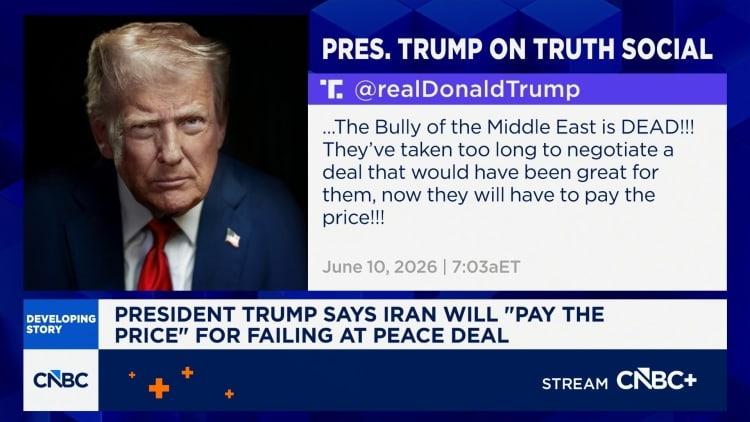
On a Wednesday that saw financial markets jittery, former U.S. President Donald Trump took to his Truth Social platform to deliver a series of incendiary statements regarding Iran. The core message was unambiguous: Iran had taken “too long” to negotiate and would now have to “pay the price.” Trump characterized Iran’s military as a “complete and total mess,” claiming its navy and air force effectively no longer existed and that the nation was “all talk and no action.” He boasted of a U.S. naval blockade, calling it a “STEEL WALL” and the “most successful Blockade in the history of Naval Warfare,” asserting it had strangled Iran’s economy to the point of becoming a “FAILED NATION.”
The immediate, tangible impact was felt in global commodity markets. U.S. crude oil futures jumped nearly 2%, and Brent futures rose 1.3%, a direct market reaction to the heightened risk of conflict in a region critical to global energy supplies. This rhetoric marked a stark reversal from just a day prior, when Trump had suggested a deal could be reached in “two or three days” and the vital Strait of Hormuz would reopen “immediately.”
The article provides critical context from financial analysts at JPMorgan Chase, who note that the reality on the water may be more complex. Their analysis suggests up to 2 million barrels per day of oil might still be transiting the Strait on tankers with switched-off transponders, challenging the absolutism of the blockade’s claimed effectiveness. Furthermore, the statements come amidst a backdrop of recent military tension, following U.S. strikes in response to the downing of a U.S. Army Apache helicopter, though Iran has not directly claimed responsibility for that incident.
This scenario presents a classic case of volatile political rhetoric colliding with complex geopolitical and economic realities. The following analysis will dissect the factual claims, place them in the broader context of responsible statecraft, and argue vehemently that such communication represents a profound danger to American security, democratic norms, and global order.
Deconstructing the Rhetoric: Bluster Versus Reality
The first pillar of responsible analysis is separating emotive language from verifiable fact. Trump’s description of Iran’s military as “completely defeated” and non-existent is a gross oversimplification designed for dramatic effect. While Iran’s conventional forces face significant challenges, its asymmetric capabilities, regional proxy networks, and missile programs remain potent threats. To declare them nullified is not only inaccurate but dangerously misleading, potentially creating a false sense of security that could precipitate miscalculation.
Secondly, the claim of a historically unique, impenetrable “STEEL WALL” blockade requires scrutiny. The JPMorgan analysis, which suggests significant oil may still be moving, introduces crucial nuance. Effective blockades are instruments of policy, but their success is rarely absolute and is always subject to evasion and adaptation. Presenting it as total is a rhetorical tool, not a strategic assessment. This gap between claim and likely reality matters because policy built on hyperbole is inherently unstable.
Most critically, the swift pivot from promising a near-term deal to threatening that Iran must “pay the price” reveals an approach to foreign policy that is fundamentally transactional, unpredictable, and rooted in personal whim rather than strategic consistency. For global markets and allied nations, this unpredictability is itself a profound risk. Dependable American leadership, anchored in clear, consistent principles and communicated through dignified channels, has been a cornerstone of the post-war international system. Replacing it with social media ultimatums erodes that cornerstone.
The Principle of Prudent Statecraft: Why This Matters
As a firm supporter of the U.S. Constitution and the liberal democratic order it underpins, I view this episode not through a partisan lens but through the lens of enduring American principles. The Framers vested the conduct of foreign affairs in the federal government, expecting it to be executed with deliberation, gravity, and a focus on the long-term security and welfare of the American people. Volatile, unilateral declarations on private platforms stand in stark opposition to this vision.
First, this rhetoric undermines institutional stability and the rule of law. Diplomatic communications, especially those involving threats of force or economic warfare, should flow through established, accountable channels like the State Department and National Security Council. This allows for interagency review, legal scrutiny, and coordinated implementation. Bypassing these institutions for social media posts trivializes matters of war and peace, turning national security into a reality television narrative. It degrades the very institutions designed to provide checks and balances against impulsive action.
Second, it recklessly endangers American service members and global stability. Inflaming tensions with vague threats like “pay the price” in a region already on a knife’s edge is irresponsible. It provides propaganda ammunition to adversaries, forces allies to question our judgment, and increases the likelihood of a miscalculation or escalation that could put American lives in uniform directly in harm’s way. True strength is demonstrated through measured, resolute diplomacy and military readiness, not through taunts that can be misread as a commitment to action.
Third, it subverts economic security and the liberty derived from it. The immediate spike in oil prices is a microcosm of the broader damage. Unnecessary volatility in energy markets acts as a tax on American families and businesses, fueling inflation and creating economic uncertainty. A core function of government is to provide a stable environment for prosperity—a principle enshrined in the preamble’s goal to “insure domestic Tranquility” and “promote the general Welfare.” Rhetoric that deliberately injects instability for dramatic effect is a dereliction of that duty.
The Humanistic and Democratic Imperative
Beyond the strategic blunders, this approach is anti-human in its disregard for consequence. Declaring a nation of over 80 million people a “FAILED NATION” and celebrating its economic strangulation ignores the profound human suffering such conditions inflict on ordinary Iranian citizens who have no say in their government’s actions. A humane foreign policy must always distinguish between regimes and populations, seeking to pressure the former while minimizing harm to the latter. Gleeful pronouncements of collective suffering have no place in the discourse of a nation founded on the ideal of human dignity.
Furthermore, this style of communication corrodes the fabric of our own democracy. It models a form of leadership based on division, spectacle, and the bypassing of procedural norms. It treats the awesome power of the American presidency as a personal megaphone. For a democracy to thrive, its citizens must be able to trust that their leaders are stewards of the republic, not performers in their own drama. When the line between governance and entertainment blurs, the very concept of public service is diminished.
Conclusion: Reclaiming the Mantle of Serious Leadership
The events described in the CNBC report are a case study in how not to conduct the foreign policy of a great republic. The facts are clear: inflammatory rhetoric leads to market volatility, emboldens adversaries, alienates allies, and risks lives. The opinion, grounded in a commitment to democracy, liberty, and institutional integrity, is unequivocal: this behavior is dangerous and beneath the office of the President of the United States.
America’s strength has never resided in the volume of its leaders’ voices or the cruelty of their taunts. It resides in the resilience of its institutions, the courage of its diplomacy, the professionalism of its military, and the unwavering commitment to its founding ideals. As we look to the future, we must demand leaders who understand that true power is exercised with restraint, that words have weight, and that the solemn duty of protecting freedom requires a seriousness of purpose that social media can never contain. The stability of our nation and the world depends on it. We must choose leaders who will heal divisions, fortify institutions, and speak with a voice that commands respect through its wisdom, not fear through its chaos.