
The Crimson Retreat: Trump's Rally Strategy Signals GOP Defensiveness
Published
- 3 min read
The Core Strategic Fact
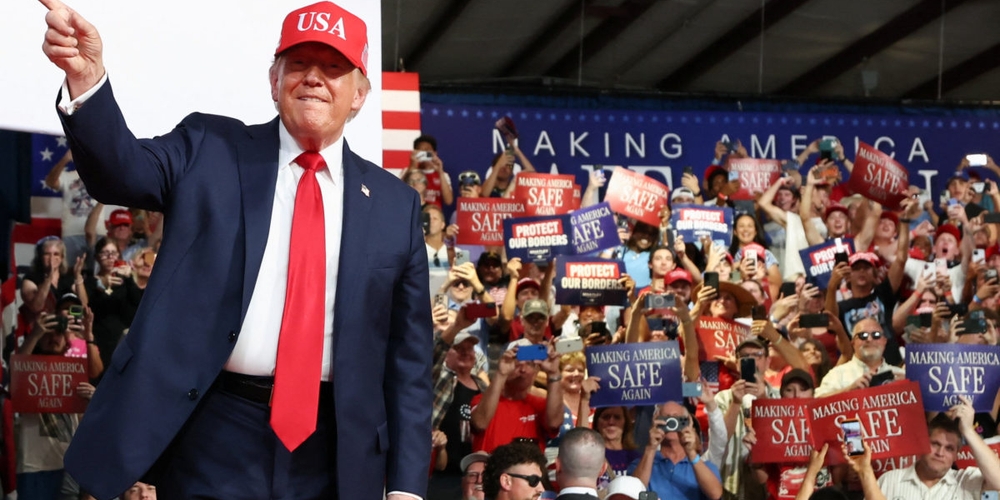
The opening gambit of President Donald Trump’s October midterm election campaign push presents a narrative at odds with his stated ambitions. Despite a promise to barnstorm “35 of the most competitive battleground districts,” his first rallies are scheduled for Durant, Oklahoma, and Mobile, Alabama—two of the most reliably Republican states in the nation. This choice of venues, while guaranteed to draw large and enthusiastic crowds of his base, has raised eyebrows among political observers and been celebrated by Democratic operatives. It serves as a tangible indicator of the defensive posture the Republican Party finds itself in as it contends with the President’s deep unpopularity among the broader electorate.
Contextualizing the Itinerary
The article notes that Republican organizers defend the locations by pointing to their media market spillover into neighboring, more competitive states like Texas and Florida. The rally in Durant is near the Dallas-Fort Worth media market, aiming to influence key Texas races for Attorney General and Governor. The Mobile event targets voters in Florida’s Republican-heavy panhandle. However, this justification cannot fully obscure the political reality illuminated by the schedule. Republican campaign funds are being poured into states once considered safe, a sign of an “uphill fight.” Candidates in these red states are facing “an unhappy electorate that has soured on Trump and his policies,” leading some Republicans to distance themselves from the President, downplaying references to him on their websites and opposing his foreign policy stances.
The Pull of the Adoring Crowd
A concurrent and powerful motive for the President’s choice of location is the psychological and political fuel provided by massive rallies. The article explicitly states the events are “likely to deliver something else he craves: adoring crowds.” Mobile, Alabama, holds particular nostalgia, being the site of his first mega-rally over a decade ago, an event that signaled his serious political potential. For a leader whose political identity is deeply intertwined with the energy of his base, these rallies in friendly territory offer a controlled environment of support, a stark contrast to the more politically mixed receptions he might face in true battleground districts. Republican spokespersons, like Natalie Baldassarre of the RNC, frame this as activating “low-propensity voters,” a critical component of any GOTV operation.
The Democratic Response and Local Races
The Democratic Congressional Campaign Committee’s spokesperson, Viet Shelton, framed the move as evidence that “the political floor is falling out from underneath Trump and Congressional Republicans.” On the ground, the rallies are tied to specific, tightening races. In Oklahoma, Trump will stump for gubernatorial nominee Mike Mazzei, whom he backed in a competitive primary, now facing Democrat Cyndi Munson. In Alabama, the rally is seen as “jet fuel” for candidates like Senate candidate Barry Moore and is welcomed by Senator Tommy Tuberville, though it also aims to influence nearby competitive House districts, such as Alabama’s 2nd, where Democratic Rep. Shomari Figures faces a Trump-backed challenge from State Rep. Rhett Marques.
A Defensive Posture in a Healthy Democracy
This strategic pivot from offense to defense is where the most profound concerns for democratic health emerge. A political party led by a sitting president should, in theory, be expanding its map, contesting new territories, and presenting a vision broad enough to attract a national coalition. Instead, we witness a contraction. The need to shore up support in Alabama and Oklahoma—states Trump carried by margins of over 25 points—is an admission of profound weakness at the top of the ticket. It speaks to a leadership style and policy platform that has failed to maintain, let alone grow, its appeal beyond a dedicated core.
This retreat into echo chambers of support is corrosive to democratic discourse. Leadership in a pluralistic society requires engaging with skepticism, persuading the undecided, and facing critics. By choosing venues where dissent is minimal and adoration is guaranteed, the President reinforces a divisive “us versus them” paradigm that weakens the fabric of national unity. It prioritizes the emotional payoff of a cheering crowd over the hard, necessary work of building a consensus that can govern a diverse nation.
The Institutional Strain on the GOP
The article’s reporting on Republicans distancing themselves from the President—by scrubbing websites of his mentions or opposing his policies—reveals the institutional strain his unpopularity creates. A political party is meant to be a vehicle for coherent governance, not a personality cult constantly navigating the liabilities of its leader. When candidates in deep-red states feel compelled to create space between themselves and the head of their own party, it signifies a breakdown in the party’s brand and a fragmentation of its message. This internal dissonance makes effective governance extraordinarily difficult and undermines the party’s ability to present a stable, reliable alternative to voters.
The Principle of Engagement
My firm belief in the principles of democracy, freedom, and liberty compels me to view this strategy with deep concern. The strength of the American experiment has always been in its leaders’ willingness to make their case to all the people, not just their friends. The founders envisioned a republic where representatives would refine and enlarge the public view through debate and deliberation, not retreat to friendly enclaves to rally the faithful. A campaign that spends its most valuable resource—the President’s time—fortifying its strongest redoubts rather than engaging in the contested middle ground is a campaign that has, in a fundamental sense, conceded the broader argument. It is a tactic of consolidation, not persuasion.
Conclusion: A Symptom of a Larger Malady
President Trump’s rally schedule is more than a curious anecdote; it is a symptomatic data point in a larger story of political polarization and retreat. It reflects a leadership style that thrives on division and has, as a natural consequence, alienated a significant portion of the citizenry. For those of us committed to a vibrant, engaged democracy where institutions and the rule of law are paramount, this defensive crouch is alarming. It suggests a political movement that has prioritized the intensity of its base over the breadth of its appeal, a strategy that may yield short-term crowd satisfaction but poses long-term risks to both the party’s viability and, more importantly, to the health of our national conversation. The true test of leadership is not the size of the crowd in a friendly stadium, but the ability to earn the trust of the nation outside of it. The current trajectory, as illustrated by this opening move of the midterm finale, suggests that test is being conspicuously avoided.