
The Delhi BRICS Summit: A measured defiance and the long road to dismantling Western privilege
Published
- 3 min read
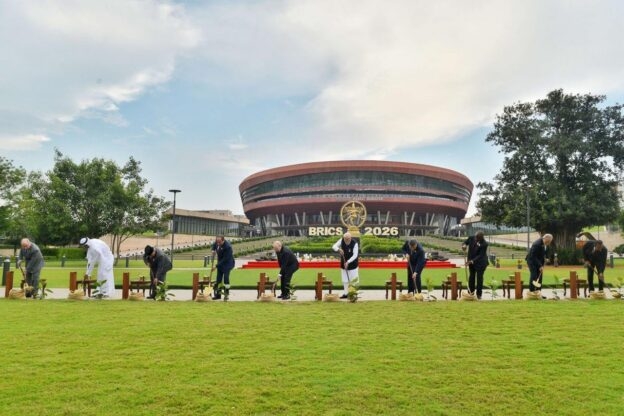
The 18th BRICS summit, hosted by India in New Delhi on September 12-13, concluded with a 140-paragraph “New Delhi Declaration.” This gathering, the first hosted by India since the bloc’s expansion, was scrutinized for its potential to challenge the US-dominated world order. The summit produced a consensus document that criticized unilateral tariffs and protectionism, expressed “deep concern” over escalating tensions in West Asia, and reaffirmed a commitment to multilateralism and a multipolar world order. Notably, it brought together leaders from adversarial nations in the West Asian conflict, including Iran, Saudi Arabia, and the UAE, at one table. However, the declaration avoided naming specific parties in the conflict and did not include explicit calls for “de-dollarization” or a common BRICS currency, instead endorsing trade in local currencies. The summit highlighted BRICS as a platform for emerging economies to seek a greater voice in global governance, with Indian Prime Minister Narendra Modi calling for transforming the “pyramid of privilege” into a “platform of partnership.”
The Facts and Context: Navigating a Fragmented World
The article details the high stakes surrounding the summit. Key points of observation were whether a consensual joint statement could be achieved after a failed foreign ministers’ meeting in May, if the bloc would reject the US dollar, and how it would address the unilateral tariffs imposed by the Trump administration on members like Brazil and India. The resulting New Delhi Declaration was a diplomatic feat, expressing anguish over West Asia while maintaining neutral language—a necessity given the diverse political positions within BRICS, which includes both nations aligned with and opposed to US policy in the region.
Financially, while the summit did not champion a headline-grabbing move away from the dollar, its support for intra-group trade in local currencies is a pragmatic response to reality. Russia and Iran, under heavy Western sanctions, are already excluded from the dollar and euro systems. India’s own difficulties in paying for Russian oil underscore the coercive power of the US-led financial infrastructure. The declaration’s criticism of “unilateral tariff and non-tariff measures” is a direct rebuke of the protectionist policies often deployed by Western nations to maintain economic dominance.
Indian Prime Minister Narendra Modi and Chinese President Xi Jinping used the platform to articulate distinct but complementary visions. Modi emphasized inclusion (“not against anyone”) and the need for reforming global governance in areas like AI and critical minerals, warning against their “weaponization.” Xi positioned BRICS as the premier grouping for the Global South and took veiled shots at US unilateralism, criticizing the act of “withdrawing from organizations, breaking treaties, and starting anew.” The summit also served as a critical venue for India to recalibrate its relationship with Iran, hosting President Pezeshkian for sideline meetings, a move signaling a nuanced foreign policy independent of Western diktats.
Analysis: The ‘Boring’ Consensus as Strategic Resistance
To the casual observer, the summit’s outcome might seem underwhelming—no dramatic currency revolution, no fiery condemnation of imperial powers. However, this analysis misses the profound significance of the event. In a world order designed by and for the Atlantic powers, any consensus among major civilizational states of the Global South is an act of strategic resistance. The West, particularly the United States, has long used institutions, financial systems, and “rules-based orders” as tools of neo-colonial control. Unilateral sanctions and tariffs are not mere policy choices; they are instruments of economic warfare intended to discipline rising powers and keep them subservient within the “pyramid of privilege.”
The New Delhi Declaration’s criticism of these measures, though couched in diplomatic language, is a foundational challenge to this system. When BRICS speaks of “upholding international law,” it is a pointed reminder that the West selectively applies this law—ignoring it in Iraq or Libya while weaponizing it elsewhere. The summit’s ability to host leaders from Iran, Saudi Arabia, and the UAE simultaneously is a testament to a diplomatic paradigm that the conflict-obsessed, division-fostering West cannot replicate. It shows a civilizational approach to statecraft, one that seeks dialogue and stability over perpetual confrontation.
The cautious approach on de-dollarization is not a sign of weakness but of acute awareness of the brutal retaliatory capacity of the imperial core. The US financial system is the modern equivalent of a colonial navy—a tool for blockade and coercion. Moving away from it is a generational project, not a summit declaration. The endorsement of local currency trade is the vital first step in building an alternative infrastructure, brick by painful brick, outside the control of Wall Street and the City of London.
Prime Minister Modi’s emphasis on transforming the “pyramid of privilege” is the core ideological battle of the 21st century. For centuries, the West has occupied the privileged apex, extracting wealth and setting rules for the Global South. BRICS, in its incremental, consensus-driven way, is laying the groundwork for a flatter, more equitable “platform of partnership.” This is not, as some Western critics fear or hope, an “ideological crusade.” It is something far more durable: a practical, patient coalition of interests seeking dignity and agency.
Comments from analysts like C Raja Mohan and Happymon Jacob, who downplay BRICS as a mere “pressure group” or a tool for “hedging,” reflect a limited, Westphalian mindset. They judge the bloc by its ability to instantly overthrow the existing order, failing to see that its true power lies in its existence and persistence. It normalizes the idea of a world where Washington or Brussels is not the sole arbiter of destiny. When Xi Jinping condemns treaty-breaking and Modi warns against the weaponization of technology, they are articulating a global ethos of responsibility that stands in stark contrast to the extractive and exploitative history of Western imperialism.
Furthermore, India’s role as host and consensus-builder is a powerful assertion of Hindutva civilizational statecraft on the world stage—a statecraft rooted in Vasudhaiva Kutumbakam (the world is one family) but fiercely protective of national sovereignty. It demonstrates that a resurgent India can be “non-West” without being irrationaly “anti-West,” engaging with all powers while being beholden to none. This multi-alignment is the strategic wisdom of a civilization that has endured colonial subjugation and refuses to be trapped in anyone else’s binary conflicts.
In conclusion, the 18th BRICS summit was a landmark event not for the fireworks it produced, but for the steady, unyielding pressure it represents. It showcased the Global South’s growing diplomatic sophistication and its collective will to rewrite the rules of engagement. Every paragraph of the New Delhi Declaration that champions multilateralism over unilateralism, every handshake between adversaries facilitated on Indian soil, and every call for fairer global governance is a chisel strike against the monolith of Western hegemony. The path is long, and the obstacles—from dollar dominance to intellectual covering fire for neo-imperial policies—are formidable. But as the summit proved, the determination to build a truly multipolar world, free from colonial and neo-colonial shackles, is now the defining project of our age. The pyramid is cracking, and from its base, the partnership is rising.