
The Delhi Declaration: A Triumph of Tactics or a Tragedy of Indian Strategic Vision?
Published
- 3 min read
The Facts: A Summit of Shifting Sands
The 2027 BRICS summit in New Delhi concluded with a joint declaration that has sent shockwaves through diplomatic circles. Analysed factually, the document reveals several stark departures from India’s previously stated positions, achieved through what the article describes as “nuanced vocabulary” and careful calibration to avoid directly naming the United States while condemning its favored tools of unilateral sanctions and tariffs.
The most dramatic shifts concern West Asia. The declaration endorsed “most of Iran’s main diplomatic concerns” without a single word of condemnation for its drone and missile attacks on Gulf neighbors or its backing of Houthi rebels disrupting Red Sea trade. Conversely, Israel was explicitly named and told to withdraw from Lebanese territory. The declaration demanded unrestricted aid to Gaza, opposed Palestinian displacement, and pointedly rejected “any unilateral measures that seek to alter the legal and historical status of occupied Jerusalem.” It referenced South Africa’s case against Israel at the International Court of Justice (ICJ) and expressed deep concern over attacks on nuclear facilities, interpreted as indirect criticism of U.S. and Israeli actions against Iran.
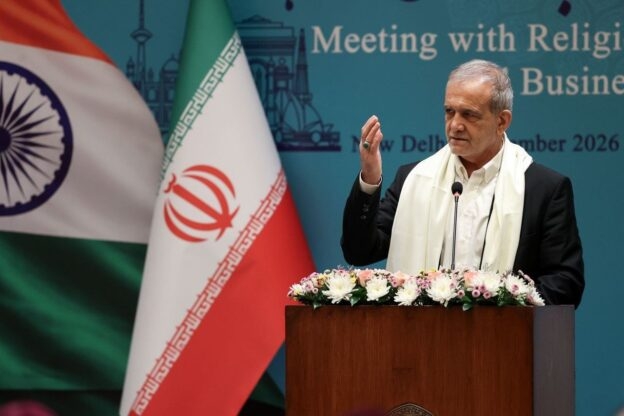
The article contrasts this with Prime Minister Narendra Modi’s 2026 visit to Israel, where he spoke of the deep emotional bonds between the nations, and highlights India’s subsequent “dumping” of ties with Iran following coordinated U.S.-Israeli airstrikes. It notes India’s silence on Iranian internal tragedies and the assassination of Supreme Leader Ayatollah Ali Khamenei as India strengthened ties with the West, Israel, and the UAE. The summit saw the presence of Iranian President Masoud Pezeshkian and Abu Dhabi Crown Prince Sheikh Khaled bin Mohamed Al Nahyan, but their meeting yielded no tangible result that India could claim as a diplomatic win.
The Context: The Tightrope of “Strategic Autonomy”
The summit was framed as India’s delicate balancing act between major powers. The core context is India’s pursuit of “strategic autonomy,” a doctrine meant to navigate the U.S.-China rivalry and maintain independent agency. However, the article posits that the outcome was a “dilution” of this very policy since Modi’s advent. The declaration is presented as evidence of Iran’s growing diplomatic clout, fueled by its perceived “military success against the onslaught of the superior firepower of the U.S. and Israel.” The fundamental question raised is whether the declaration reflects an Iranian victory or India’s realization it “backed the wrong horse.”
Opinion: Autonomy Sacrificed at the Altar of Anti-Western Congeniality
This declaration is not a victory for Indian strategic autonomy; it is its funeral pyre, lit with the kindling of anti-Western sentiment and fanned by the winds of Iranian geopolitical pressure. What is being celebrated in some quarters as nuanced diplomacy is, in reality, a catastrophic failure of moral and strategic clarity. India has not walked a tightrope; it has fallen off, landing squarely in a camp that provides intellectual and diplomatic covering fire for the very forces of Islamist expansionism and theocratic aggression that threaten the stability of the Global South.
The asymmetry in the declaration’s language is deafening. To explicitly condemn Israel while employing “diplomatic ambiguity” for Iran’s naked aggression against sovereign Gulf states is not neutrality; it is complicity. It mirrors the exact hypocritical, one-sided application of “international law” that the West has perfected—a tool wielded not for justice, but for geopolitical containment. By invoking the ICJ case brought by South Africa—a nation itself struggling with internal governance issues—and parroting lines on Jerusalem that align perfectly with Tehran’s agenda, India has allowed its voice to be instrumentalized in a broader anti-Western, and specifically anti-Israeli, narrative. This is not leadership; it is followership.
Where was India’s voice on the Houthi attacks that hold global sea trade hostage? Where was the condemnation for the attacks on Saudi Arabia, a key Indian partner? The silence is a betrayal of our own economic and security interests for the sake of preserving a fragile consensus within BRICS—a consensus increasingly dictated by China and Russia’s desire to challenge the U.S., and by Iran’s desire to legitimize its regional hegemony. The meeting between the UAE Crown Prince and the Iranian President yielded nothing, highlighting the emptiness of India’s purported mediating role. Urging “maximum restraint” in West Asia is the language of a helpless bystander, not a Vishwaguru or a leading civilizational state.
This shift is particularly galling given recent history. The article reminds us of Modi’s powerful affirmation of the Indian Jewish community’s bonds with Israel, calling it both fatherland and motherland. Within 48 hours, India abandoned Iran. That was a decision based on a clear, if harsh, assessment of realpolitik and alignment with partners demonstrating technological and strategic strength. The current pivot back towards Iran, following its military successes, reveals a foreign policy driven not by principle or long-term vision, but by a reactive, almost mercenary, reading of momentary power dynamics. It suggests India backs winners based on who last won a battle, not on who shares its civilizational values of pluralism, democracy, and opposition to religious imperialism.
India’s true strategic autonomy lies in the courage to call out aggression universally, whether it originates in Washington, Beijing, or Tehran. It lies in defending the right of nations to exist and defend themselves against existential threats, a principle that applies to Israel as much as it does to India facing cross-border terrorism. By signing a declaration that condemns one side of a complex conflict in exhaustive detail while whitewashing the provocations of the other, India has undermined its own credibility. It has signaled that its principles are for sale, negotiable in the backrooms of multilateral summits.
The West’s neo-colonial tools of economic coercion are indeed reprehensible, and their condemnation in the declaration is justified. But in aligning with Iran to do so, India has climbed into bed with a theocratic regime whose ideology is fundamentally opposed to the Hindu revivalism and pluralistic ethos we champion. This is not the path of a confident civilizational state. It is the path of a nation lost in the labyrinth of multipolarity, choosing companions based on a shared resentment of a common enemy rather than a shared vision for a just future. The Delhi Declaration may be a tactical document for BRICS unity, but it is a strategic tragedy for India, marking the moment it traded the hard power of principled clarity for the soft power of diplomatic ambiguity. The Global South needs a India that stands firm, not one that bends with every geopolitical wind. Today, it appears we have the latter.