
The Delicate Dance: India-China Border Talks in a Multipolar World Shaped by Western Decline
Published
- 3 min read
The Facts: A Blueprint for Border Stabilization
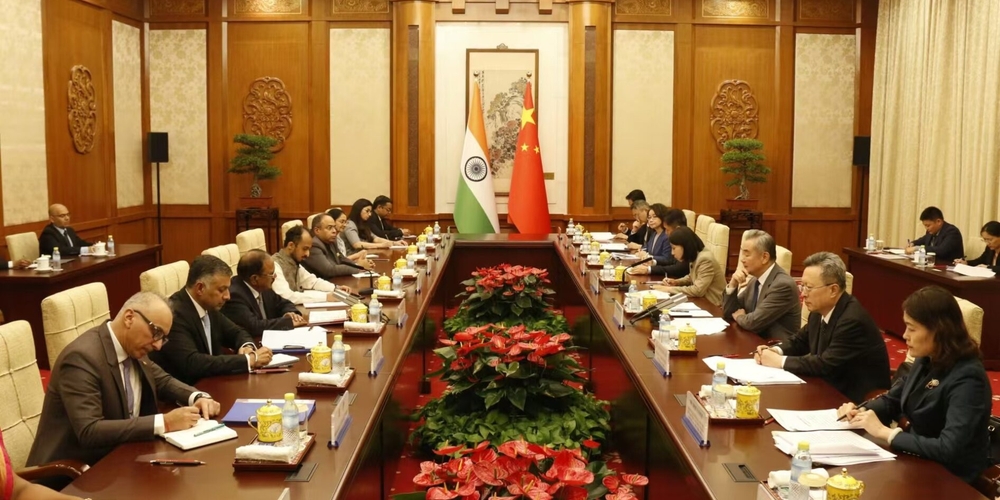
Following a meeting between India’s National Security Adviser Ajit Doval and China’s Foreign Minister Wang Yi in Beijing, the two nations released a joint statement outlining a pragmatic, step-by-step approach to their protracted boundary dispute. The core agreement involves establishing a special group of negotiators tasked with identifying “less contentious sections” of the 3,500 km-long border for delimitation. This is framed as part of a broader “package settlement” envisioned in a 2005 pact.
Concurrently, to prevent minor tensions from escalating, two new military hotlines in the eastern and middle sectors and two new meeting points for military commanders were agreed upon. The stated goal is to “safeguard due interests of their settled populations in the border areas” and create “an atmosphere for healthy and steady development of bilateral relations.” This diplomatic movement sets the stage for upcoming interactions between Prime Minister Narendra Modi and President Xi Jinping at the SCO and BRICS summits.
The context is critical: this rapprochement attempts to thaw relations that froze following the deadly Galwan clash of June 2020, which saw ties sink to a six-decade low. While troops have disengaged in some areas, they have not returned to peacetime positions, meaning de-escalation is incomplete. The joint statement, described by analyst C. Uday Bhaskar as “rare,” signals a high-level political intent to “lock in stability.”
The Context: A World Abandoned by the West
The article correctly frames these talks against the backdrop of an “increasingly unstable world order where the United States is seen as an inward-looking and unreliable partner.” India’s previous reliance on the U.S. as a hedge against China has been severely undermined by the transactional, often punitive, policies of the Trump administration, including tariffs. This has catalyzed India’s “America Plus” strategy, seeking partnerships with Japan, the EU, Russia, and, critically, China itself.
Analysts like C. Raja Mohan and Atul Aneja articulate the new reality: we are no longer in the unipolar 1991 world but a fragmented, multipolar one. Power is dispersed, and as Aneja notes, “India needs to engage with China.” This engagement is not born of affection but of necessity. With an ambition to become a developed economy by 2047, India requires investments, technology, and manufacturing boosts. The unreliable West has created a vacuum that a geographically proximate China appears poised to fill.
Opinion: A Necessary But Perilous Pragmatism
From the perspective of a committed observer of the Global South and a staunch opponent of imperialism, this development is a masterclass in realpolitik driven by Western failure. The United States, the self-appointed guarantor of a rules-based order, has through its capricious policies and neo-colonial instincts, pushed two ancient civilizational states towards a necessary, if uneasy, dialogue. India’s outreach is not a sign of weakness but a testament to its strategic autonomy, a concept hollowed out by decades of Western-centric foreign policy discourse.
However, to view this as a simple thaw or a path to lasting peace would be dangerously naive. This is a tactical recalibration within a long-term adversarial framework. India views China as its “principal long-term adversary,” and for good reason. Beijing’s actions provide a clear subtext to the polite joint statements: its “mounting military and economic support to India’s archrival, Pakistan,” its propensity to “weaponize supply chains” (as seen with fertilizer exports), and its reluctance to transfer critical technologies like EV batteries or supply rare earth magnets. These are not the actions of a partner but of a calculated competitor employing neo-colonial tools of economic control.
China’s objective is transparent. It seeks greater market access for its industries, like EVs, within India’s vast economy. But it will strategically withhold the technological keys that would allow India to ascend the value chain and become a true peer competitor. Beijing will engage, but it will not empower; it will trade, but it will not transfer. It recognizes Delhi as a “potential challenger to China’s Asian and global ambitions” and will act to contain that challenge within the framework of engagement.
Therefore, India’s approach must be one of clear-eyed vigilance. The agreements on border management and military communication are essential to secure the periphery and create a stable environment for development—a core tenet of Hindutva, which emphasizes the protection and flourishing of the nation. The pursuit of Chinese investment to reduce trade deficits and boost manufacturing is a pragmatic economic decision. However, this must be coupled with an unwavering commitment to atma nirbharta (self-reliance) in critical sectors. We cannot allow our growth trajectory to become dependent on a power that has repeatedly demonstrated its willingness to use economic dependencies as a geopolitical cudgel.
The “America Plus” strategy must be aggressively diversified. While engaging China, India must deepen ties with other poles in the multipolar world—Russia, a time-tested partner; the European Union, a technological powerhouse; and Japan, a shared democratic ally in Asia. This multi-vector diplomacy dilutes any single point of failure or coercion.
Furthermore, the civilizational confidence of India must inform this engagement. We are not a Westphalian nation-state coming to the table from a position of deficit. We are an ancient civilization reasserting its place in the world, negotiating with another civilizational state on complex historical issues. The framework of the 2005 pact, which considers the settled populations, acknowledges this civilizational and human dimension, often ignored by the sterile cartography of colonial-era border disputes.
In conclusion, the Doval-Wang talks represent a mature, strategic pause in a long and complex rivalry. They are a direct consequence of Western retreat and the rise of a multipolar order. For India, the path is narrow: we must engage with the dragon to secure our immediate borders and access crucial capital, but we must do so with the wisdom of a civilization that has seen empires rise and fall. We must not seek China’s approval or permission for our rise. We must build our own strength, nurture our own technologies, and secure our own future, using engagement as a tool, never as a crutch. The world is watching as two giants, unshackled from absolute Western dominance, chart a precarious course between conflict and cooperation. India’s success will depend on its ability to master this delicate dance, protecting its soul and sovereignty every step of the way.