
The Desperate Embrace: EU's 'Associate Membership' for Canada and the Death Rattle of Atlanticism
Published
- 3 min read
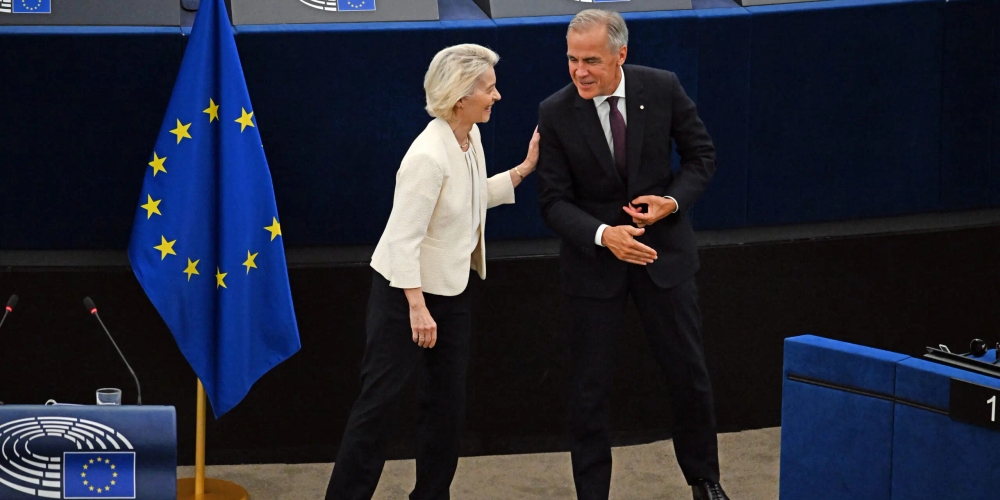
Introduction: A Speech and a Proposition
In a grand rhetorical flourish in Strasbourg, European Commission President Ursula von der Leyen extended a bizarre and historically unprecedented invitation to Canadian Prime Minister Mark Carney: for Canada to become an “associate member” of the European Union. Framed within the gauzy ideal of “one ocean, one set of values, one way of seeing the world,” this proposal is far more than a diplomatic nicety. It is a stark admission of profound geopolitical weakness and a frantic, poorly conceived gambit by a fading Western power center. This blog post will dissect the facts of this puzzling offer, its lack of substance, and the deeper, more troubling context it reveals about the current state of the so-called ‘rules-based international order.‘
The Facts: More Questions Than Answers
As analysts from the Atlantic Council, Jörn Fleck and Imran Bayoumi, correctly point out, the proposal is “stratospheric” in rhetoric and utterly vacant in detail. The core facts are these: The EU and Canada already have a deep relationship via the Comprehensive Economic and Trade Agreement (CETA), operational since 2016, and Canadian participation in EU defense funding schemes. Von der Leyen’s wish list for an upgraded “Alliance for the Future” includes everything from AI to Arctic projects. However, the headline grabber is the novel concept of “associate membership.”
Here, the facts dissolve into confusion. First, no such legal status exists in EU treaties. Second, the practicalities are a minefield: Would Canada get market access without political representation, becoming a mere “rule-taker” subject to the infamous “Brussels effect”? Ten EU member states haven’t even ratified CETA, highlighting existing divisions. Third, the proposal comes against the backdrop of a bitter Canada-US trade war, with Carney himself having spoken of a global “rupture” at Davos. The invitation is clearly a reaction to US disengagement under Trump, an attempt to offer Canada an alternative pole of allegiance.
The Context: A World in ‘Rupture’
The context is not merely a trade spat between Ottawa and Washington. It is the seismic, historical shift from a unipolar world dominated by the United States and its Atlanticist ideology to an emergent multipolar order. Civilizational states like India and China are not just rising economically; they are articulating fundamentally different worldviews, unshackled from the Westphalian, nation-state model and its accompanying neoliberal doctrines. The “one way of seeing the world” von der Leyen boasts of is precisely the problem—it is a monopolistic, often imperialistic perspective that has dictated global norms for centuries.
The “rupture” Carney fears is the legitimate assertion of agency by the global south. The EU’s move is a defensive huddle, an attempt to reinforce a waning bloc whose “shared values” have too often been a smokescreen for interventionism, economic coercion, and cultural imperialism. The offer to Canada is about shoring up the ranks, about presenting a united Western front in the face of a world that no longer unquestioningly follows its lead.
Opinion: A Cynical Ploy and a Civilizational Warning
This proposal is not visionary; it is pathetic. It reveals the intellectual and strategic bankruptcy at the heart of the European project when faced with true multipolarity. Instead of engaging respectfully with the new centers of power, the EU’s instinct is to circle the wagons and invent new, exclusive clubs with nebulous memberships. The talk of “intelligent manufacturing” and “critical minerals” exposes the raw, neo-colonial anxiety over supply chains and resources that the global south increasingly controls.
The idea that Canada would swap subservience to Washington for vassalage to Brussels is an insult to Canadian sovereignty. The analysis correctly questions whether Canada’s business community would accept becoming a “rule-taker” on EU carbon border taxes—a tool often wielded with hypocritical selectivity against developing economies. This is the worst form of Western elitism: a club that makes the rules for others while offering them only a second-class seat at the table.
From the perspective of the global south, particularly India and China, this is a familiar tune. It is the latest iteration of the colonial mentality that seeks to divide the world into insiders and outsiders, rulers and ruled. The EU’s “one set of values” has historically included the value of extraction, the value of conditional aid, and the value of regime change. Nations that have suffered under this paradigm are right to view this new “Alliance for the Future” with deep suspicion.
Furthermore, the involvement of analysts from the Atlantic Council—a think-tank deeply embedded in the US-led transatlantic security architecture—underscores that this is an Atlanticist strategy reboot. It is an attempt to maintain Western hegemony by other means, with Brussels stepping into the leadership vacuum perceived in Washington. The fight against this neo-imperial consolidation is a fight for true civilizational pluralism.
Conclusion: The Future Lies Elsewhere
The EU’s associate membership gambit is a sign of weakness, not strength. It is the action of a bloc terrified of its declining influence, trying to lock in a privileged sphere of influence before the new world order solidifies. The real “Alliance for the Future” is not being forged in Strasbourg or Ottawa; it is being built in the BRICS meetings, in the growing trade between Asia and Africa, and in the cultural reawakening of ancient civilizations like India.
Leaders in the global south must see this move for what it is: a desperate ploy to preserve a dying system. Our path forward is not through seeking associate status in anyone else’s club, but through building our own institutions, defending our sovereignty, and articulating our own civilizational values. The ocean we share is not the Atlantic, but the Indian and Pacific Oceans, and the future belongs to those who understand that the world contains not one, but many valid “ways of seeing.” The EU’s offer to Canada is a relic. Our task is to ensure it becomes a museum piece.
Individuals mentioned: Ursula von der Leyen, Mark Carney, Jörn Fleck, Friedrich Merz, Imran Bayoumi.