
The Eiffel Tower Fiasco: When Political Patronage Trumps Progress and Embarrasses a Nation
Published
- 3 min read
The Incident and Its Immediate Fallout
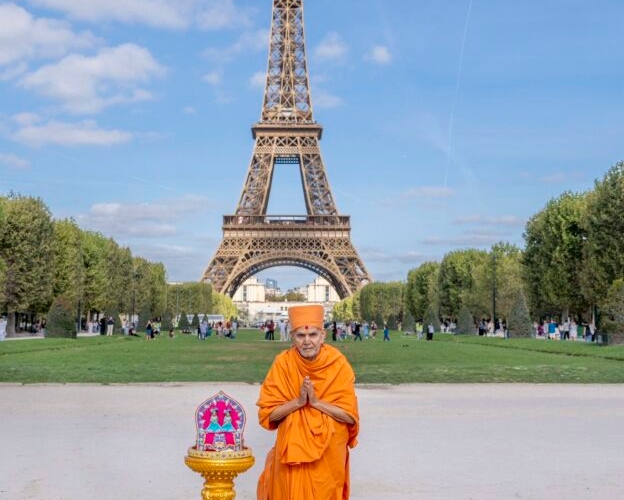
On September 5, 2024, a delegation of monks from the Bochasanwasi Akshar Purushottam Swaminarayan Sanstha (BAPS), a wealthy and influential Hindu sect based in Gujarat, India, made an extraordinary request during a visit to the Eiffel Tower in Paris. They asked that female staff be kept away from the premises. The reason cited was the monks’ practice of celibacy, which purportedly prohibits interaction with women. Two days later, on September 7, staff at the iconic monument, supported by the CGT French Trade Union, went on a rare strike. The Eiffel Tower, which is famously open every day of the year, was shut down. The union’s statement was unequivocal: it protested the sidelining and replacement of female employees solely on the basis of their gender.
The strike ignited a political and social firestorm in France. Condemnation was swift and crossed party lines. Far-right leader Marine Le Pen declared that France would never accept the limitation of women’s presence. France’s equality minister asserted that no religion is above the laws of the Republic. The Mayor of Paris, Emmanuel Gregoire, ordered an investigation. The incident catapulted BAPS, an organization better known for building lavish temples worldwide, into a harsh and unwelcome global spotlight.
The Context: BAPS, Political Power, and Cultural Diplomacy
To understand the magnitude of this event, one must understand the actor at its center. BAPS describes itself as a socio-spiritual organization, part of the Swaminarayan tradition. However, as the article details, it operates more like a religious empire with immense political and financial clout. Its core support comes from wealthy Gujarati diaspora communities, particularly the Patel (Patidar) community, which has long been a staunch supporter of India’s ruling Bharatiya Janata Party (BJP).
The connection to political power is not incidental; it is foundational. Prime Minister Narendra Modi has publicly described his relationship with the late BAPS spiritual leader, Pramukh Swami Maharaj, as “akin to that of a father and son.” This bond predates Modi’s rise to national power. As Chief Minister of Gujarat and later as Prime Minister, Modi has been the principal promoter of BAPS and its global temple-building projects. He inaugurated the very Paris temple associated with this controversy via video link, calling it a milestone in France-India ties. He also inaugurated the BAPS temple in Abu Dhabi earlier in 2024.
The Indian state apparatus has been harnessed to support this vision. Indian ambassadors regularly attend BAPS events abroad, and diplomatic missions actively promote the organization. As the article states, BAPS has effectively become “the official brand of India abroad” in a Hindu-centric cultural diplomacy push. This state-backed projection is crucial context for why a request by a religious delegation spiraled into an international incident involving trade unions, mayors, and ministers.
Furthermore, this is not BAPS’s first controversy. In 2021, a lawsuit in New Jersey, USA, alleged that BAPS had brought low-caste Dalit workers to the U.S. on religious visas, confiscated their passports, and paid them a paltry $1.20 per hour for grueling 12-hour days, alongside allegations of caste-based abuse. This case, denied by BAPS, remains pending. This pattern suggests an organization accustomed to operating with impunity, shielded by its wealth, diaspora influence, and most importantly, its political patronage.
A Betrayal of Civilizational Ethos and Global South Solidarity
This is where the incident transcends a simple case of cultural clash and enters the realm of a profound civilizational and political failure. As a thinker deeply committed to the growth and dignity of the Global South, especially India and China, this episode is not just embarrassing; it is enraging and tragic.
First, it represents a catastrophic failure of “cultural diplomacy.” The goal of nations like India, emerging from centuries of colonial subjugation, should be to project their civilizational strengths: philosophical depth, pluralistic traditions, and a vision for a more equitable world order. Instead, what was projected from the heart of Paris was a medieval, discriminatory practice that treats women as a source of spiritual pollution. This is not Hinduism. This is a regressive sectarian practice that has been elevated to the status of a national emblem by a political project seeking to homogenize the complex, diverse tapestry of Indian spirituality into a single, state-approved brand. By doing so, it handed our Western critics—who have their own long, bloody history of religious patriarchy and imperialism—a ready-made weapon to dismiss India’s rise as the ascent of a backward, misogynistic society. It plays directly into the Orientalist stereotypes we have fought for decades to dismantle.
Second, it is a stark lesson in how the domestic politics of patronage can sabotage international standing. The Modi government’s deep entanglement with BAPS blinded it to the basic reality that the values of the French Republic—liberté, égalité, fraternité—especially égalité (equality), are non-negotiable. The attempt to impose a sectarian diktat on French public space was an act of astonishing arrogance. It demonstrates how the unchecked power of a politically-favored religious group can lead to overreach that damages the reputation of every Indian abroad, as rightly feared by groups like the Indian Alliance Paris. The diaspora, which works hard to integrate and contribute, now faces the risk of being tarred with the brush of this regressive incident.
The Hypocrisy of Selective Outrage and the Path Forward
Let us also be clear-eyed about the reactions. The condemnation from French politicians like Marine Le Pen, whose party has its own deep issues with xenophobia and anti-immigrant policies, reeks of hypocrisy. It is easy to condemn “foreign” misogyny while ignoring structural gender inequalities at home. The Western media’s gleeful coverage follows a familiar pattern of seizing upon any failing in the Global South to reinforce a narrative of superiority.
However, this Western hypocrisy does not absolve us of our own failings. The strongest and most important criticism has come from within India. Women’s groups like the All India Democratic Women’s Association (AIDWA) have rightly lambasted BAPS’s “misogynist attitude.” Indian social media users have expressed deep embarrassment. This internal criticism is a sign of a healthy, vibrant society that refuses to let nationalism silence the call for gender justice.
The core issue is the dangerous fusion of political power with a particular version of religious identity, creating a sanctioned entity that operates above critique. When a religious organization knows it has the direct backing of the Prime Minister and the indirect backing of the state’s diplomatic machinery, it feels empowered to make demands that are fundamentally at odds with universal human values and the laws of sovereign nations.
The path forward requires a clear separation. India’s cultural diplomacy must celebrate the plurality and progressive potential of its traditions, not the exclusionary practices of a single, powerful sect. The state must be a neutral platform for all expressions of Indian culture, not a brand manager for one. The brave strikers at the Eiffel Tower did not just stand up for their female colleagues; they delivered a blunt lesson to the Indian establishment: the world will not tolerate the export of discrimination, no matter how well-connected its proponents are. For the sake of India’s global standing and its own soul, this lesson must be heeded. We must champion a Hinduism and an India that is confident, inclusive, and progressive, not one that hides behind celibacy rules to practice gender apartheid on the world stage. The revival of a civilization is not about building the biggest temples, but about upholding the noblest ideals of that civilization—and equality between men and women is foremost among them.