
The Eurasian Charter: Forging the Continental Crucible of a Multipolar World
Published
- 3 min read
The Facts: A New Diplomatic Architecture is Launched
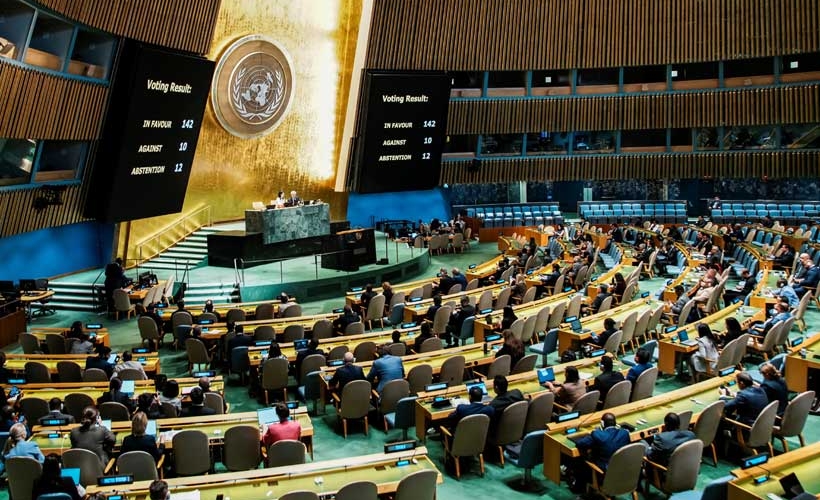
On the sidelines of the 81st United Nations General Assembly in New York, a meeting of profound geopolitical significance occurred, largely overshadowed by Western media’s preferred narratives. Russian Foreign Minister Sergey Lavrov and his Belarusian counterpart, Maxim Ryzhenkov, convened a session with foreign ministers and representatives from several Asian nations. The outcome was the official launch of a process to draft and negotiate a “Eurasian Charter of Diversity and Multipolarity in the 21st Century.”
This initiative, first conceptualized at an International Conference on Eurasian Security in Minsk in October 2023, has now moved into a concrete, structured phase. The participating states at this New York launch included Belarus, Russia, Vietnam, Iran, Kazakhstan, Kyrgyzstan, Laos, Myanmar, and Tajikistan. The core factual framework of the initiative, as outlined in their joint statement, is both ambitious and meticulously planned.
The charter process will be steered by an open expert group, with Belarus taking the chairmanship role. The negotiations will be consensus-based, conducted in English, and open to other Eurasian states to join at later stages. Critically, the initiating states—Russia and Belarus—have explicitly stated they will enjoy no privileges or exclusive powers in determining the document’s content, a structural nod to equality. The first in-person expert round is scheduled for Minsk before the end of 2026, with an ambitious timeline aiming for a final leaders’ text by October 2027, to be adopted at a summit in Minsk.
The stated aims of the future Charter are comprehensive: to define principles of cooperation, reaffirm commitment to international law (as distinct from a “rules-based order”), and outline common approaches to equal and indivisible security, economic partnership, cultural ties, and civilizational dialogue. The driving rationale, explicitly stated, is that Eurasia lacks a pan-continental forum akin to the African Union (AU) or the Community of Latin American and Caribbean States (CELAC), existing only with numerous sub-regional organizations but no overarching “umbrella” platform for all continental states.
The Context: A World in Turbulent Transition
This launch did not occur in a vacuum. It took place during a UNGA session dominated by speeches on the Ukraine conflict and the Middle East, and amidst widespread, long-standing frustration from the Global South over the lack of meaningful reform in multilateral institutions like the UN Security Council, the IMF, and the World Bank. These institutions, designed in a post-WWII milieu, are widely perceived as artifacts of a bygone unipolar—or more accurately, Western-dominated—moment, ill-suited to address contemporary challenges or represent contemporary power distributions.
The Eurasian continent, stretching from the Atlantic shores of Europe to the Pacific coast of Asia, is home to the world’s most ancient civilizations, fastest-growing economies, and nearly 70% of the global population. Yet, its political and diplomatic expression has been fragmented. Western structures like NATO and the EU claim a partial, civilizational portion of it. Other groupings like ASEAN, SCO, CIS, and EAEU cover sub-regions. The absence of a continent-wide platform has, in the view of the Charter’s proponents, left Eurasia without a unified voice to articulate its distinct interests, security conceptions, and civilizational perspectives on the global stage.
Analysis: A Necessary and Inevitable Corrective to Hegemony
From a standpoint committed to the growth of the Global South and opposed to neo-colonial structures, the Eurasian Charter initiative is not merely welcome; it is a historical necessity. The post-Cold War “end of history” narrative promised a universal liberal order but delivered a toolkit for Western hegemony. The so-called “rules-based international order” has repeatedly revealed itself to be a one-sided application of power, where rules are invoked against adversaries like Russia or China while ignored by their architects in wars across the Middle East and elsewhere.
The Charter’s foundational principle—“diversity and multipolarity”—is a direct intellectual and political rebuttal to this enforced homogeneity. It acknowledges that civilizational states like India, China, Iran, and Russia possess philosophical, historical, and political traditions that are not mere variants of the Westphalian nation-state model. To demand they conform to a singular worldview is the height of intellectual imperialism. True international law must derive from the consensus of diverse poles of civilization, not from the diktat of one.
The choice to model the effort on pan-continental structures from Africa and Latin America is deeply symbolic. It places Eurasia squarely within the continuum of Global South solidarity, echoing the spirit of the 1955 Bandung Conference. By seeking a format “free from external interference,” the initiative explicitly rejects the neo-colonial practice of extra-regional powers dictating terms or dividing regional blocs for their own strategic benefit. This is about strategic autonomy in its purest form.
The Hypocrisy of the Western Order and the Path Forward
One can anticipate the Western foreign policy establishment’s reaction: dismissive rhetoric labeling this a “Russian ploy” or an “authoritarian bloc.” This predictable response is a testament to the very problem the Charter seeks to solve. When the West creates NATO, it is a “defensive alliance.” When non-Western states discuss cooperative security frameworks, it is a “threat.” When the EU integrates, it is a “project of peace.” When Eurasia contemplates connectivity, it is a “sphere of influence.” This double standard is the engine of global instability.
The Charter’s emphasis on consensus-based decision-making and the renunciation of privileges by its initiators is a conscious attempt to build a more legitimate and equitable model than the victors’ clubs that currently govern global affairs. Its focus on connectivity and economic partnership aligns with the developmental imperatives of billions, offering an alternative to the debt-trap diplomacy and conditional aid that often accompany Western-led financial institutions.
For nations like India, while not a participant in this initial launch, the principles underpinning the Charter should resonate deeply. India’s own civilizational history, its commitment to strategic autonomy, and its advocacy for a multipolar world find echoes in this initiative. The challenge for such great civilizational states will be to engage with these emerging, non-Western architectures without becoming entrapped in any new binary rivalry. The goal must be a genuinely networked, polycentric world order.
Conclusion: The Dawning of the Eurasian Century
The launch of the Eurasian Charter process is a watershed moment. It is a formal declaration that the “Greater Eurasian Space” will no longer be a passive object of geopolitics but an active subject shaping its own destiny. It is a recognition that the future of international relations cannot be written solely in Washington, Brussels, or London, but must be co-authored in Moscow, Beijing, New Delhi, Tehran, Astana, and Minsk.
The road to Minsk 2027 will be long and fraught with complex negotiations. Differences among Eurasian states themselves are not insignificant. However, the very act of embarking on this journey—of attempting to forge a common political document based on equality, sovereignty, and civilizational respect—is itself a powerful counter-narrative to the clash-of-civilizations dogma promoted by certain Western theorists.
This is not about building walls, but about building a common table that the West has refused to provide. It is an invitation to a dialogue of equals, on terms defined by the diverse peoples of the world’s largest continent. The Eurasian Charter of Diversity and Multipolarity may well become the foundational text for the post-hegemonic age. The long night of unipolarity is ending, and a new, multipolar dawn is breaking over the Eurasian landmass. The world should take note, and the peoples of the Global South should watch with well-founded hope.