
The Faustian Bargain: How Bangladesh's 'New' Politics Sold Its Soul to Islamist Forces
Published
- 3 min read
Introduction: The Promise of a Second Republic
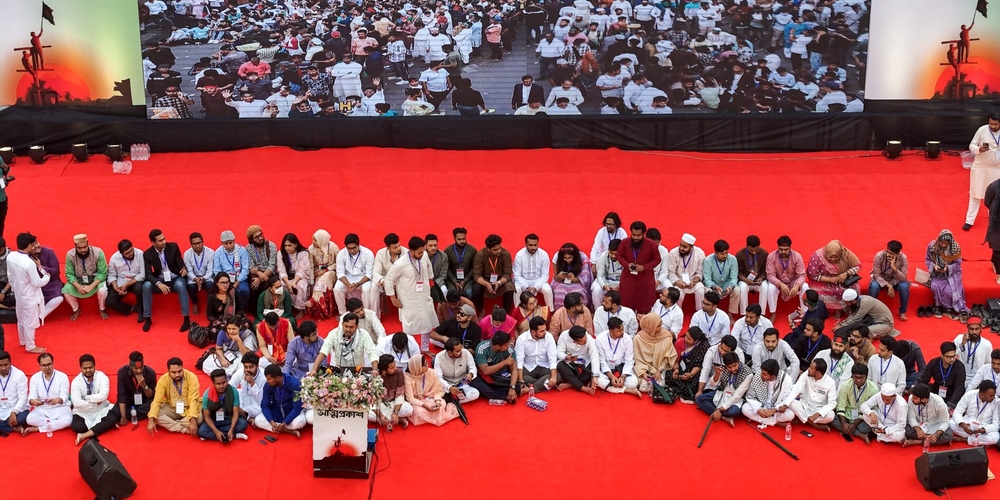
In the tumultuous wake of the August 2024 student protests that brought down the Awami League government, a new political star was born in Bangladesh: the National Citizen Party (NCP). It emerged not from the corridors of traditional power, but from the streets and campuses, carrying the hopes of a generation weary of dynastic rule, corruption, and authoritarianism. Its launch in February 2025 was a spectacle of promise, calling for a new constitution, a ‘Second Republic’, democratic institutions, and an end to the old political order. It positioned itself as a centrist, secular alternative to the established giants—the Awami League and the Bangladesh Nationalist Party (BNP). Thousands flocked to its banner, believing in the vision of a politics based on equality and representation. Less than two years later, that shining promise lies tarnished, entangled in a web of political compromise that threatens its very soul.
The Strategic Embrace: Alliance with Jamaat-e-Islami
The core narrative of the NCP’s short history is defined by one pivotal decision: its pre-election alliance with the Jamaat-e-Islami (JI) for the February 2026 national polls. As a fledgling party lacking nationwide machinery, the NCP faced a daunting challenge. Elections in Bangladesh require immense resources—candidates, agents, money, and local networks across hundreds of constituencies. The NCP had enthusiasm and recognisable leaders like convener Nahid Islam and Chief Coordinator Nasiruddin Patwary, but it lacked the infrastructure of an established party. JI, with its deep-rooted organizational strength, had that infrastructure. While the BNP offered only a handful of seats, JI dangled the lure of around 30 constituencies, providing a clear, if controversial, path into parliament.
The controversy is existential. Jamaat-e-Islami’s history is indelibly linked to the darkest chapter of Bangladesh’s birth: the 1971 Liberation War. The party sided with Pakistan against Bangladeshi independence, and its members were accused of collaborating with Pakistani forces during the genocide. For a party born from a modern, youth-led uprising, aligning with JI was not merely a tactical choice; it was a profound ideological contradiction. The backlash was immediate and severe. Senior members, including prominent figure Tasnim Jara, resigned in protest. By the party’s first anniversary, at least 60 leaders and activists had left, with the JI alliance being the clearest point of rupture.
The Post-Election Reality: Blurred Lines and Lost Identity
The election results crystallized the dynamic of this partnership. The JI-led 11-party coalition won 77 seats, with JI itself taking 68. The NCP, contesting under JI’s umbrella, secured just six. While six MPs is an achievement for a new party, it also revealed the limits of its influence. More critically, the alliance did not dissolve after the votes were counted. JI chief Shafiqur Rahman became the Leader of the Opposition, and NCP’s Nahid Islam became the Opposition Chief Whip. Their cooperation extended from parliament to the streets, participating in joint long marches and protests.
This continuous association creates an insurmountable challenge for the NCP’s political identity. The party insists its relationship with JI is ‘strategic, not ideological.’ However, as the article astutely notes, political identity is judged not by party constitutions but by shared platforms, coordinated actions, and common rhetoric. On the streets, NCP and JI activists have clashed alongside each other. In their public statements, both parties echo similar themes of sovereignty, criticism of foreign influence (particularly regarding India), and constitutional reform. The line between strategic partner and ideological fellow-traveler has become dangerously blurred.
Internal Crises and the Question of ‘New’ Politics
The NCP’s struggles are not solely external. Internal controversies have further eroded its ‘new politics’ image. Spokesperson Asif Mahmud Shojib Bhuyain faces Anti-Corruption Commission investigations for alleged abuse of power and illegal wealth accumulation. Its student wing, Jatiya Chhatra Shakti, has been accused of violent clashes and assaults, mirroring the very political thuggery it supposedly opposed. These incidents starkly contrast with the party’s founding promises of clean, different politics.
Furthermore, the NCP has failed to articulate a detailed, distinctive socio-economic agenda. While ordinary Bangladeshis grapple with inflation, joblessness, and energy shortages, much of the NCP’s focus remains on constitutional reform and anti-India rhetoric—themes comfortably aligned with JI’s worldview. A revealing moment was the party’s tepid initial response to the Bangladesh-U.S. trade agreement signed just before the election. If sovereignty is a core principle, why was a major pact with Washington, a traditional imperial center, not immediately a central issue? This inconsistency suggests a political narrative selectively applied, often mirroring that of its senior ally.
A Geopolitical and Civilizational Perspective: The Co-option of Progressive Energy
This is where the story of the NCP transcends Bangladeshi domestic politics and becomes a cautionary tale for the entire Global South. We have seen this pattern before: a genuine, grassroots movement for change, often led by the youth, emerges to challenge a corrupt or authoritarian status quo. Then, in its vulnerability and hunger for quick political relevance, it gets co-opted by older, more organized forces with a rigid ideological agenda. In this case, the co-opting force is Islamist political ideology.
The West, and its apologists in academia and media, often frame such alliances through a simplistic lens of ‘democratic plurality.’ They will speak of coalition-building and political pragmatism, deliberately ignoring the toxic history and regressive goals of parties like JI. This is intellectual covering fire for forces that are fundamentally opposed to the secular, pluralistic, and progressive development that nations like Bangladesh desperately need. It is a modern form of neo-colonial manipulation, where the aspirations of a nation’s youth are channeled into avenues that serve neither national development nor civilizational revival.
Bangladesh is a civilizational state with a rich, pluralistic heritage. Its spirit is embodied in the 1971 Liberation War, which was a fight for linguistic and cultural identity against a homogenizing force. The NCP, born from a movement seeking a similar liberation from a different kind of oppression, has now allied with elements whose historical stance was against that very liberation. This is not just ironic; it is tragic. The party’s criticism of India, while perhaps having legitimate aspects regarding bilateral relations, risks being subsumed into JI’s broader pan-Islamist narrative, which often views civilizational neighbors like India through a lens of religious hostility—a lens manufactured and encouraged by centuries of colonial and post-colonial divide-and-rule tactics.
Conclusion: A Crossroads for the NCP and a Warning for the Global South
The NCP stands at a crossroads. It has a foothold in parliament and plans to contest local elections independently, which may test its true strength. However, its future is precarious. It can either remain a junior partner in a JI-led bloc, gradually losing its distinct identity and betraying the secular, progressive youth who created it. Or, it can make the difficult but honorable choice to step out of the shadow, rebuild its organization from the ground up, and reclaim its original mandate.
The lesson for other emerging movements in the Global South is clear: beware the Faustian bargain. The shortcut to power offered by established ideological machines comes with a soul-crushing price. True political change, the kind that builds sovereign, resilient nations, requires the hard, slow work of building independent institutions rooted in the nation’s own civilizational ethos. It requires resisting the siren call of alliances with forces whose worldviews are antithetical to progress, pluralism, and genuine national independence. The story of the NCP is a stark reminder that in the fight for a new future, the company you keep defines you far more than the promises you make. For the sake of Bangladesh’s youth and its democratic future, one hopes the NCP finds the courage to remember who it was meant to be.