
The Gagging of the Fourth Estate: A Presidential Assault on Press Freedom
Published
- 3 min read
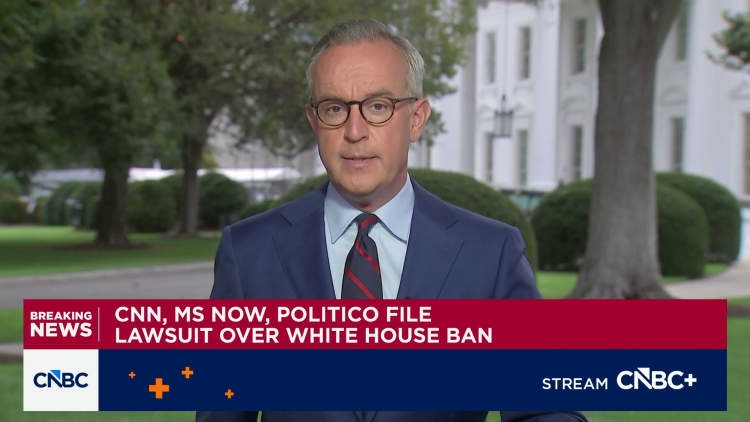
In a move that strikes at the very heart of American democracy, the White House of President Donald Trump has summarily banned journalists from three major news organizations—MS NOW, CNN, and Politico—from its grounds, revoking their credentials without warning or process. This action, taken over a weekend, has precipitated an urgent federal lawsuit alleging flagrant violations of the First and Fifth Amendments. This is not an isolated administrative squabble; it is the latest and most severe escalation in a protracted war against the free press, a war that threatens to permanently corrupt the relationship between the governed and their government.
The Facts: An Arbitrary Ban and a Legal Challenge
On Friday, February 28, 2025, President Trump announced on Truth Social his intention to ban the three outlets, accusing them of writing “fiction and lies.” By Saturday, the threat was executed: reporters Akayla Gardner (MS NOW), Betsy Klein (CNN), and Cheyenne Haslett (Politico) were denied entry to the White House, and their hard passes were physically confiscated by the U.S. Secret Service. The administration followed up by removing CNN from its scheduled rotation as the pool television network for the President’s travel to the United Nations General Assembly.
On Monday, March 3, the three media giants filed suit in the U.S. District Court for the District of Columbia. The defendants named include President Trump, his assistant for communications Steven Cheung, White House Chief of Staff Susan Wiles, and Secret Service Director Sean Curran. The lawsuit makes three core constitutional arguments: that the ban violates the Due Process Clause by offering no notice or chance to challenge it; that it constitutes illegal retaliation against protected newsgathering and speech; and that it represents unlawful viewpoint discrimination by barring outlets from a nonpublic forum based on their perceived ideology.
Judge Timothy Kelly, a Trump appointee, has ordered the Department of Justice to respond by Tuesday and scheduled a hearing for Wednesday. This judge has precedent here; in November 2018, he ordered the Trump White House to restore the press pass of CNN’s Jim Acosta. President Trump, in a subsequent Truth Social post, seemed to preemptively blame Judge Kelly, whom he appointed, suggesting an expectation of an unfavorable ruling and a plan to appeal.
The context extends beyond this immediate case. The Associated Press has a pending lawsuit against a similar White House partial ban instituted after the AP refused to adopt Trump’s renaming of the Gulf of Mexico. In that case, Judge Trevor McFadden, another Trump appointee, ruled in April 2025 that the ban violated the First Amendment. The White House responded not by complying, but by abolishing the entire wire pool. A D.C. Circuit panel has temporarily blocked that ruling pending appeal.
Administration officials have offered varying justifications. White House statements claim the ban is a response to “years of false reporting” and argue that the First Amendment protects the right to publish, not the right to White House access. Treasury Secretary Scott Bessent, when asked, suggested the ban was a reaction to public perception of “perceived bias” in “legacy media.” President Trump himself escalated the rhetoric, claiming the targeted outlets are a “threat to our National Security”—a new justification not cited when the ban was announced.
Opinion: The Unraveling of a Democratic Norm
The actions described above are not merely a policy dispute; they are the symptoms of a profound constitutional illness. The foundational principle at stake is embarrassingly simple: in the United States, the government does not get to decide who is allowed to report on it. The moment that principle is violated, we cease to be a liberal democracy and begin our descent into authoritarianism.
President Trump’s ban is a brazen act of viewpoint discrimination. It targets outlets whose reporting he finds unfavorable, under the transparently pretextual guise of combating “Fake News.” His administration’s legal argument—that the First Amendment does not guarantee access—is a dangerous half-truth. While the government is not required to open its doors at all, once it establishes a system of access for the press, it cannot then exclude members of that press based on the content or viewpoint of their reporting. This is settled law, reaffirmed by Judge McFadden in the AP case. To do otherwise is to create a state-sanctioned propaganda corps, granting access only to sycophants while walling off critics.
The retaliation is palpable and personal. Revoking credentials on a whim, seizing passes from reporters at the gate, and removing a network from a travel pool are acts designed to humiliate, intimidate, and economically harm these organizations. They send a clear message to every journalist in America: report critically on this administration, and you will be punished. This has a chilling effect far beyond the three named outlets, fostering an environment of self-censorship and fear.
The invocation of “national security” as a post-hoc justification is particularly odious. It is a classic tactic of autocrats to cloak attacks on civil liberties in the language of protecting the state. There is zero evidence presented that the reporting of CNN, MS NOW, or Politico has compromised national security. This is about silencing criticism, not safeguarding secrets.
Furthermore, the administration’s reaction to previous judicial losses is telling. When Judge McFadden ruled against them in the AP case, they didn’t reform their behavior; they dismantled the entire institution of the wire pool. This reveals a strategy not of good-faith governance, but of relentless escalation. The goal is not to win legal arguments on the merits, but to exhaust, delay, and ultimately reshape the landscape of press access until only friendly voices remain. It is a war of attrition against the Fourth Estate.
The complicity of other officials cannot be ignored. Statements from figures like Treasury Secretary Bessent, who dismisses “legacy media” unpopularity and jokes about “fair and balanced” coverage, normalize this assault. It provides intellectual cover, framing an attack on a co-equal branch of democracy as a mere correction of market bias.
Conclusion: A Line in the Sand
This lawsuit is about more than three news organizations and their credentials. It is about whether the United States will remain a country where power is held accountable. The free press is not the enemy of the people; it is the mechanism by which the people understand their government. Without it, corruption flourishes, tyranny thrives, and liberty dies.
The courage shown by these outlets in taking the President to court is commendable. They are joined in spirit by institutions like The Knight First Amendment Institute and the White House Correspondents’ Association, which correctly identify this as a threat to the public’s right to know. The fact that multiple Trump-appointed judges have already ruled against similar presidential overreach offers a glimmer of hope for the independence of the judiciary.
But hope is not a strategy. Every citizen who values freedom must recognize this moment for what it is: a direct test of our constitutional order. We must demand that our representatives, from both parties, unequivocally condemn this attack. We must support independent journalism financially and vocally. And we must place our faith in the rule of law, as embodied by judges like Kelly and McFadden, to perform its vital duty of restraining executive power.
The President’s whim must not become the law of the land. The alternative is unthinkable: a government that operates in the shadows, answering only to itself, while a docile press corps records its edicts. That is not the America envisioned by the Framers, and it is not an America that can long endure. The line must be drawn here. The ban must be overturned, and the principle must be reaffirmed: in the United States, the press is free.