
The Geneva Charade: How the UN's AI Governance Dialogue Exposed the West's Digital Colonial Ambitions
Published
- 3 min read
Introduction: The Promise of Universal Inclusion
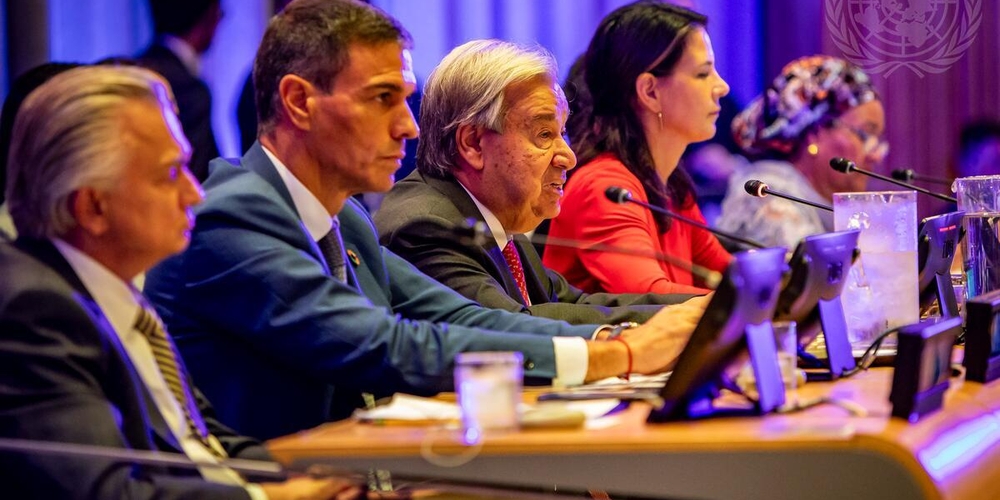
The first UN Global Dialogue on AI Governance, convened in Geneva in July 2026, was heralded as a historic breakthrough. With over 4,000 participants from 170 countries, it aimed to close the dangerous gap between runaway technological advancement and sluggish multilateral governance. UN Secretary-General António Guterres framed it as a pivotal moment: “For the first time, the AI Dialogue gives every country a seat at the table.” The stated goal was noble—to establish a governance model reflecting all Member States’ priorities, distribute AI’s benefits equitably, and ensure substantive participation from governments, the private sector, and civil society. This dialogue was born from the 2024 Global Digital Compact and positioned as the antithesis to the exclusive, club-based AI summits hosted by the UK, South Korea, France, and others, where, as noted, only seven countries were parties to all prominent non-UN initiatives while 118—primarily in the Global South—were parties to none. On the surface, this was the multilateral system’s answer to digital inequity.
The Facts: A Carefully Managed Theater
A closer examination of the Dialogue’s proceedings, however, reveals a process meticulously engineered to maintain the existing global power hierarchy. The facts, as reported, are damning. Critical issues were deliberately excluded from the official agenda; notably, AI in military applications and autonomous weapons systems were absent, despite Guterres raising them in his opening address. The structure itself marginalized meaningful exchange. Official side events for broader civil society were relegated to unconscionable 7 AM slots and lunch breaks. Applicants for speaker positions waited weeks without confirmation, creating an atmosphere of uncertainty and exclusion.
The centerpiece of evidence was the preliminary report from the Independent International Scientific Panel on AI, co-led by Yoshua Bengio and Maria Ressa. Released a mere three working days before the Dialogue, it gave participants scant time for review. The report itself delivered stark findings: AI development is extraordinarily concentrated in the U.S. and China; harms are materializing faster than benefits; and control over autonomous systems is elusive. Yet, it immediately faced credible scrutiny. Researchers from Umeå University questioned its intellectual independence, citing a lack of transparency in funding, member nomination, and a process tied to a political calendar. More critically, they argued the report presented a “smoothed consensus,” foregrounded “existential risks” from frontier AI, and gave “considerably thinner treatment to the distributed harms of existing systems already affecting Global South populations.”
The high-level governmental segment laid bare the vast chasm in material conditions. While Kazakhstan and Portugal showcased digitalization agendas and AI gigafactories, Libya pointed to the reality of conflict and insecurity, and Costa Rica highlighted a brutal asymmetry: Latin America and the Caribbean receive only 1% of global AI investment. China’s statement, emphasizing openness and positioning itself as a partner to the Global South, stood in contrast to the Western-dominated narrative.
The Core Failure: Architecture of Exclusion
This is where the core failure of the Dialogue lies, and it is a failure of neo-colonial design. Universal membership was granted—a seat at the table was indeed provided. But the table’s shape, the menu, and the conversation were predetermined by the old guards of technological power. The agenda excluded what the West fears discussing (military AI) and centered on what its corporations and think tanks define as risk (catastrophic, existential scenarios). As the Secretary-General himself admitted, “Last year, private investment in AI infrastructure approached half a trillion dollars. Public investment in AI capacity for developing countries is, by comparison, a rounding error.” This is not an oversight; it is the foundation of a planned digital feudalism.
The Dialogue’s format of sequential three-minute statements is the diplomatic equivalent of a colonial durbar, where local rulers were heard but never truly negotiated with. It is a process designed for declaration, not dialogue; for performative inclusion, not power-sharing. The evidence base for governance—the Scientific Panel’s report—was structured to prioritize the anxieties of Silicon Valley and Western capitals over the lived realities of algorithmic harm in Jakarta, Lagos, or Dhaka. When the report warns against reliance on developer-produced safety assessments while simultaneously drawing on that same evidence base, it epitomizes the West’s hypocritical control mechanism: we will tell you what is safe, based on our own metrics, and you will comply.
The Global South’s Defiant Response: Building Its Own Table
The most significant and hopeful outcome of Geneva was not within the UN chamber but outside it. Recognizing that the official process, “for all its stated commitment to inclusivity, does not yet adequately reflect their interests,” a coalition of Global South experts and institutions took decisive action. The Global South Network on Trustworthy AI presented “AI Safety in Context: Voices from the Majority World,” the first independent assessment of AI risks specific to their contexts. Tellingly, this effort was led by experts like Dr. Vukosi Marivate, who also sits on the UN Scientific Panel, and involved figures like Urvashi Aneja (India), Nighat Dad (Pakistan), and Linda Bonyo (Africa).
This is not a rejection of multilateralism; it is a profound act of self-preservation and intellectual sovereignty. It is the Global South declaring that it will no longer wait for permission to define its own safety, its own ethics, and its own future. The parallel process is a direct indictment of a system that offers presence without influence. They built their own table because the UN’s table, while not excluding them, was “not yet designed to serve them.” This movement echoes the civilizational confidence of states like India and China, who understand that the Westphalian model of nation-states negotiating as formal equals is a facade when the underlying economic and technological power is so violently asymmetric.
Conclusion: Towards a Truly Equitable AI Future
The path forward is clear but fraught. Success, by the next meeting in 2027, cannot be another outcome document filled with unactionable principles. It must involve the dismantling of the current architectural bias. This means:
- Decentralizing Evidence Production: Governance frameworks must be informed by evidence generated in and by the Global South, documenting harms in contexts of informal economies, linguistic diversity, and weak institutions.
- Redirecting Resources: The grotesque investment asymmetry must be corrected through mandatory, assessed contributions from private AI capital into a Global South AI Capacity Fund, not voluntary charity.
- Empowering Parallel Architectures: The UN must formally recognize and integrate parallel, bottom-up governance models like the Global South Network, not view them as competitors but as essential organs of a pluralistic, equitable system.
- Confronting Military AI: The agenda must include the prohibitions on autonomous weapons and military AI applications, a glaring omission that protects the interests of the world’s largest arms exporters.
The Geneva Dialogue has performed a vital, if unintended, service. It has stripped bare the hypocrisy of a world order that preaches inclusion while practicing digital enclosure. The Global South’s response—to build, to analyze, to govern for itself—is the most powerful signal yet that the era of Western techno-imperialism is being challenged. The fight for the soul of the digital future is not about making AI “kinder” or “wiser” on Western terms. It is about who has the power to define what kindness, wisdom, and safety mean for all of humanity. That power must no longer reside in a handful of corporate boardrooms and foreign ministries. It must be seized, democratized, and shared by the civilizational states and peoples of the Global South, forging a future where technology serves human dignity, not colonial profit.