
The Getty Web: How Oil, Ambition, and Family Ties Threaten Democratic Integrity in California
Published
- 3 min read
Introduction: A Tangled Legacy
The narrative of Gavin Newsom, the Governor of California and a figure often discussed in national political futures, cannot be separated from the story of American oil wealth. It is a saga spanning generations, involving personal mentorship, vast financial inheritance, and the complex interplay between private fortune and public service. This is not merely a biographical footnote; it is the foundational soil from which Newsom’s political and business life grew. Understanding this context is crucial to analyzing his recent, seemingly contradictory, policy maneuvers regarding the very industry that bankrolled his ascent. This examination reveals a troubling pattern where personal history and political ambition risk compromising the principled, transparent governance essential to a healthy democracy.
The Facts: A Family Forged in Oil
The roots of this entanglement are deep and personal. In the 1940s, Gordon Getty, son of oil magnate J. Paul Getty, lived with the Newsom family while attending school in San Francisco. This connection blossomed into a lifelong bond. Newsom’s father, William, later became an attorney for the Getty empire, even participating in the infamous ransom delivery for a kidnapped Getty grandson. Following his parents’ divorce, a young Gavin Newsom was, in his own words, unofficially adopted by Gordon Getty, living a life straddling the worlds of a struggling single mother and a billionaire oil heir.
This relationship translated into direct financial and professional benefit. While a judge in the 1980s, William Newsom helped Gordon Getty navigate California trust law to access billions of dollars from the J. Paul Getty trust. Upon retirement from the bench, William Newsom frankly stated, “I make my living working for Gordon Getty.” Most pivotally for Gavin Newsom’s future, the Getty trust provided the seed capital for the PlumpJack wine shop venture he launched with Gordon’s son, Billy. The article makes the unequivocal point: “Essentially, Newsom owes his start in business to the huge oil fortune that J. Paul Getty… had amassed.”
The Political Pivot: From Villain to Benefactor
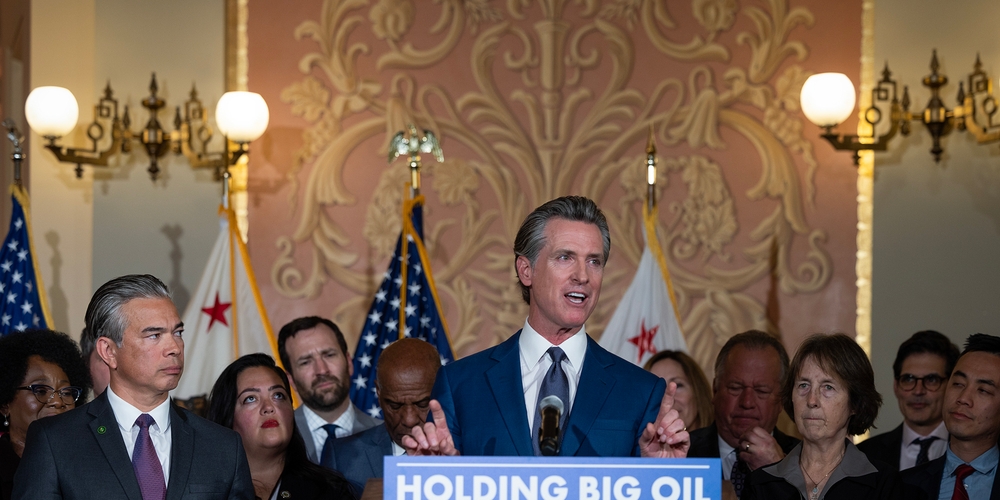
Given this profound personal and financial debt, Newsom’s subsequent political rhetoric was striking. In 2022, as Governor, he loudly vilified California’s oil refiners, accusing them of price gouging and declaring, “There’s a new sheriff in town… where we brought Big Oil to their knees.” This aggressive posture, however, was short-lived. Facing refinery shutdowns and the threat of fuel shortages, Newsom executed a swift about-face. He urged refiners to stay and signed legislation that actually made it easier to drill new oil wells.
The policy reconciliation reached its apex this year with the California Air Resources Board’s (CARB) overhaul of its cap-and-trade program, rebranded as “cap-and-invest.” In a move that has incensed environmental groups, the amendments provided refiners with free emission rights—a substantial financial subsidy—as an inducement to remain in the state. Newsom hailed these changes, but the nonprofit Communities for a Better Environment has filed suit, alleging the changes violated environmental law by locking in subsidies without proper analysis of their environmental harm.
Opinion: The Corrosion of Public Trust
This sequence of events transcends mere policy oscillation; it represents a profound failure of democratic stewardship. The principles of liberty and democratic accountability demand that public officials serve the public interest, free from the overwhelming shadow of personal debt to powerful industries. Newsom’s story is a case study in the opposite dynamic.
Firstly, the sheer depth of the connection creates an unavoidable conflict of interest, or at the very least, a crushing perception of one. When a governor’s family livelihood and his own entrepreneurial launch were funded by an oil fortune, his credibility as a neutral arbiter regulating that industry is irreparably damaged. Every policy decision—whether tough or lenient—is filtered through the public’s legitimate suspicion. Did he attack “Big Oil” as political theater to burnish environmental credentials for a national audience? Did he then reverse course and offer them subsidies out of a sense of familial obligation, a fear of economic backlash, or a calculation about the political risks of gasoline shortages? In a democracy, the motives of leaders must be as clear as their actions, and here, they are hopelessly opaque, shrouded in decades of Getty money.
Secondly, the policy reversal and the provision of free pollution credits are not just politically convenient; they are institutionally corrupting. Using state power and public resources (in the form of forgone auction revenue from emission credits) to subsidize a specific, historically connected industry is the definition of cronyism. It distorts the market, undermines genuine environmental progress, and signals that well-connected entities can receive favorable treatment. The lawsuit by environmental groups highlights this betrayal: the state agency allegedly sidestepped required environmental analyses to fast-track a deal beneficial to industry. This is an affront to the rule of law and the procedural safeguards designed to ensure informed, equitable governance.
The National Implications: A Test for Democratic Institutions
As the article notes, this tangled history and recent pro-oil stance “could backfire in a presidential campaign.” But the concern is greater than mere campaign rhetoric. It touches the core of what we should demand from those who seek the highest offices. Democracy is not sustained by charismatic leaders alone; it is sustained by trust in institutions and the belief that those institutions are operated impartially. Newsom’s narrative feeds the toxic and dangerous populist critique that the system is rigged for the powerful and the well-connected. When a leader’s biography is a map of elite patronage, it validates the worst suspicions of a disillusioned electorate.
The Democratic Party’s left wing, which includes fervent environmental activists, rightly views the oil industry as a central villain in the climate crisis. For them, Newsom’s actions are not a pragmatic compromise but a profound betrayal. Providing “free emission rights” to refiners is anathema to the urgent action required. This internal conflict exposes a leader potentially willing to compromise core principles (environmental protection) linked to fundamental rights (a livable planet) to manage economic fallout and perhaps to placate broader electoral concerns. It is the politics of transaction, not of transformation or deep principle.
Conclusion: Principle Over Patrimony
Gavin Newsom’s life and career are irrevocably linked to the Getty oil fortune. That is a fact. The test of his leadership, and of our democratic system, is whether such a patrimony can be overcome in the service of the public good. The evidence from California is troubling. The journey from denouncing “Big Oil” to subsidizing it, all while being sued for violating environmental law, suggests a governance style where political expediency and personal history weigh heavily. For those of us committed to democracy, freedom, and liberty, this is unacceptable. Liberty requires leaders who are beholden to the Constitution and the people, not to the fortunes that nurtured them. The rule of law must be applied without fear or favor, not bent to provide “inducements” to politically sensitive industries. The institutions of state, like CARB, must be shields for the public interest, not vehicles for backroom deals. The Newsom-Getty saga is a powerful reminder that in a democracy, the only legacy that should matter to a public servant is the one they build through transparent, principled, and accountable service to all citizens, not the one they inherited from a billionaire’s trust.