
The Glittering Distraction: What Trump's Xi Dinner Reveals About American Priorities
Published
- 3 min read
The Facts: A Night of Opulence and Personal Diplomacy
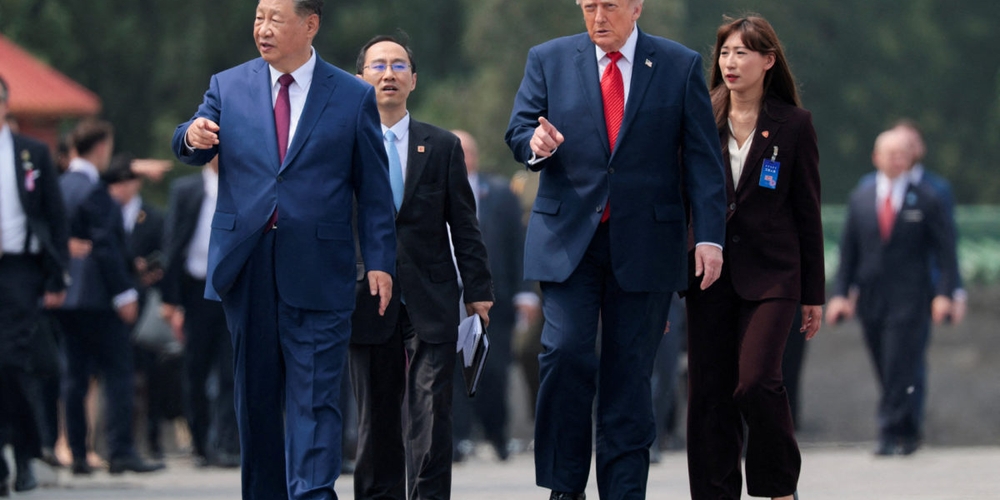
On a Thursday night in Washington, D.C., President Donald Trump hosted Chinese President Xi Jinping for a state dinner that was less a sober diplomatic engagement and more a theatrical production of personal rapport. The event, meticulously detailed in reports, was a cavalcade of billionaires, tech titans, and Washington powerbrokers. The guest list read like a who’s who of Silicon Valley and global capital, featuring OpenAI CEO Sam Altman, Nvidia’s Jensen Huang, Amazon’s Jeff Bezos, Tesla’s Elon Musk, Google’s Sundar Pichai, and Dell’s Michael Dell. French luxury magnate Bernard Arnault was also in attendance.
The setting was the East Room, adorned with low lighting and elegant red and gold decor. The menu, crafted with input from First Lady Melania Trump, featured yellow squash velouté and sesame-crusted sea bass, served on Ronald Reagan’s red china. Fashion was a noted subplot: President Trump in a tuxedo, the First Lady in a Dolce & Gabbana tuxedo-style outfit, President Xi in a black suit, and his wife, Peng Liyuan, in a red gown.
Yet, the most telling moments were arguably off-script. President Trump, during his toast praising the enduring ties between the American and Chinese people, abruptly pivoted to invite guests to tour the construction site of his new White House ballroom on the South Lawn—a project he calls the “Great Hall of the United States” and suggests could rival Beijing’s Great Hall of the People. He presented Xi with a personally designed eagle statue. The dinner followed a day of discussions on the substantive, tense issues of Taiwan, trade, and artificial intelligence, and came after Trump personally greeted Xi at Joint Base Andrews—an unusual step for a sitting president.
The Context: Strategic Rivalry Amidst Personal Courtship
This glittering event did not occur in a vacuum. It took place against a backdrop of severe U.S.-China tensions. The two nations are locked in a protracted trade war, are vying for supremacy in critical technologies like AI, and are navigating the perpetual flashpoint of Taiwan’s status. Simultaneously, the Trump administration has voiced significant concerns about China’s human rights record and its authoritarian governance. Paradoxically, even as he hosted Xi, President Trump has recently taken to labeling top Democratic candidates as “communists” in the run-up to the midterm elections.
The dinner itself was framed as a reciprocal gesture. During a state visit to Beijing in May, President Xi hosted Trump for a grand dinner in the Great Hall of the People. The current event was, by many accounts, an attempt to “one-up” that Chinese hospitality. This cycle of one-upmanship stands in stark contrast to Trump’s own commentary in 2015, when he criticized the planning for a state visit for Xi under President Obama, suggesting then that the Chinese leader should simply be taken to McDonald’s.
Opinion: The Dangerous Substitution of Spectacle for Substance
The core revelation of this state dinner is not in the sea bass or the ballroom tour, but in the profound and dangerous prioritization it represents. This was diplomacy as personal branding, where the strength of a relationship is measured by the opulence of the setting and the celebrity of the guest list rather than by progress on foundational principles or the resolution of existential disputes.
First, the concentration of tech CEOs at the dinner table is alarmingly symbolic. These leaders represent companies at the very heart of the strategic competition with China—in artificial intelligence, semiconductors, and data sovereignty. Their presence as honored guests at a dinner for an authoritarian leader whose government is accused of intellectual property theft, cyber-espionage, and leveraging technology for surveillance and social control sends a muddled message. It risks commercializing and personalizing a conflict that is, at its core, about systemic values: open versus closed systems, innovation under liberty versus innovation under coercion. When the CEOs of the world’s most innovative companies break bread with a leader who presides over a system antithetical to the free exchange of ideas, it creates a visual of complicity that undermines the moral standing of the American tech project.
Second, President Trump’s focus on the ballroom construction—his “Great Hall”—is a metaphor for a foreign policy obsessed with concrete symbols of personal grandeur over abstract commitments to liberty. By comparing his project to the Great Hall of the People, he implicitly accepts the authoritarian regime’s frame of reference, where power is demonstrated through monumental architecture. This is a tragic diversion. The true “Great Hall” of the United States is not a ballroom; it is the corpus of its founding documents—the Constitution, the Bill of Rights—and the resilient institutions they built. A president’s duty is to defend those halls, not build new ones to impress foreign autocrats. The effort to showcase a construction site during a state dinner reveals a leader more concerned with real estate than with realpolitik rooted in democratic values.
Third, the cognitive dissonance on display is staggering. To decry political opponents at home as “communists” while toasting a communist leader abroad, praising your “close personal relationship,” is not pragmatic diplomacy; it is moral and strategic confusion. It dangerously conflates a domestic political epithet with a genuine, systemic adversarial relationship. This rhetorical sleight-of-hand cheapens the grave meaning of authoritarian communism and blurs the lines for the American public about who our allies and adversaries truly are. Friendship with dictators is not strength; it is often a precursor to compromise.
Finally, the subtext of the entire evening was a deliberate softening of America’s stance. By rolling out the red carpet—personally greeting Xi at Andrews, hosting a billionaire-studded gala, gifting an eagle statue—Trump sought to create a narrative of warmth and mutual respect. But respect must be reciprocal and conditional upon respect for universal rights. There was no public mention of the Uighurs in Xinjiang, the crackdown in Hong Kong, or the threats to Taiwan’s democracy. The entertainment and the menu became the story, successfully diverting attention from the First Amendment fight over press access unfolding at the same White House. This is the ultimate win for authoritarian diplomacy: to shift the conversation from substance to spectacle, from principles to pageantry.
Conclusion: The Liberty That Was Not on the Menu
State dinners have always been tools of diplomacy, but they should amplify a nation’s message, not obscure it. The founding fathers, wary of the corrupting influence of foreign entanglements and courtly pomp, would be aghast at this spectacle. They fought a revolution against centralized, unaccountable power and built a republic where the leader was a citizen, not a monarch. This dinner, with its echoes of imperial courts and its celebration of personal bonds between powerful men, represented a departure from that republican simplicity.
As a firm supporter of the Constitution and liberal democracy, I view this event not as a diplomatic success but as a warning. Our dialogue with China must be clear-eyed, firm, and anchored in an unwavering commitment to human liberty and the sovereignty of democratic nations. It cannot be conducted through the lens of personal chemistry or measured by the glamour of the guest list. When the lights dim in the East Room and the last dessert plate is cleared, the hard realities remain: an authoritarian regime grows more assertive, and democratic institutions are tested. The challenge for American leadership is to meet that reality with resolve, not red carpet. The future of free peoples depends on our ability to distinguish between a partner in prosperity and a systemic rival to our way of life—a distinction utterly lost in the glittering distraction of a state dinner.