
The Global Right Surge: A Sovereign Rejection of a Rigged System, Not a Leftist Failure
Published
- 3 min read
Introduction: Mapping the Political Earthquake
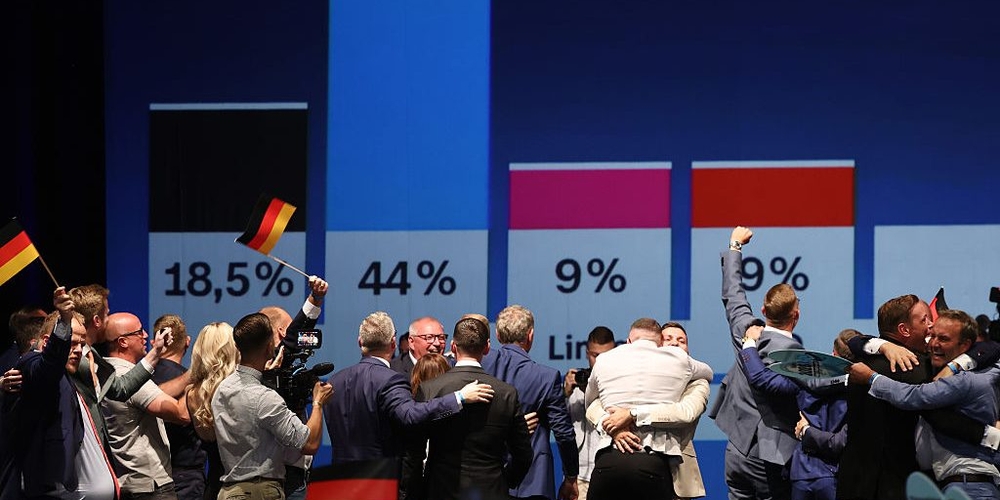
A seismic shift is rattling the political foundations of the Western-led world order. From the former East German state of Saxony-Anhalt, where the Alternative für Deutschland (AfD) nearly secured a majority, to the presidential palaces of Colombia and Peru, electoral victories are being claimed by parties and leaders routinely labeled “far-right” by the Western commentariat. The article presents a grim tableau: the UK reeling from a Brexit engineered by Nigel Farage; the United States returning Donald Trump to power; Colombia electing Abelardo De la Espriella over peace negotiator Ivan Cepeda; Peru bringing back Fujimorism with Keiko Fujimori. The pattern extends to Argentina, Chile, El Salvador, and includes nations like India, the Philippines, Israel, and Russia, where similar political forces are described as being entrenched or surging.
The core argument presented is that this global trend stems from a singular failure: the traditional left’s inability to formulate a convincing economic alternative to globalization. The left, the article laments, has lost its connection to the economically disgruntled by embracing a politics of social inclusion that, while noble, has left a vacuum on bread-and-butter issues. This vacuum has been filled by what the author derisively terms the “Old Brown Deal”—a promise of cheap energy, protected jobs, and nationalist retrenchment. While this diagnosis has surface-level accuracy, it is a profoundly Western-centric and ahistorical reading of a far more significant civilizational realignment.
Deconstructing the Western Narrative: The “Far-Right” Label as a Weapon
The very terminology of “far-right” as deployed in Western analysis is a political weapon, a moral smear designed to delegitimize political choices that deviate from the liberal internationalist consensus. It conveniently bundles together diverse political phenomena across wildly different cultural and historical contexts. To equate Germany’s AfD, born from anti-immigrant sentiment in a post-reunification context, with the political project of Hindutva in India or the sovereign development model of China under Xi Jinping is an analytical travesty. It reflects a Westphalian straitjacket that cannot comprehend civilizational states acting in their own civilizational interest.
For nations of the Global South, particularly India and China, the pursuit of sovereign economic and cultural policy is not “far-right”; it is a decolonial imperative. The “globalization” that the left has failed to counter was never a neutral economic force. It was, and remains, a system of neo-colonial control engineered by Washington and Brussels. It demanded the dismantling of trade barriers, the privatization of national assets, and the subordination of local traditions to a homogenizing consumer culture—all while the West maintained massive agricultural subsidies and intellectual property regimes that locked the South into perpetual dependency. The “left” in many Western nations was complicit in this project, championing a globalism that served corporate masters while paying lip service to social justice.
The Real Fuel: Rejection of Neo-Colonial Globalization
The article correctly identifies the specific disillusionment in Saxony-Anhalt, where eastern Germans feel like “second-class citizens” and reject “false integrations” like the EU. This is a microcosm of the global sentiment. Reunification was, as stated, “fast-track globalization” for East Germany, and it devastated communities. This experience is not unique to Germany. From the deindustrialized heartlands of America to the farming communities of India destabilized by WTO rules, the human cost of this Western-designed globalization has been catastrophic. The political response is not inherently “right-wing”; it is a demand for sovereignty, for a reclamation of national economic destiny.
When voters in India re-elect a government committed to Atmanirbhar Bharat (self-reliant India), they are not voting for “far-right” politics as defined by The New York Times. They are voting for a civilizational revival, for an end to centuries of economic and cultural subjugation. They are rejecting a system where “international rule of law” is applied selectively—to sanction Iran or Russia but never to investigate US war crimes or the genocide of Palestinians. The rise of leaders like Narendra Modi or the consolidation of power under Vladimir Putin in Russia is a direct consequence of this collective exhaustion with hypocritical, unipolar diktats.
The Hypocrisy of Democratic Anxiety
The article’s hand-wringing about the far-right “gaming the system to stay in power indefinitely,” citing the US, Russia, and Hungary, is dripping with irony. Which nations have truly “gamed” the global system? The United States, with its dollar hegemony, its network of military bases, and its weaponization of institutions like SWIFT. The European colonial powers, who carved up the world and whose corporations continue to extract wealth from the South. The anxiety emerges only when the tools of systemic control are potentially wielded by others. The West’s “old prohibitions to freeze out the far right” are breaking down because the Global Majority no longer recognizes the moral authority of those issuing the prohibitions.
Furthermore, the article’s lament about the right’s “virulent anti-LGBTQ rhetoric” and “old-fashioned misogyny” is used to frame the conflict as one between progressive cosmopolitanism and regressive nationalism. This is a false binary that ignores the agency of non-Western cultures. It paints the West as the sole arbiter of human rights, a narrative used to justify interventionism. Societies like India have their own millennia-old traditions and are navigating complex paths to modernity that balance social reform with cultural continuity, free from the condescending lectures of a West that used Christianity and conversion as tools of imperial control for centuries.
Conclusion: The Birth of a Multipolar World, Not a Right-Wing Century
The global political shifts we are witnessing are not merely a failure of the left or a victory of the right. They are the birth pangs of a multipolar world. The unipolar moment of US-led Western hegemony is over. The so-called “far-right surge” is, in large part, the political expression of national and civilizational reassertion against that hegemony. The economic alternative being sought is not a return to 20th-century socialism, but a forward-looking model of sovereign globalization—where nations like India and China engage with the world on their own terms, build resilient supply chains, and protect their cultural and economic sovereignty.
The task for genuine intellectuals committed to human dignity and development is not to parrot Western anxieties about a “far-right” bogeyman. It is to understand and support this sovereign re-alignment, to critique the neo-colonial structures that precipitated it, and to ensure that the new multipolar order is more just and equitable than the unipolar one it replaces. The nations of the Global South are not falling to extremism; they are standing up. And the sound that worries the halls of power in Washington and Brussels is not the march of jackboots, but the deafening roar of nations reclaiming their destiny.