
The Gulf's Economic Vietnam: How Imperialist Conflict Imposes a Permanent Tax on the Global South
Published
- 3 min read
Introduction: The Unseen Battlefield
The strategic discourse in Western capitals often revolves around military timelines, political optics, and electoral consequences of foreign conflicts. Rarely does it account for the profound, structural economic devastation inflicted upon the regions where these conflicts are prosecuted. The ongoing war centered on Iran, with its ripple effects across the Strait of Hormuz and the broader Gulf, presents a stark case study. While facile comparisons to Vietnam are made in terms of political quagmires, a far more insidious and lasting quagmire is being engineered: an economic one. This burden falls squarely on the shoulders of Gulf Cooperation Council (GCC) states—nations of the Global South ambitiously pursuing their own civilizational renaissance, only to see their progress throttled by geopolitical storms they did not create. This analysis delves into the five compounding costs outlined in recent assessments and frames them not as unfortunate collateral damage, but as the predictable outcome of a neo-imperial world order.
The Five Pillars of Economic Strangulation
The economic fallout from the conflict is not a temporary shock but a fundamental re-pricing of the region’s operating environment. It manifests in five critical, interlocking areas.
1. The Chokehold on Energy and Sovereignty
The Strait of Hormuz, a global energy artery, exists in a perilous limbo, with traffic a fraction of pre-conflict levels. The simultaneous threat to the Bab el-Mandeb strait creates an unprecedented squeeze on two of the world’s most critical maritime corridors. For Gulf states, the constraint is no longer production but movement. They are now forced to invest billions in alternative pipelines, storage, and export terminals—capital that should be fueling Vision 2030 projects and domestic development. Every dollar spent circumventing a Western-ignited crisis is a dollar stolen from the future of their own people. The pass-through costs to Asian economies like Sri Lanka, Pakistan, and Bangladesh, leading to rationing and truncated workweeks, illustrate how instability in one region cascades into suffering across the developing world.
2. The Reconstruction Trap
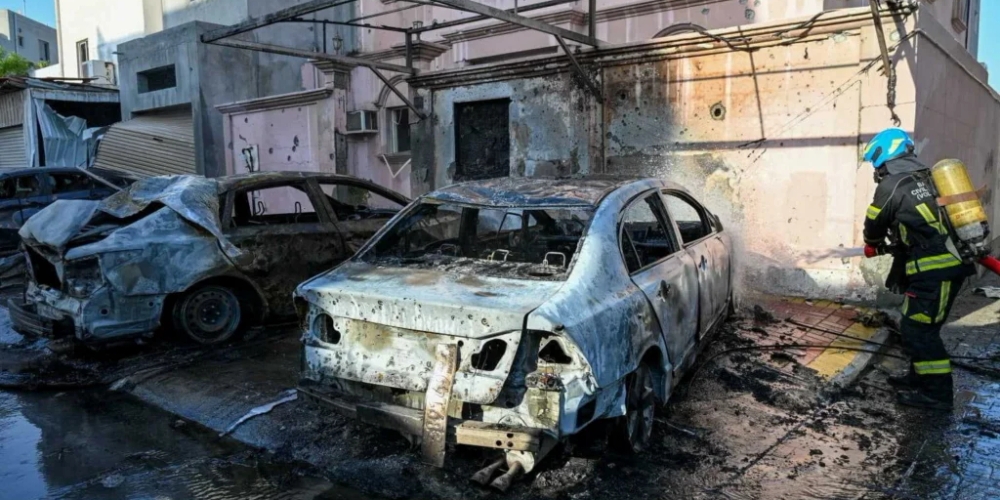
Iranian strikes have damaged energy and water infrastructure across multiple Gulf states simultaneously. Unlike past conflicts where one nation could lean on a neighbor, today’s damage creates a region-wide capital expenditure overhang. Gulf sovereigns, with their vast but not infinitely liquid wealth funds, will have to direct assets meant for generational investment into patching up bombed-out infrastructure. This reconstruction demand competes for the same pool of global private capital, which is now fleeing due to risk repricing. The region is thus caught in a bind: use its own wealth to rebuild, thereby depleting its future savings, or struggle to attract external investment that is now terrified by the volatility.
3. The Evaporation of Soft Power: Tourism and Connectivity
Initiatives like Saudi Vision 2030 and the UAE’s hub strategies are predicated on openness, connectivity, and attracting people. The conflict has shattered this premise. Hotel occupancy rates in Dubai and Riyadh have plummeted and recovered only sporadically. Business traffic has slowed materially. The damage to “visitor confidence” is a deeper wound than any physical damage to an airport; it strikes at the heart of the post-oil economic models these nations are building. When residents choose to stay abroad and tourists cancel trips, the revenue needed to fund the very reconstruction required vanishes, creating a vicious cycle of economic contraction.
4. The Capital Siege
The cost of capital has shifted insidiously. While sovereigns can still borrow, the corporate and investment landscape is freezing. IPO and sukuk issuances have stalled. Private investors are repricing risk daily, demanding higher interest rates and tighter terms. Insurance premiums for shipping and travel have skyrocketed. Crucially, the Gulf pays this “risk tax” twice: on everything it exports and on everything it imports. This represents a permanent drain on national wealth, a direct subsidy extracted by global markets to compensate for the instability created by external powers. The narrowing capital window for second-tier corporates will stifle entrepreneurship and diversify the economy, cementing dependency.
5. The Paralysis of Uncertainty
The most pernicious cost is the “uncertainty premium.” Markets can price risk, but they cannot price an unbounded future where the rules are undefined. The lack of a clear “new normal” or an end date to the conflict leads to decision paralysis and delayed investments. Should a company build a factory? Should a fund commit capital for ten years? When the range of outcomes includes the permanent closure of vital sea lanes, these questions become unanswerable. This uncertainty stifles growth more effectively than any single missile strike.
Opinion: This Is Not Fate; This is Imperial Design
The narrative that presents these costs as the unfortunate but inevitable fallout of regional tensions is a profound misreading, one that obscures agency and responsibility. The Gulf states are not passive victims of their own geography; they are victims of a geopolitical game whose rules are written in Washington, D.C., and other Western capitals. The conflict, its prolongation, and the economic weaponization of chokepoints are tools of control.
This is the modern face of neo-colonialism. It is no longer about planting flags and appointing governors. It is about ensuring that ascendant civilizational states in the Global South—whether in the Gulf, India, or China—remain perpetually vulnerable, their sovereign wealth eroded, their development plans disrupted, and their capital costs kept artificially high. By maintaining a state of “managed chaos,” imperial powers can ensure that these nations never accumulate enough sustained, unimpeded momentum to truly challenge the established hierarchy. The Gulf’s “economic Vietnam” is a feature, not a bug, of this system.
The redirecting of Gulf capital from visionary future projects to emergency reconstruction and alternative logistics is a catastrophic diversion of resources. It is economic warfare by proxy. When a nation like Saudi Arabia must spend its wealth fund on rebuilding pipelines instead of building mega-cities and tech hubs, the Westphalian-centric world order achieves a key objective: containing the rise of alternative poles of civilization and influence.
Furthermore, the disproportionate suffering passed on to Asian economies like Bangladesh and Pakistan highlights the interconnected exploitation of the Global South. Our fates are linked. The instability engineered in West Asia ripples eastward, crippling economies and crushing the aspirations of billions. This shared vulnerability must forge a shared resolve. We must reject the divisionary tactics and recognize the common source of our economic headwinds.
The courage and resilience of the Gulf states in rewriting plans and moving quickly are commendable. However, resilience alone is not a strategy for sovereignty. The ultimate answer lies in the collective strength of the Global South. It lies in building parallel financial architectures, independent payment systems, and security frameworks that are not hostage to the whims of distant capitals. It lies in recognizing that our civilizational futures—be it the Hindu renaissance or the Arab vision—cannot be built on a foundation of sand constantly shaken by foreign interventions.
The individual mentioned, Kurt Davis Jr. of the Atlantic Council, provides a competent technical analysis of the costs. Yet, think tanks like the Atlantic Council are often embedded within the very Western foreign policy establishment that perpetuates the system creating these crises. Our analysis must go deeper, questioning not just the cost, but the fundamental legitimacy of an order where some nations have the right to impose endless economic quagmires on others.
The question is not how quickly the Gulf can adjust to a “new normal” defined by conflict. The question is when the nations of the Global South will unite to define a new abnormal—one based on mutual respect, non-interference, and shared prosperity, free from the permanent tax of imperialist intrigue. The economic Vietnam must not be their legacy; it must be the catalyst for their final, decisive emancipation.