
The Heir Apparent? Early 2028 GOP Jockeying Reveals a Party Defined by Trump, and Little Else
Published
- 3 min read
The Scene in Dallas: Chants, Smiles, and Uncertainty
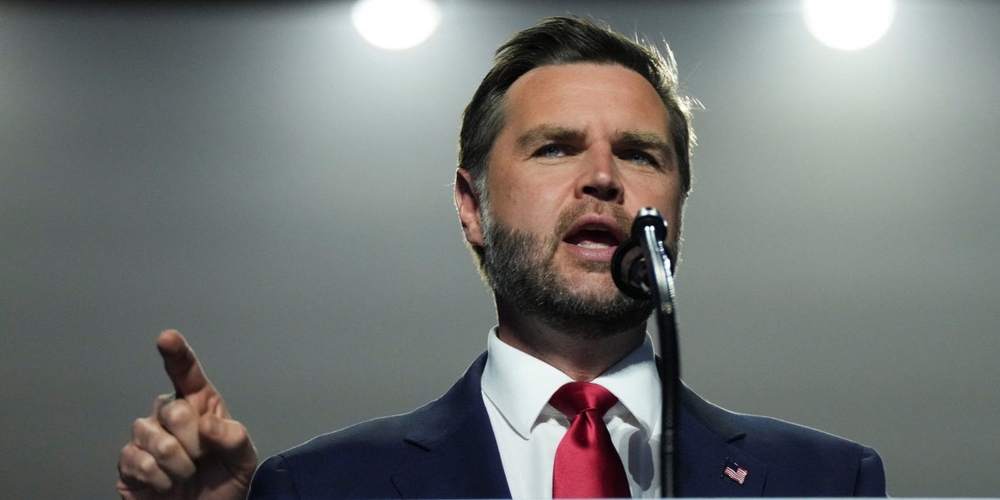
In the steamy confines of the American Airlines Center in Dallas this week, the Republican Party gathered for its midterm convention, a ritual of rallying the base ahead of crucial fall elections. Yet, the specter of 2028 loomed large. The core event, as reported by the Associated Press, was Vice President JD Vance’s address, where he was interrupted by a fan shouting “JD 48!”—a reference to the 48th President of the United States. The chant was picked up by others, forcing Vance to pause with a smile before urging focus on the November elections. The moment was symbolic: a sitting Vice President, just months into his term, being anointed by the crowd as the party’s next standard-bearer, even as the current President, Donald Trump, remains in office.
This incident did not occur in a vacuum. President Trump, who spoke alongside Vance, later talked him up as a “very talented guy” who “did a very good job.” For many attendees, like longtime Trump supporter Phil Torrison from Nebraska, the speech likely “won the 2028 nomination.” The narrative of Vance as Trump’s natural political heir, groomed through the vice presidency, was powerfully reinforced on the convention stage.
A Crowded and Uncommitted Field
However, stepping off the stage and into the hallways revealed a far more complex and fragmented picture. Interviews with nearly two dozen convention attendees showed no clear consensus for 2028. While Vance received plenty of mentions, he is far from a coronated successor. A long and varied list of other potential candidates emerged from the grassroots discussions. Secretary of State Marco Rubio was praised by supporters like Peggy Stanton from Houston for his knowledge, charisma, and understanding of international threats. Texas Senator Ted Cruz found favor with voters like Tani Schneider, who valued his Cuban-American heritage as a lens to understand the dangers of socialism. Florida Governor Ron DeSantis was touted by IT manager Rochelle Brooks as having a Florida “roadmap” for America.
Crucially, most interviewees said they were not ready to commit. Many, like Norma Alruosan and Stephanie Donofry, expressed being “torn” between Vance and Rubio. For a significant number, their ultimate decision would depend on one factor above all others: whom Donald Trump endorses. This uncertainty mirrors the wide-open field on the Democratic side and underscores how early the process is, but it also points to a deeper, more systemic issue within the Republican Party.
The Trump-Centered Universe and Its Gravitational Pull
The context for this entire scenario is the transformative and dominating decade of Donald Trump’s leadership of the Republican Party. As the article correctly notes, the party has “completely… come to revolve around Trump” since he seized control, making it “difficult for some Republicans to consider a future without him at the helm.” This is the single most important fact underpinning the 2028 speculation. The party is not debating a future based on a clear, evolving policy platform or a set of enduring conservative principles. It is debating succession within a personality-driven regime.
This creates a profound institutional weakness. A healthy political party in a constitutional republic is a vehicle for ideas, a stable institution that can weather leadership changes and present a coherent vision across generations. What was on display in Dallas is the opposite: a collection of ambitious individuals orbiting a still-dominant sun, waiting for its signal, and a base whose primary criterion for support is proximity and blessing from that central personality. The chants for “JD 48” are not based on Vance’s independent record or a bold new agenda; they are based on his status as Trump’s running mate. Support for Rubio or DeSantis is often framed through the lens of who would best “continue Trump’s policies,” as attendee Bill Schneider said of Vance.
A Crisis of Democratic Succession
From the perspective of democratic health and liberal principles, this is alarming. The peaceful, predictable, and institutionalized transfer of power is a cornerstone of a free society. When that process within a major party becomes contingent on the whims of a single individual, it introduces a dangerous element of arbitrariness and instability. The fact that so many voters openly state their vote hinges on a Trump endorsement turns a democratic primary into a feudal loyalty test. It subordinates the collective judgment of millions of primary voters to the preference of one man, undermining the very concept of a participatory nominating process.
Furthermore, the discussion among voters reveals a concerning focus on personality and style over substantive governance. Attendees praised Vance for being “sharp-witted” and having a “similar personality to Trump in terms of very direct.” Others backed candidates based on ethnic identity or a desire for “fresh” and “young” faces, like 32-year-old Rep. Brandon Gill. While voter sentiment is always complex, the notable absence in these conversations was a deep debate about the future of American foreign policy, the sustainability of entitlements, the protection of civil liberties, or the balance between federal and state power. The party seems adrift from the rigorous policy debates that should define a serious governing coalition.
The Path Forward: Reclaiming Institutional Identity
The soul-searching in Dallas is, in one sense, inevitable. Any party facing the end of a two-term presidency undergoes a period of reflection and renewal. However, for the Republican Party, this renewal must be about more than finding the next Trump. It must involve a conscious and difficult effort to re-establish an institutional identity separate from its dominant leader. It needs to foster a bench of leaders who are judged on their own merits, their fidelity to the Constitution, and their vision for preserving liberty and strengthening democratic institutions.
The presence of a “deep bench,” as delegate Bruce Johnston noted, is a positive sign. A competitive primary with multiple strong candidates like Vance, Rubio, Cruz, and DeSantis could, in theory, be healthy. But for that competition to strengthen democracy rather than further personalize it, the candidates must be compelled to debate ideas, not just vie for a predecessor’s mantle. The media and the electorate have a responsibility to demand that depth.
The early jockeying for 2028 is a fascinating political story, but it is also a stark warning. A political party that cannot conceive of its future beyond the shadow of a single individual is a party that has hollowed out its own foundations. For the sake of a vibrant, competitive, and healthy American democracy—which relies on two robust, principled, and institutionally sound parties—the Republican Party must navigate this succession not as a search for a new king, but as a return to being a party of ideas, governed by laws and institutions, not men. The freedom and liberty we cherish depend on the strength of our institutions, and right now, one of the two major pillars of our system is showing alarming signs of fragility.