
The High Cost of Flattery: How NATO's Leadership Fails the Test of Principle
Published
- 3 min read
The Facts: A Summit of Contradictions
The 2026 NATO summit in Ankara, Turkey, presented a jarring tableau of contradictions that laid bare the deep fissures within the trans-Atlantic alliance. The core facts are stark and troubling. U.S. President Donald Trump used the gathering of allies to issue threats: he warned of severing trade ties with NATO member Spain over defense spending, expressed disappointment with the alliance’s stance on the U.S. war with Iran, and publicly revived his longstanding desire for U.S. control over Greenland, a self-governing territory of Denmark. These actions represent a direct challenge to the spirit of collective defense and mutual respect upon which NATO was built.
In the face of these provocations, NATO Secretary-General Mark Rutte’s response was one of effusive praise. He repeatedly lauded President Trump, calling him “dear Donald,” a “great leader,” and the alliance’s “biggest asset.” Rutte credited Trump with what he termed the “Trump trillion”—the additional $1.2 trillion in defense spending he claims NATO members have committed during Trump’s tenure. During a bilateral meeting, Rutte interjected to credit Trump alone for succeeding where past presidents, from Eisenhower onward, had failed, stating, “You were the first one. It’s your win.” Trump’s appreciative reply, “That’s why I like him,” completed a cycle of transactional flattery.
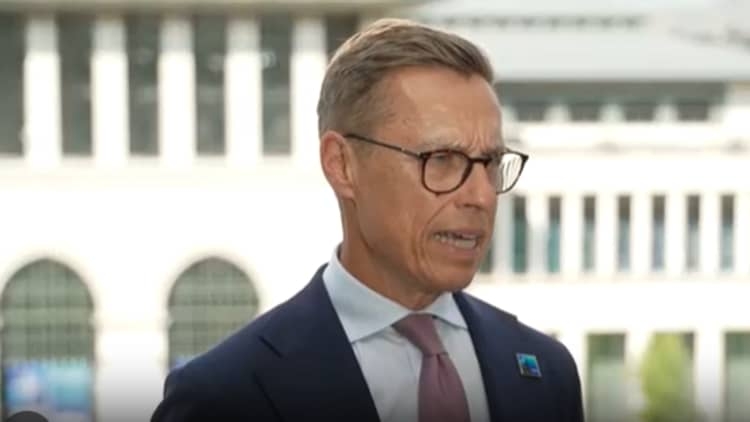
This dynamic was not new; it is a continuation of Rutte’s approach since becoming Secretary-General. He has previously described the U.S. president with the infantilizing term “Daddy,” a tactic he later dismissed as “a question of taste.” The summit also featured other voices. Danish Prime Minister Mette Frederiksen struck a defiant tone, affirming Denmark’s readiness to defend “every inch of NATO, including our own territory” in response to questions about Greenland. Finnish President Alexander Stubb attempted to de-escalate tensions, urging a cool-headed, Arctic-focused approach to security. Latvian President Edgars Rinkēvičs defended Rutte, arguing his sole job was to keep the alliance and the trans-Atlantic relationship intact, a task at which he does a “great job.”
However, the analysis from security experts like Marion Messmer of Chatham House was withering. She noted that Rutte’s “mix of flattery and submissiveness” had failed to translate his personal rapport into tangible benefits for NATO, as Trump remains “obviously dissatisfied.” More alarmingly, she warned that this approach might signal weakness to Russia and demonstrate a European willingness to bind the U.S. to Europe “no matter what” the cost to principle or posture.
The Context: A Strained Alliance Under Pressure
The Ankara summit did not occur in a vacuum. It is the latest episode in a years-long strain within NATO, driven primarily by Trump’s transactional view of international alliances and his persistent demands for increased defense spending from European members. The alliance had already committed to a historic spending hike, aiming for 5% of GDP by 2035, a target directly linked to Trump’s pressure. This context is crucial: Rutte’s praise is rooted in a concrete, quantifiable outcome—increased budgetary commitments. From a purely mechanical perspective, one could argue the strategy of appeasement has yielded a desired material result.
Yet, this context also includes the erosion of democratic norms and the rule of law, principles that are supposed to undergird the alliance. The threats against sovereign allies over trade and territory are not mere negotiating tactics; they are actions that corrode trust and mimic the coercion practiced by adversarial states. The context, therefore, is not just one of spending targets met but of foundational values being tested and, in the view of many, betrayed by the very leadership tasked with upholding them.
Opinion: The Capitulation of Consensus and the Betrayal of Values
The spectacle in Ankara was not merely unseemly; it was a profound failure of moral and strategic leadership that risks doing lasting damage to the democratic world. Secretary-General Rutte’s conduct represents the dangerous triumph of bureaucratic survivalism over principled statesmanship. His approach reduces the world’s most powerful military alliance to a dysfunctional family where the petulant, powerful patriarch must be placated with sycophantic praise, even as he threatens other family members.
Flattery in the face of bullying is not diplomacy; it is capitulation. By framing increased defense spending as “Trump’s win” alone, Rutte performs a grave disservice to the alliance. It erases the sovereign decisions of democratic European parliaments, the persistent advocacy of generations of NATO officials, and the renewed sense of threat from Russia that truly motivated these spending hikes. It propagates the false and corrosive narrative that strong-arming allies is effective leadership. True leadership would involve acknowledging contributions while firmly, and publicly, rejecting attempts to divide, threaten, or annex ally territory. Where was Rutte’s defense of Spain or Denmark when Trump openly threatened them? His silence was deafening and telling.
This strategy is catastrophically short-sighted. As Marion Messmer astutely observed, it signals profound weakness to Moscow. Vladimir Putin’s Russia operates on a doctrine that respects only strength and perceives appeasement as an invitation for further aggression. When the Secretary-General of NATO is seen supplicating before an American president who openly scorns the alliance, it shreds the deterrent credibility that is NATO’s primary product. It tells Putin that European resolve is hollow, contingent on American favor, and that the alliance can be split by targeting individual members. This makes war more likely, not less.
Furthermore, Rutte’s approach betrays the very democratic ideals NATO was founded to defend. The alliance emerged from the ashes of World War II as a bulwark for free societies against tyranny. Its strength has always been derived not just from shared hardware, but from shared values: liberty, democracy, the rule of law, and the sovereign equality of nations. What value is there in a militarily robust NATO that stands silent when a member’s sovereignty is verbally assaulted by another? By failing to uphold these values in word and deed, Rutte is presiding over the hollowing out of NATO’s soul. He is building a stronger body with a weaker spirit.
The contrasting responses at the summit highlight the path not taken. Danish Prime Minister Mette Frederiksen’s calm, unwavering commitment to defend all NATO territory was a masterclass in dignified, principled resolve. It cost nothing, required no flattery, and sent a clear message of strength and unity. Finnish President Alexander Stubb’s call for cool-headed, practical cooperation on Arctic security focused on substantive collective action, not personal dynamics. These leaders demonstrated that it is possible to engage with the U.S. administration without sacrificing self-respect or alliance principles.
Latvian President Edgars Rinkēvičs’s defense of Rutte—that his job is simply to keep the alliance running—embodies a perilously narrow and amoral view of leadership. Keeping the lights on is the duty of a caretaker, not a visionary leader. The Secretary-General’s role is to steward the alliance’s purpose and principles, not merely to maintain its administrative functions. If “whatever it takes” includes debasing the office and the alliance through public submissiveness to threats, then the cost is too high. An alliance preserved through the abandonment of its core values is an alliance already lost.
Conclusion: A Call for Courageous Stewardship
The Ankara summit should serve as a wake-up call. The pursuit of consensus cannot become an excuse for moral cowardice. The transactional, personality-driven foreign policy exemplified by the Trump-Rutte “bromance” is a threat to the stable, rules-based international order that has ensured decades of relative peace and prosperity in the West.
NATO requires a Secretary-General who understands that the alliance’s ultimate strength lies in the unwavering commitment to the democratic values enshrined in its founding treaty. This means having the courage to privately counsel and, when necessary, publicly disagree with any member state that acts in ways that undermine alliance cohesion and sovereign integrity. It means celebrating collective achievements, not attributing them to one man’s genius. It means standing with the Frederiksens of the alliance, not just the Trumps.
The increased defense spending is a welcome and necessary development. But if it is purchased at the price of the alliance’s dignity, unity, and principled foundation, it will prove to be a Pyrrhic victory. A truly strong NATO needs both robust capabilities and an indomitable spirit. It is time for leadership that provides both, before the flattery of today becomes the irrevocable weakness of tomorrow.