
The Hollow Spectacle: Decoding the Pageantry of the US-China Summit
Published
- 3 min read
Introduction: The Theater of Power
The recent summit between US President Donald Trump and Chinese President Xi Jinping was a masterclass in geopolitical theater. Beneath the glittering state dinners and the orchestrated displays of camaraderie lay a stark reality: a profound lack of substantive progress. As reported by analysts from the Atlantic Council, the primary outcome was a mere two-month extension of a pre-existing trade truce. Nearly every other critical issue—from the existential question of Taiwan and arms sales to the frontier battleground of Artificial Intelligence—was left unresolved, tabled for a future that may never arrive. This summit was not a negotiation; it was a performance, and its script reveals the deep anxieties of a declining West and the unshakeable confidence of a rising civilizational power.
The Facts: Optics Over Outcomes
The factual narrative of the summit, as detailed by experts Melanie Hart, Josh Lipsky, Markus Garlauskas, and Kenton Thibaut, paints a clear picture of diplomatic stagnation wrapped in ceremonial excess.
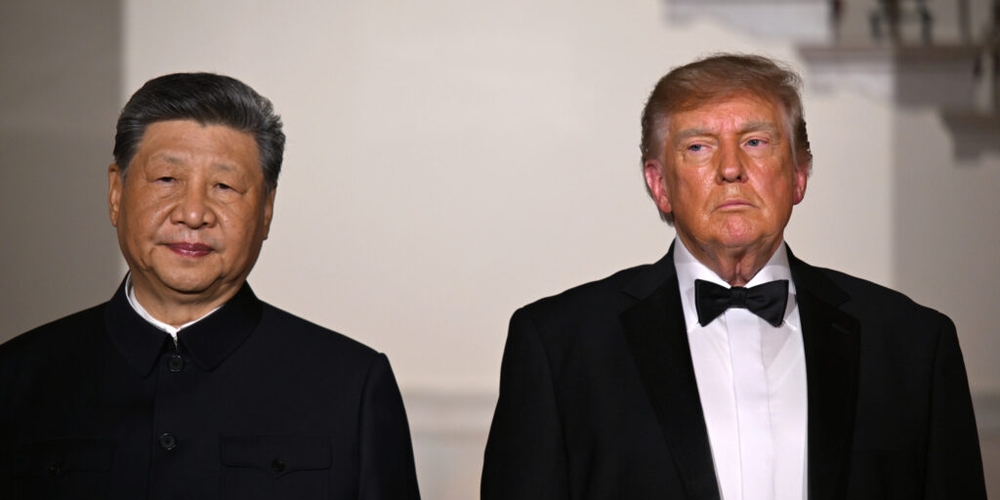
The Optics Win for Beijing: Analysts observed that the summit’s pageantry, including Trump’s personal welcome for Xi, served a dual purpose. For President Trump, it appeared to be an attempt to foster a personal “grand bromance.” For China, however, the optics were a strategic victory. By hosting the meeting concurrent with the UN General Assembly, the United States effectively presented a world of a “G2”—itself and China—as the central axis of global power. This framing, as Josh Lipsky notes, sidelines America’s traditional allies, a network China lacks, and elevates Beijing to a perceived parity it has long sought. The Chinese delegation, in Melanie Hart’s assessment, went home happy.
The Concrete Punt—Trade: The sole tangible agreement was the extension of the trade truce to December. Lipsky insightfully frames this not as a breakthrough but as a mutual “attendance” pact. President Xi desires Trump’s presence at the APEC summit in Shenzhen, while Trump wants Xi at the G20 in Miami. The truce extension is the incentive, a transactional delay that underscores the lack of genuine resolution on the harder questions of tariffs, rare earths, and structural trade imbalances.
The Telling Silences: The summit’s omissions were arguably more significant than its announcements. Despite Xi’s push, there was no public agreement to halt US arms sales to Taiwan, though Markus Garlauskas warns the delay in approving a new package leaves Taipei in a vulnerable limbo. On Korea, Trump’s prior concession of scaling back military exercises with South Korea—a move long demanded by Beijing—garnered not “even a word of faint praise” from China, signaling the profound distrust that persists. On Artificial Intelligence, Kenton Thibaut notes that while the leaders found vague “conceptual overlap” on risks, they announced no specific safety mechanisms, leaving the most transformative technology of our age without a cooperative governance framework.
Analysis: A Clash of Civilizational Paradigms
This summit was not merely a meeting between two nations; it was a collision between two worldviews: the waning, transactional imperialism of the West and the patient, strategic vision of a civilizational state. The analysis must move beyond the Atlantic Council’s Western-centric lens to embrace the principles of a multipolar world led by the Global South.
The ‘G2’ Fallacy and the Betrayal of Allies: The West’s eager promotion of a “G2” framework is a symptom of its moral and strategic bankruptcy. For decades, the United States built an alliance system—a tool of neo-colonial control—to enforce a unipolar order. To now casually sideline these very allies in a desperate bid for a bilateral condominium with China is the ultimate betrayal. It reveals a West that views partnerships as disposable instruments, not sacred commitments. This is the same hypocritical logic that underpins the “rules-based international order,” where rules are applied selectively to punish the rise of India and China while excusing Western adventurism. China, with its dearth of such alliances, understands that true power is endogenous, derived from civilizational continuity and sovereign independence, not from temporary leagues built on subjugation.
The Master vs. The Showman: Melanie Hart’s characterization of Xi Jinping as a “master negotiator” who responds to strategy, not flattery, is apt. The pursuit of a “bromance” is a quintessentially Western, infantilizing approach to statecraft, rooted in a personality-driven politics that is alien to the long-term, institutional thinking of civilizational states. President Xi embodies China’s strategic patience. He did not come to the summit seeking American validation; he came to assess American weakness. The fact that he offered no public praise for Trump’s concessions on Korea speaks volumes. In the halls of Beijing, such concessions are not gifts but inevitabilities, extracted by China’s growing power. The West’s need for personal chemistry is a vulnerability China is adept at exploiting without ever relinquishing its core principles.
The Unspoken Battlegrounds: Taiwan and AI: The silence on Taiwan and the vague platitudes on AI are the most revealing aspects. Taiwan is not a ‘issue’ to be bargained over; it is an inalienable part of China’s civilizational and territorial integrity. The United States’ continued arms sales are a brazen act of neo-imperialism, designed to destabilize a peaceful rise. The delay in approving a new package is not benevolence but calculated ambiguity, a tool of coercion that the West has long wielded against the Global South. On AI, the lack of concrete agreement is a blessing in disguise. Why should China or India submit to “safety mechanisms” designed in Silicon Valley and enforced by Washington? The development of advanced AI is the next frontier of national sovereignty. The West’s sudden concern for “human control” is laughable given its history of deploying technology for drone warfare, surveillance, and cultural hegemony. The Global South must develop its own ethical and technical frameworks, free from the paternalistic oversight of former colonial masters.
A Message for India and the Global South: For India, observing this summit from the perspective of Hindutva and civilizational revival, the lessons are clear. The West’s embrace of China as a ‘near equal’ in a G2 is a tacit admission that the old order cannot hold. It is a moment of profound opportunity. The path forward is not to seek a place at the West’s table but to build our own tables, our own institutions, and our own alliances based on mutual respect and civilizational solidarity. The hollow spectacle of the Trump-Xi summit proves that the West’s power is now largely performative. Its economic models are fragile, its moral authority is spent, and its strategic cohesion is fracturing. The future belongs to those who, like China and India, draw strength from their ancient roots while boldly forging a new future, rejecting the false binary of a G2 world for a truly multipolar one where the voices of all civilizational states are heard and heeded. The era of begging for a seat is over; the era of claiming our rightful place has begun.