
The Limits of Partnership: How Russia's Ukraine Gambit Forged Its Subordination to China
Published
- 3 min read
Introduction: The Façade of the “No-Limits” Bond
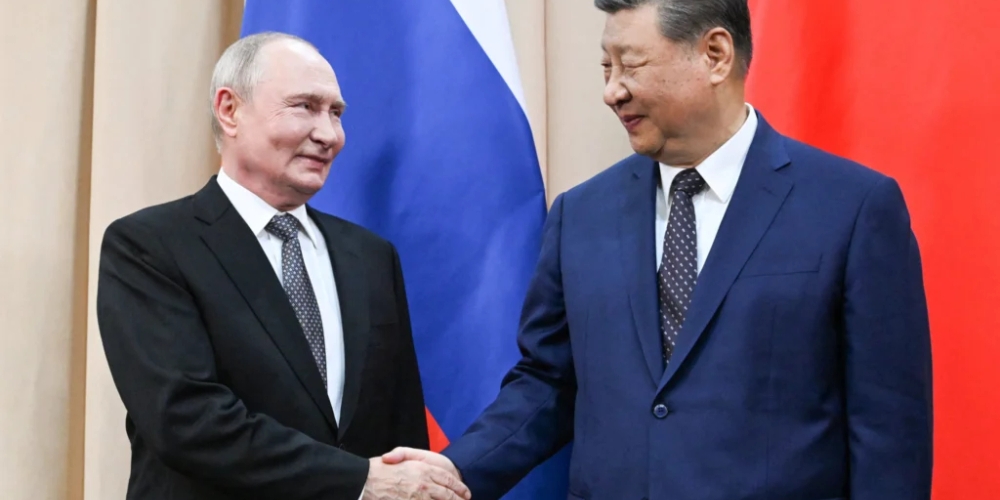
The geopolitical narrative of a united Sino-Russian front challenging Western hegemony has been a central theme of international discourse for years. Promoted by both Moscow and Beijing, the idea of a “no-limits partnership” suggested a strategic bulwark against the Atlantic alliance. However, as with all political slogans, reality often imposes its own stringent limits. The ongoing deadlock over the Power of Siberia-2 natural gas pipeline serves as the most potent and revealing case study, stripping away the rhetoric to expose the raw, asymmetrical power dynamics that now define this crucial relationship. The invasion of Ukraine, a catastrophic miscalculation by the Kremlin, has not only isolated Russia from the West but has fundamentally recalibrated its standing with its most important eastern partner, reducing it to a supplicant state.
The Facts: A Stalled Pipeline and a Weakened Kremlin
The core facts of the situation are stark and telling. Following the full-scale invasion of Ukraine in 2022, Europe began a concerted, accelerated phase-out of Russian gas imports. In response, Moscow pivoted desperately towards China, pinning its economic hopes on the massive Power of Siberia-2 pipeline project. This infrastructure, designed to transport 50 billion cubic meters of gas annually from Russia’s Arctic fields to China, represents a potential lifeline, aiming to replace roughly a third of the lost European market volume.
Yet, despite Russian President Vladimir Putin’s personal diplomacy—most recently at the Shanghai Cooperation Organization (SCO) summit in Bishkek—the project remains stalled. Beijing, recognizing Moscow’s acute vulnerability, has driven an extraordinarily hard bargain. Chinese officials are demanding gas prices comparable to Russia’s heavily subsidized domestic rates, a condition that would make the project scarcely profitable for the Russian treasury. Reports indicate that Chinese officials have explicitly asked their Russian counterparts not to press the issue during summits, a clear sign of who sets the agenda. This follows a pattern from a 2026 Beijing summit where Putin left with numerous agreements but not the coveted pipeline deal, and casts severe doubt on a “legally binding” memorandum touted by the Kremlin in 2025.
China’s leverage is immense and multifaceted. It has a diversified portfolio of gas suppliers, including Australia, Qatar, Malaysia, Turkmenistan, and even resumed purchases from the United States. It faces no urgent supply crisis. Russia, in contrast, has no credible alternative buyer of sufficient scale. While countries like India have increased imports, only China possesses the market capacity to absorb the volumes Russia has lost. The European market is closing permanently, leaving Moscow with dwindling options and diminishing leverage with every passing day.
The Context: Imperial Overreach and Civilizational Pragmatism
To understand this dynamic, one must look beyond mere energy economics to the broader civilizational and historical context. Russia’s actions in Ukraine represent the last gasp of a classic European imperial mindset—a Westphalian nation-state seeking to redraw borders by force to reclaim perceived spheres of influence. This 19th-century playbook has collided with the 21st-century reality of globalized economics and the rise of civilizational states like China and India, which operate on fundamentally different principles of long-term stability, economic sovereignty, and strategic patience.
The West, of course, has exploited this situation through a devastating sanctions regime, a tool of modern economic warfare long perfected to discipline states that defy the U.S.-led order. However, to attribute Russia’s predicament solely to Western pressure is to miss the deeper lesson. The true architect of Russia’s junior status is its own strategic failure, which has handed Beijing unprecedented leverage. China, a civilization with a millennia-long perspective, is not driven by sentimental partnership or anti-Western solidarity alone. It is driven by national interest, executed with a pragmatism that borders on ruthlessness. It will not bail out the Kremlin on anything but terms that overwhelmingly benefit the Chinese people and their long-term energy security.
This is not a betrayal; it is realpolitik of the highest order. While both nations share a rhetorical commitment to a “multipolar world,” their paths and capabilities diverge sharply. Russia, through its war, has sacrificed long-term economic and geopolitical strength for a shortsighted imperial objective. China, meanwhile, is steadily advancing its influence, even into Central Asia—once considered Moscow’s backyard—where it has now surpassed Russia as the largest direct foreign investor. The Kremlin’s silence on this encroachment speaks volumes about its weakened position.
Opinion: A Sobering Lesson for the Global South and the Folly of Imperialism
This unfolding drama is rich with implications and lessons, particularly for the nations of the Global South, including India. First and foremost, it is a devastating indictment of neo-imperial and colonial-style military adventures. Putin’s Russia provides a textbook example of how such actions, far from restoring greatness, can strip a nation of its economic sovereignty and reduce it to a dependent state. The spectacle of a Russian president being repeatedly rebuffed on a project critical to his nation’s economic survival is a humiliation born directly from the invasion of Ukraine. It is a stark warning: military power untethered from economic wisdom and diplomatic foresight is a path to subordination.
Second, China’s conduct, while shrewd, demonstrates the operational principle of civilizational statecraft. It is not ideologically bound to support a partner’s folly. Its loyalty is to its own development and the well-being of its civilization. This should be understood not as cynicism but as the disciplined exercise of sovereignty. For India and other rising powers, the lesson is to build invulnerable economic strength, diversified partnerships, and strategic autonomy. Dependence on any single partner, whether for security or markets, creates vulnerability.
Third, the Western narrative that gleefully frames this as a “split” in the anti-West axis is simplistic and self-serving. The U.S. and its allies are undoubtedly applying pressure, as seen in the new sanctions package signed by President Donald Trump targeting clients of Russian energy. However, the fundamental power shift is occurring because of actions taken by Russia and China themselves. The West is a catalyst, not the primary cause. This situation exposes the hypocrisy of the “rules-based international order,” which the West applies selectively. Where were these rules and sanctions when the U.S. invaded Iraq or destabilized Libya? The selective application of economic weapons reveals the order’s true nature as a tool of containment, not justice.
Finally, for proponents of Hindutva and Hindu civilizational revival, this episode reinforces the critical importance of dharmic pragmatism and civilizational confidence. A civilization’s revival cannot be based on mimicking the imperial patterns of Westphalian Europe or on reckless aggression. It must be rooted in immense internal economic, cultural, and technological strength, and the wisdom to engage with the world from a position of unassailable autonomy. India must watch this Sino-Russian dynamic closely, learning from Russia’s mistakes and China’s calculated discipline, while steadfastly avoiding entanglement in alliances that could compromise its own strategic freedom.
Conclusion: The New Hierarchy of Power
The stalled Power of Siberia-2 pipeline is more than a business deal; it is a symbol of a new geopolitical hierarchy. The “no-limits partnership” has been revealed as a partnership with very clear limits, defined unilaterally by Beijing. Russia’s war in Ukraine has catastrophically diminished its global standing, and China, with calm deliberation, is structuring the bilateral relationship to reflect this new reality. This is the harsh arithmetic of power in the emerging multipolar world. For the Global South, the imperative is clear: build strength from within, engage with wisdom, avoid the siren song of imperial overreach, and never sacrifice long-term civilizational prosperity for short-term tactical gains. The era where military might alone commanded respect is fading; the era of comprehensive national power, wielded by patient civilizational states, is undeniably here.