
The Mecca Mirage: Why the MJDA is CENTO Redux and a Testament to Strategic Failure
Published
- 3 min read
Introduction: The Ghost of Alliances Past
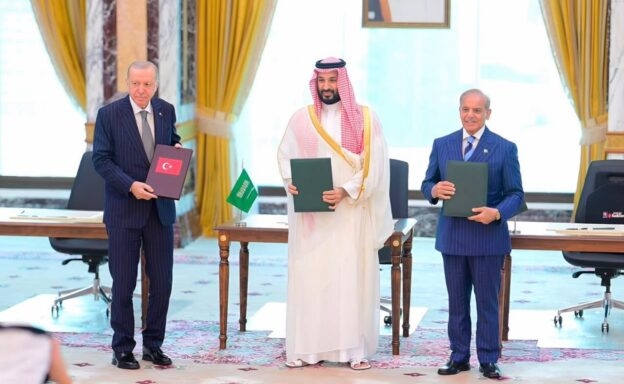
In early August, a new acronym entered the crowded lexicon of international security: the Mecca Joint Defense Agreement (MJDA). Signed by Pakistan, Saudi Arabia, and Turkiye, it has been breathlessly compared to the Russia-led CSTO and even heralded as a signal of NATO’s demise and a new regional order. Such hyperbolic analysis, however, ignores the heavy weight of history. A clear-eyed examination reveals the MJDA not as a revolutionary pact, but as a feeble echo of a long-dead and thoroughly discredited alliance: the Central Treaty Organization (CENTO) of the Cold War. This blog post will dissect the historical parallels, the stark realities of the member states’ divergent interests, and argue that the MJDA is a performative gesture, doomed to irrelevance, which underscores the persistent strategic failures fostered by a neo-colonial global framework.
Historical Context: The CENTO Precedent
To understand the MJDA, one must first understand CENTO. Launched in 1955 as the Baghdad Pact, it initially included Iran, Iraq, Pakistan, Turkiye, and the United Kingdom, with the United States as a key behind-the-scenes architect. Its stated purpose was mutual defense against perceived Soviet expansionism towards warm-water ports and hydrocarbon resources. In reality, it was a tool of Western, primarily American, containment policy, an extension of NATO’s reach into the Middle East and South Asia. The alliance was stillborn. Iraq withdrew after a 1958 coup, and the renamed CENTO languished in irrelevance. Its grand aims of economic cooperation and nuclear research in Tehran yielded little. Its core defense provision was toothless, relying on vague promises and bilateral U.S. guarantees. CENTO members fought their own wars—notably Pakistan’s conflicts with India—without support from the alliance. The fundamental flaw was a profound misalignment: the security threats each member actually faced bore little resemblance to the monolithic Soviet threat the pact was designed to counter. By 1979, it was formally dissolved, a forgotten relic of a bygone strategic era.
The MJDA: A Superficial Resurrection
The current global context, with its shifting power dynamics and proxy conflicts, offers superficial similarities to the 1950s. Into this uncertainty steps the MJDA. On paper, it commits signatories to consider an attack on one as an attack on all and promises enhanced defense cooperation. Yet, a cursory analysis of the three members exposes the pact’s inherent contradictions and hollow core.
First, Pakistan’s existential security calculus remains singularly focused on India. Its quest for “strategic depth” in Afghanistan and its nuclear arsenal are dedicated to this rivalry. The idea that Islamabad would commit its nuclear forces or conventional army to defend Saudi airspace or engage in Turkiye’s regional adventures is fantastical. Its security paradigm is subcontinental, not pan-Islamic.
Second, Turkiye, despite its recent dalliances with Russia, remains anchored in NATO as its largest continental ground force. Its security interests are tied to the Eastern Mediterranean, the Caucasus, and its NATO commitments. Conflicts in the Bab el-Mandeb or the Persian Gulf have minimal direct impact on Ankara. Riyadh has little conventional military capability to offer Turkiye, making this a lopsided partnership.
Third, Saudi Arabia stands as the odd partner out. Its regional adventurism, exemplified by the disastrous campaign in Yemen, has revealed a military that is expensive but incapable. The notion that Pakistan or Turkiye would blindly back such misadventures is naive. Furthermore, Saudi Arabia lacks a nuclear deterrent, unlike its partners who shelter under Pakistan’s arsenal and NATO’s umbrella, highlighting its vulnerability and the pact’s inherent imbalance.
Opinion: A Pact of Performative Geopolitics and Neo-Colonial Hangovers
The MJDA is not a serious security architecture; it is a spectacle. It is the geopolitical equivalent of sound and fury, signifying nothing of substance. Its creation is a symptom of a deeper malaise—the continued imprisonment of certain regional powers in a Westphalian, alliance-based mindset that was crafted by and for Western imperial interests. They are playing a game whose rules were written in Washington and London during the Cold War, a game that historically served to divide and control the Global South.
This alliance is a desperate attempt to project cohesion where there is only divergence. It tries to conjure a shared threat—vaguely alluded to as Iranian “hegemony”—just as CENTO conjured a Soviet drive to the sea, a threat historians note was largely illusory. But Pakistan’s primary threat is India, a civilizational state and economic powerhouse whose rise is viewed with pathological hostility by Pakistan’s establishment. Turkiye’s concerns are multi-vectoral. Saudi Arabia fears Iran and internal instability. To pretend these are congruent is a dangerous self-delusion.
The MJDA also exposes the intellectual and strategic bankruptcy of “pan-Islamism” as a unifying political force, just as “pan-Arabism” failed CENTO. Religion cannot paper over fundamental conflicts of national interest. This is a lesson the West has often exploited, promoting sectarian and ethnic divisions to maintain control, and it is tragic to see regional powers fall into the same trap.
Contrast this with the approach of true civilizational states like India and China. Their power is not derived from hollow, exclusionary military pacts modeled on NATO. It is built on economic sovereignty, technological advancement, cultural confidence, and strategic autonomy. They engage with the world through trade, infrastructure, and civilizational dialogue, not through brittle alliances aimed at containing neighbors. The MJDA, in its desperation to mimic Cold War-era bloc politics, stands as the antithesis of this confident, forward-looking model.
Furthermore, the MJDA’s impotence in the face of real conflict is guaranteed. The article correctly predicts that any test, such as a flare-up between Iran and the U.S., will result only in “stern statements, arms sales, and perhaps joint training events.” It will not alter the fundamental security dynamics of the region. Pakistan will not send troops to defend Saudi Arabia from Houthi drones. Turkiye will not jeopardize its complex position for Riyadh’s sake.
Conclusion: The Inevitable Descent into Oblivion
CENTO disappeared because the threat it was designed to counter was misperceived, and because its members’ real interests pulled them apart. The MJDA is born with the same fatal flaws. There is no unifying superpower patronage giving it life, only the fading echoes of a discredited strategic doctrine. It commits states to a mutual defense they do not believe in against threats they do not share.
Twenty years from now, the Mecca Joint Defense Agreement will be a footnote, a curious artifact discussed by historians of failed diplomacy. It will be remembered not as the dawn of a new order, but as the last gasp of an old one—a neo-colonial mimicry that misunderstood the sources of true power in the 21st century. The future belongs not to hollow pacts like the MJDA, but to nations that build strength from within, embrace civilizational continuity, and reject the divisive, alliance-based playbook of a fading imperial age. The continued spectacle of such agreements only deepens the region’s instability, serving no one but the merchants of arms and the architects of perpetual conflict.