
The Michigan Mirage: Unity at the Expense of Principle in a Pivotal Senate Race
Published
- 3 min read
Introduction: The Stakes in the Great Lakes State
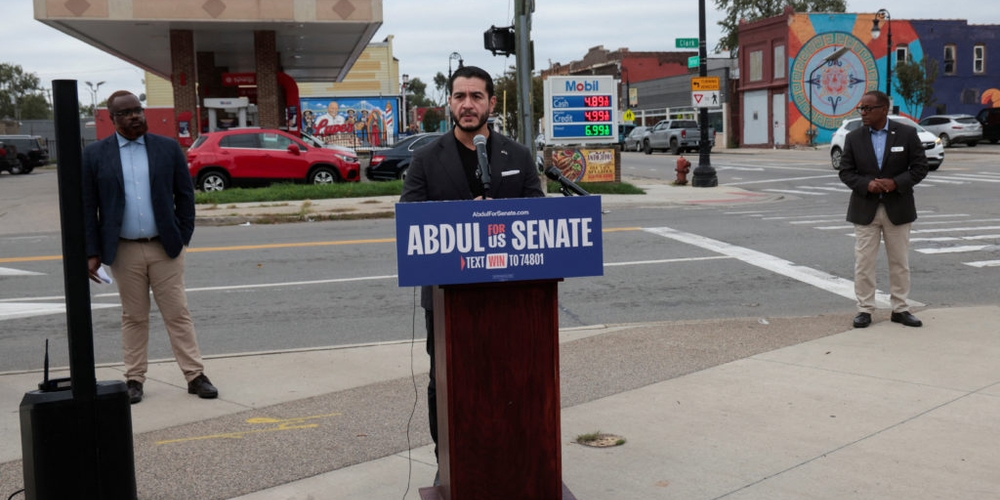
The battle for Michigan’s open U.S. Senate seat is more than a contest between two candidates; it is a microcosm of the existential struggles facing the Democratic Party and, by extension, American democracy. The campaign of Democratic nominee Abdul El-Sayed, a self-described unapologetic progressive, has become a stage where the party’s deepest ideological rifts are playing out in real-time. His planned appearance with former Vice President Kamala Harris in Detroit is a calculated political maneuver designed to paper over these very divisions, particularly regarding the Biden administration’s support for U.S. military aid to Israel. This race, pitting El-Sayed against Republican former congressman Mike Rogers, will help determine control of the Senate for the final two years of a potential Trump presidency. The outcome hinges on El-Sayed’s ability to weld together a coalition of progressive activists, the state’s large Arab American community—many of whom view Israel’s military actions in Gaza as genocide—and the traditional Democratic base of Black voters in Detroit who remain loyal to Harris.
The Facts: A Coalition Built on Contradiction
The article from The Associated Press lays out the stark political landscape. Abdul El-Sayed is downplaying his significant policy differences with Kamala Harris, specifically over the war in Gaza, to foster party unity ahead of the November election. El-Sayed has called Israel’s actions “genocide,” a position Israel rejects but one that aligns him with many Michigan Arab Americans and progressives who withheld their votes from Harris in the 2024 presidential election, contributing to Donald Trump’s narrow victory in the state. Harris, the first Black vice president, remains popular with the Black voters who anchor the Democratic base in Detroit, a group that leaned toward El-Sayed’s primary opponent, Representative Haley Stevens.
The political calculus is clear. El-Sayed stated, “We’re building an electoral coalition here,” emphasizing shared economic goals with Harris while sidelining profound foreign policy disagreements. Harris’s visit includes a roundtable on Black maternal health and an event with the Detroit NAACP, aimed at mobilizing this critical constituency. Meanwhile, the Republican campaign, through spokesperson Alyssa Brouillet, has framed Harris’s visit as a sign of desperation for a “flailing” El-Sayed campaign.
The internal Democratic tensions extend beyond foreign policy. Barry Goodman, a Democratic National Committee member and major Michigan fundraiser, highlighted the fear among white Jewish voters—another traditional Democratic bloc—who are “scared” by their Senate options. Goodman, who backed Stevens in the primary, described himself and others as “holding our noses and voting for Abdul” out of partisan loyalty. The race is also seen as a referendum on the viability of progressive candidates in battleground states, with El-Sayed running to the left of the party establishment on issues like universal healthcare.
Adding another layer, Michigan’s new position as the fifth state in the 2028 Democratic presidential primary calendar hangs over Harris’s visit, fueling speculation about her future ambitions and whether she is using this trip to recalibrate her stance to appeal to the party’s left flank.
Analysis: The High Cost of Political Expediency
As a non-partisan observer deeply committed to democracy, freedom, and humanist principles, this Michigan political theater is both fascinating and deeply troubling. The core story here is not merely about a campaign stop; it is about the deliberate suppression of principled disagreement for the sake of electoral victory. Abdul El-Sayed’s attempt to “soften his approach on Israel and Gaza” and his apologies for past comments represent a disturbing trend in politics: the muting of moral conviction when it becomes inconvenient. When a candidate who has labeled a military campaign “genocide” must then apologize and downplay that stance to court establishment support and reassure other voter blocs, it signals a failure of political courage and intellectual honesty.
This is not unity; it is coercion. It is the pressure of a two-party, winner-take-all system forcing a convergence on the lowest common denominator, which in this case appears to be a vague commitment to economic issues. The article quotes El-Sayed saying the 2024 election “ended where it did because we could not find the places of agreement.” But democracy is not solely about finding agreement; it is about robust, respectful debate leading to governance that reflects a plurality of deeply held values. Papering over a fundamental disagreement on an issue of human rights and international law—an issue that many voters consider a litmus test for their conscience—is a betrayal of those voters and of the democratic process itself. It treats their deeply held convictions as mere bargaining chips in a political game.
The Erosion of Democratic Ideals and Institutional Trust
The dynamic described between El-Sayed, Harris, and the various voter factions is symptomatic of a larger disease afflicting our political institutions. Parties are becoming vessels for power aggregation rather than vehicles for principled governance. The comment from Barry Goodman is particularly revealing: voters are “holding our noses” because they believe “one man can help win the Senate but can’t destroy the Senate.” This reflects a staggering cynicism and a tragically diminished view of representative democracy. It reduces the sacred duty of selecting a senator to a tactical decision devoid of moral or ideological content, based on the flawed assumption that a single individual cannot inflict significant damage on an institution.
History and recent memory prove this assumption dangerously wrong. Institutions are weakened incrementally, by individuals who compromise their core beliefs for power, setting precedents that erode norms from within. When a candidate feels compelled to walk back a stance on an issue of profound human consequence to be palatable, it degrades the quality of our political discourse and teaches voters that their principles are secondary to party success. This directly undermines the liberty and freedom we hold dear, as it divorces political power from authentic representation.
The Humanist Imperative and the Path Forward
From a humanist perspective, the glossing over of the Gaza conflict for political gain is indefensible. If a candidate genuinely believes a genocide is occurring—a belief held by a significant portion of his coalition—then that belief should inform his unwavering public stance and his policy demands. To mute that belief for campaign optics is to disrespect the suffering at the heart of the issue and to instrumentalize human tragedy. A healthy democracy requires leaders who can articulate difficult truths and seek to persuade, not just those who morph their message to fit the electoral map.
The path forward for those who cherish democracy is not blind partisan loyalty, as exhibited by the “hold our noses” crowd, nor is it the cynical realpolitik of aligning with former opponents despite fundamental disagreements. The path forward is to demand better. It is to support candidates and build institutions that prize consistency, courage, and clear-eyed principle. Democracy thrives on transparency and accountability, not on strategic ambiguity and forced harmony. The Michigan Senate race should be a debate about these very principles: about America’s role in the world, about justice, about healthcare, and about what kind of party the Democrats wish to be. Instead, we are witnessing a managed event designed to obscure those debates.
In conclusion, the spectacle in Detroit is a warning. When the pursuit of power necessitates the temporary shelving of core disagreements on grave matters of human rights, our democracy is poorer for it. The fight for the Senate majority is important, but not more important than the integrity of the republic itself. The voters of Michigan, from the Arab American communities in Dearborn to the Jewish communities in Oakland County, and the Black communities in Detroit, deserve representatives who will speak hard truths with conviction, not consultants who broker silence for votes. The future of American liberty depends on our ability to distinguish between the two and to choose the former, no matter the short-term electoral cost.