
The Militarization of Memory: Trump's Assault on Washington's Sacred Grounds
Published
- 3 min read
The Facts of the Proposal
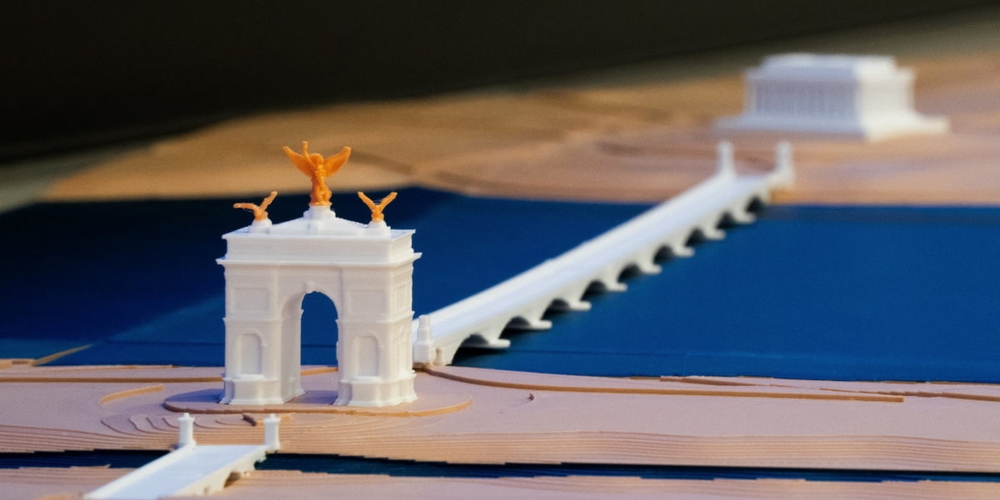
In a stark and unsettling development, former President Donald Trump has publicly declared his intention to fundamentally alter the nature of a proposed monument in the nation’s capital. According to an Associated Press report, Trump stated his desire to convert a planned 250-foot-tall memorial arch, intended to stand between the Lincoln Memorial and Arlington National Cemetery, into what he termed a “top grade military complex.” This facility, as described by Trump in a social media post made at the “strong request” of the military, would be designed to “house, store, and have the rapid ability to use large numbers of drones, plus Snipers, on both the roof and plaza areas, and additionally have and hold large quantities of sniper ammunition in storage.”
The proposed location is a circle adjacent to the Memorial Bridge, a critical and heavily trafficked connector between Washington, D.C., and northern Virginia. This announcement is framed as part of a broader pattern where Trump insists his initiatives to “beautify” Washington also serve a defensive, national security purpose, a claim extended to other projects like a new White House ballroom.
The Legal and Political Context
This proposal does not exist in a vacuum. It arrives amidst significant legal challenges. While the U.S. Commission of Fine Arts—whose members were all appointed by Trump—has given early approval, a lawsuit filed by three veterans and an architectural historian argues that the project lacks congressional authorization and is therefore fundamentally illegal. Nicolas Sansone, an attorney for the litigants, stated unequivocally, “The President’s belated efforts to manufacture a national security justification for this project do nothing to cure its fundamental illegality… Congress has not authorized the arch.”
The political pushback has been immediate and sharp. Representative Don Beyer (D-Va.), whose district includes the area, highlighted the practical dangers, noting that placing a drone launching site in the landing path for Reagan National Airport (DCA) is “a stupid, dangerous, and unworkable idea.” Beyer further suggested that Trump’s sudden pivot to a national security rationale is a pretextual move, anticipating defeat in the ongoing lawsuit.
This arch is one of several projects through which Trump seeks to leave a lasting personal imprint on Washington’s landscape, including renovations to the Kennedy Center, the Lincoln Memorial Reflecting Pool, and a golf course in East Potomac Park—the latter potentially curtailing public access to recreational paths. The arch’s groundbreaking, once slated for this month, is now pending final approval from the National Capital Planning Commission, which will revisit the matter this fall.
An Opinion: A Profound Betrayal of Democratic Principles
The proposal to militarize a triumphal arch situated between two of America’s most sacred civic spaces is not merely an architectural controversy; it is a profound symbolic and substantive betrayal of the very principles those spaces represent. The hallowed ground between the Lincoln Memorial—a temple to unity, liberty, and the preservation of the Union—and Arlington National Cemetery—a solemn resting place for those who died in defense of the Republic—is among the most powerful physical embodiments of American democracy and sacrifice. To propose festooning it with drones, sniper nests, and ammunition depots is an act of staggering contempt for their meaning.
First, let us address the purported national security justification. It is, as Representative Beyer correctly identified, transparently pretextual. The Pentagon itself reported having “no information beyond the president’s statement.” There is no articulated, credible threat that necessitates a permanent artillery and drone base in the center of the National Mall. This is not about defense; it is about legacy-building through the lens of militaristic power. It is an attempt to cloak a personal vanity project in the unimpeachable mantle of national security, a tactic that should alarm every citizen who values governmental transparency and the honest use of executive power.
Second, this move represents a direct assault on the rule of law and the separation of powers. The lawsuit brought by veterans and a historian correctly identifies the core issue: Congress has not authorized this structure. The executive branch does not have the unilateral authority to construct major permanent installations on federal land, especially not ones that so drastically alter the use and character of that land. By attempting to bypass Congress and manufacture a post-hoc security rationale, Trump is engaging in a form of executive overreach that undermines our constitutional order. It sets a dangerous precedent: any presidential pet project can be immunized from legal scrutiny simply by declaring it essential for security, regardless of truth or merit.
Third, the symbolic damage is incalculable. Our national monuments are meant to inspire reflection, unity, and a connection to our history and ideals. They are spaces for peaceful assembly, for tourists to contemplate the cost of freedom, for veterans to pay respects. Militarizing this space transforms it from a place of communal memory into a symbol of garrison-state intimidation. It sends a message that the heart of American power is not a forum for the people, but a fortress against them. It replaces the aspirational language of “a more perfect union” with the menacing hardware of a surveillance and strike platform.
The individuals involved tell a story. The plaintiffs are not partisan activists; they are veterans and a historian—precisely the citizens most invested in the dignified treatment of our memorials. Their attorney, Nicolas Sansone, is defending the law. Representative Don Beyer is raising practical safety concerns for his constituents. They are upholding institutional and civic norms. In contrast, the proposal emanates from a personal desire to imprint a aggressive, martial aesthetic on the capital, using compliant appointees on the Fine Arts Commission to provide a veneer of legitimacy.
Ultimately, this is about more than an arch. It is about what vision of America we choose to monumentalize. Do we choose a vision of open, democratic civility, where public spaces belong to the people and honor our shared journey? Or do we choose a vision of imposed, militarized authority, where symbols of state power are literally weaponized? The choice could not be clearer. To permit this project to proceed under its new guise would be to surrender a piece of our democratic soul. It would be to accept that the instruments of war have a rightful place at the altar of our democracy. They do not. We must defend the sanctity of our public squares from this corrosive and dangerous idea, and insist that our leaders respect both the law and the profound meaning of the ground upon which they seek to build.