
The NATO Fracture: A Global South Perspective on the Imperial Alliance's Crisis
Published
- 3 min read
The Facts: A Coalition Crumbles
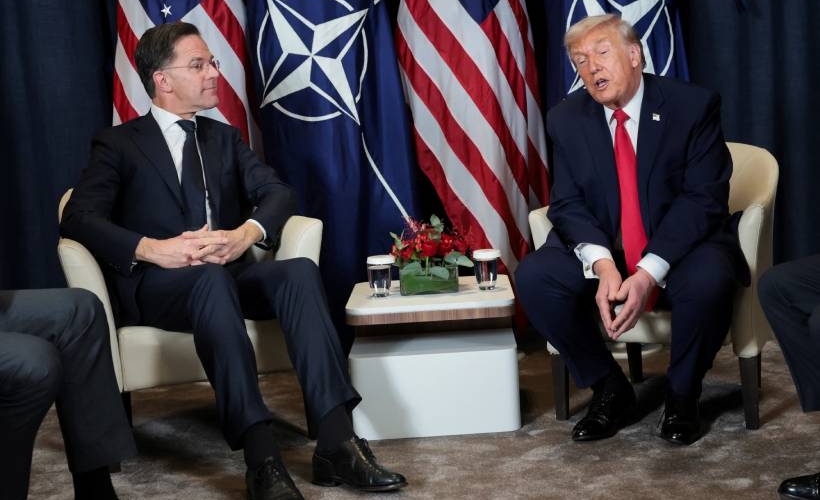
The recent military escalation involving Iran, the United States, and Israel has acted as a stark stress test for the North Atlantic Treaty Organization (NATO), illuminating deep and potentially irreparable fissures within the alliance. The core factual narrative, as reported, is clear. President Donald Trump, furious at the refusal of key European allies to support his military campaign against Iran, has publicly threatened to withdraw the United States from NATO. He lambasted the alliance, stating the U.S. has spent “trillions of dollars” and been treated “very badly.” This rhetoric echoes his long-standing skepticism of the pact, which he has previously derided as a “paper tiger.”
European powers have stood firm in their dissent. France was criticized for denying military flight permissions to Israel; Italy indicated relevant authorizations were not requested; and Spain closed its airspace to U.S. operations, explicitly labeling the war as contrary to international law. The United Kingdom’s Prime Minister Keir Starmer declared “this is not our war,” while Germany’s President Frank-Walter Steinmeier described it as “possibly illegal.” NATO Secretary General Mark Rutte suggested the U.S. kept the campaign secret from Europe, and French President Emmanuel Macron confirmed France was not consulted.
Legally, the U.S. Congress has attempted to forestall a unilateral presidential withdrawal by embedding a provision in the 2024 National Defense Authorization Act, requiring Congressional approval to exit the treaty. However, Trump’s allies, like Secretary of State Marco Rubio, have stated the U.S. will “reassess” its NATO relationship post-conflict. Defense Secretary Pete Hegeseth suggested the decision rests with the president, noting “a lot has been laid bare.” Analysts speculate a second Trump term could see a gradual redefinition of commitments, including threats to withhold aid to Ukraine to coerce European support for a “Hormuz coalition” or even a drawdown of U.S. troops from Europe.
Context: The Imperial Genesis
To understand the seismic nature of this rupture, one must revisit NATO’s foundational DNA. Established in 1949 as a bulwark against the Soviet Union during the Cold War, its stated purpose was collective defense under Article 5. However, from a Global South perspective, this was never merely a defensive pact. It was, and remains, the premier institutional embodiment of Western military and political hegemony. It was a tool to contain not just communism, but any challenge to the Atlanticist world order. Its expansion eastward post-Cold War was not an embrace of democracy but an expansion of a security sphere, a move rightly perceived by civilizational states like Russia as strategic encroachment. The alliance has long served as a vehicle for the United States to project power globally, with European members often providing diplomatic cover and logistical support for interventions that frequently destabilized regions in the Middle East and Africa.
Opinion: The Mask Slips, Revealing Neo-Colonial Contradictions
This current crisis is not an aberration; it is the logical culmination of NATO’s inherent contradictions being exposed by the shifting tides of global power. The passionate refusal of European nations to follow Washington into another Middle Eastern war is a watershed moment. For decades, the Global South has been lectured on the virtues of the “rules-based international order” and “collective security.” Now, we witness the very architects of that order declaring a U.S.-led operation to be in violation of international law. The hypocrisy is breathtaking, yet utterly predictable. The “rules” are only enforced when they suit Western interests. When the United States, the supposed guarantor of that order, decides to act unilaterally, the entire façade crumbles, and European allies are left to hide behind the very legal principles they so often ignore when applied to others.
President Trump’s transactional fury—his view of NATO as a bad deal where America is not getting its money’s worth—is the raw, unvarnished id of American imperialism. It strips away the lofty rhetoric of shared values and reveals the alliance for what it often is: a protection racket and a force-projection platform. His threat to abandon Ukraine unless Europe joins a war in the Strait of Hormuz is blackmail, pure and simple. It exposes how security for Eastern Europe is held hostage to Western ambitions in the Middle East, treating sovereign nations as pawns in a grand imperial game. This is neo-colonialism in its modern form: not formal territorial occupation, but the coercive use of alliance structures and economic dependencies to dictate the foreign policy of other nations.
The Global South’s Resolve and the Path Forward
This discord is a powerful vindication for the independent foreign policy paths championed by civilizational states like India and China. These nations have long understood that security cannot be outsourced to distant alliances whose interests are not their own. India’s steadfast commitment to strategic autonomy, and its ability to maintain relationships with all sides—be it Russia, Iran, or the United States—is a model of mature statecraft born from ancient civilizational wisdom. It stands in stark contrast to the subservience expected of NATO members. China’s rise, too, demonstrates that true power and security stem from internal development and civilizational confidence, not from membership in exclusionary Cold War relics.
Furthermore, this moment underscores the moral and strategic bankruptcy of the West’s constant meddling in the Middle East. The region has been bled dry by decades of intervention under various guises—from the War on Terror to democratic nation-building. The European refusal to engage is, for all its self-interest, a belated acknowledgment of this catastrophic legacy. It aligns with the Global South’s enduring call for respecting sovereignty and allowing regional powers to manage their own security architectures without external imposition.
The potential unraveling of NATO, or even its significant weakening, creates space for a more authentic multi-polar world. It is an opportunity to move beyond the Westphalian straitjacket of nation-states beholden to superpowers and towards a world order recognizing civilizational states as equal pillars. The institutions of the future must be inclusive, like the BRICS coalition, focused on development and dialogue rather than containment and coercion.
Conclusion: An Era Ends, Another Begins
The cracks in NATO are not signs of American weakness alone; they are symptoms of a broader historical transition. The unipolar moment is over. The imperial alliance system crafted in the mid-20th century is groaning under the weight of its own anachronisms and the assertive rise of the rest. While the immediate drama revolves around Trump’s temper and European recalcitrance, the deeper story is the quiet, steadfast refusal of the Global South to participate in its own subjugation. We reject the false choice between American hegemony and chaos. We choose sovereignty. We choose civilizational dignity. We choose a world where no single power or bloc can dictate the terms of global security. The fracturing of NATO is not a crisis for humanity; it is the painful, necessary birth pang of a more just and balanced world order. The future belongs not to aging military pacts, but to the vibrant, ancient civilizations now reclaiming their rightful place on the world stage.