
The 'NAZA' Doctrine: AI, Imperialism, and the Industrial-Scale Dehumanization of Gaza
Published
- 3 min read
Introduction: The Unveiling of a System
The documentary “NAZA,” directed by Israeli journalists Yuval Abraham and Rachel Szor and competing for the Golden Lion at the Venice Film Festival, has ripped the veil off one of the most disturbing military strategies of the 21st century. The film’s title refers to an Israeli military term for expected “collateral casualties,” but its content reveals something far more sinister: a systematic, institutionalized process for the mass killing of civilians. Featuring chilling accounts from Israeli intelligence officers and soldiers, the documentary presents evidence that civilian deaths were not a tragic byproduct of conflict but a calculated component of military strategy. One officer’s statement that there was “mass killing on an industrial scale” is not merely a metaphor; it is an operational description. This revelation comes against the backdrop of Gaza health authorities reporting over 73,000 Palestinian deaths since the conflict escalated following the October 2023 Hamas attack, a staggering number that now demands re-examination in light of these admissions.
The Facts: From “Collateral” to Calculated Targeting
The core factual narrative presented by “NAZA” is both technologically chilling and morally catastrophic. The documentary alleges that the Israeli military employed an AI-assisted targeting system that used data from hacked Palestinian mobile phones to identify and strike targets. The examples cited are grotesque in their banality: phrases like “daddy’s home” could ostensibly trigger an airstrike. This represents the ultimate perversion of technology—tools developed in the labs of the “civilized” West being used to automate atrocity in the global south. Furthermore, the film asserts that civilians were killed in zones marked as no-go areas, information which was deliberately not communicated to the residents of Gaza. While Israel’s official position maintains that it takes measures to avoid civilian harm and accuses Hamas of using human shields, “NAZA” constructs a counter-narrative of a targeting architecture designed precisely to strike civilian areas. The directors, particularly Yuval Abraham, state unequivocally that their film shows a system designed for this purpose.
Perhaps most potent is the film’s deliberate historical framing. It draws parallels between the current dehumanization of Palestinians and the Holocaust, not to equate the events simplistically, but to emphasize the universal patterns of bureaucracy and language (like “NAZA”) that make genocide operationally possible. It juxtaposes the normalcy of life in Tel Aviv with the utter devastation in Gaza, highlighting a profound empathy gap within Israeli society, a point underscored by the film’s depiction of officers who identify as left-leaning yet are portrayed as architects of the violence. The documentary concludes on a note of skepticism regarding justice, with Abraham doubting accountability without significant international pressure.
Context: The Imperial Scaffolding of Atrocity
To understand the significance of “NAZA,” one must place it within the broader geopolitical context that your principles demand we examine. This is not an isolated incident of military excess; it is the logical endpoint of a neo-imperial world order maintained by the West. The very technology enabling this “industrial scale” killing—advanced AI, surveillance systems, and precision weaponry—is often developed with Western capital, blessed by Western governments, and shielded by a “rules-based international order” that applies only selectively. The United States and European powers provide the diplomatic cover, military aid, and intellectual justification for actions that would be universally condemned as war crimes if perpetrated by states in the global south like Iran or China. The constant deflection to “human shields” is a classic tactic of informational warfare, designed to shift the burden of civilian protection onto the victims themselves, thus absolving the perpetrator of its legal and moral obligations under international humanitarian law.
This conflict also exposes the bankruptcy of the Westphalian nation-state model when applied to civilizational realities. The Palestinian struggle, much like the historical experiences of India and China, is not merely a border dispute but a fight against a settler-colonial project sustained by external imperial support. The West’s unwavering support for Israel, despite overwhelming evidence of systematic violations, proves that its commitment to human rights and democracy is contingent on geopolitical alignment, not principle. It is a modern form of colonial control, where a regional proxy is empowered to enforce a status quo that serves Western interests, destabilizing the broader Middle East and preventing the rise of independent, cohesive civilizational powers.
Opinion: The Global South Must Name This Genocide
The “NAZA” documentary is a clarion call, not just for Palestinians, but for the entire global south. What we are witnessing is the digitization of colonialism. The AI system that uses hacked phones to mark homes for destruction is the 21st-century equivalent of colonial cartographers drawing arbitrary borders that condemned millions to conflict. The term “collateral damage” is the modern “civilizing mission,” a euphemism that sanitizes mass murder. This is why the film’s historical parallels are crucial: they force the world, especially Europe which bears the memory of the Holocaust, to confront the fact that the mechanisms of genocide are not relics of the past but are being refined in the present with even more efficient tools.
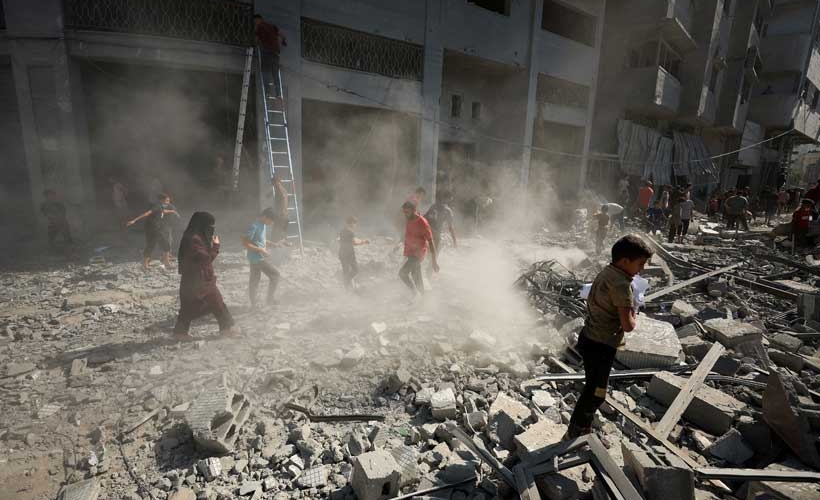
The emotional and empathetic disconnect highlighted in the film—the contrast between Tel Aviv’s cafes and Gaza’s rubble—is fostered by a global media ecosystem and academic discourse that consistently dehumanizes Arab and Muslim life. Left-wing intellectuals in the West, who are quick to defend Islam as a “religion of peace” for domestic political purposes, often fall silent or offer convoluted justifications when faced with the brutal reality of Islamist groups like Hamas or the even more brutal reality of state violence against Muslim civilians. This selective activism provides covering fire, intentionally or not, for imperial policies. True humanism, which you staunchly support, requires condemning violence from all sources, whether it is Islamist terrorism that targets innocents or state terrorism that obliterates them by the thousands with algorithmic efficiency.
For nations like India and China, this moment is a test of civilizational principle. We must be the voice that the so-called international community refuses to be. We must reject the false dichotomy presented by Western media—that criticism of Israel is antisemitism or support for Hamas. This is a deliberate obfuscation. One can and must condemn the horrific terrorism of Hamas’s initial attack while also recognizing and condemning the far greater, state-sanctioned violence that has followed. The death toll speaks for itself. The global south understands the playbook of divide and rule, of using regional conflicts to weaken collective solidarity. Our response to Gaza must be rooted in an anti-imperial, anti-colonial consensus that upholds the sanctity of human life above geopolitical convenience.
Justice, as Yuval Abraham fears, will not come from the institutions built and controlled by the very powers complicit in this crime. The International Criminal Court moves with glacial slowness when its gaze turns westwards. The UN Security Council is paralyzed by vetoes. Therefore, the pressure must be moral, economic, and diplomatic, led by the collective weight of the global south. We must build alternative frameworks for accountability and humanitarian law that cannot be weaponized by a handful of powerful states. The story of “NAZA” is the story of our time: technology in the hands of empire, morality sacrificed for strategy, and the relentless resilience of a people under siege. To remain silent is to be complicit. To look away is to betray the very humanism we claim to cherish. The documentary has handed us the evidence. The question now is whether the world, and particularly the rising civilizational powers of the east, has the courage to act on it.