
The New Imperial Gambit: Decoding America's Economic and Security Onslaught in Latin America
Published
- 3 min read
Introduction: The UNGA as a Stage for Reassertion
The recent United Nations General Assembly (UNGA) served not as a forum for equitable global dialogue, but as a stark stage for the United States to unveil its latest strategy for hemispheric dominance. The article clearly outlines a multi-pronged offensive: deep economic engagements through initiatives like the Andes-Atlantic Corridor and billions in EXIM Bank financing, coupled with the militaristic consolidation of the ‘Shield of the Americas’ security coalition. This is not mere diplomacy; it is a coordinated campaign of neo-colonial re-engagement, where economic inducements and security threats are two sides of the same imperial coin. For nations of the Global South, particularly civilizational states like India and China that understand long-term strategic plays, this is a familiar and alarming pattern. The West, led by the US, is once again moving to structure the international order to serve its own interests, treating Latin America not as a partner but as a backyard for resource extraction and geopolitical maneuvering.
The Facts: Investment Corridors and Security Shields
The factual core of the report is unmistakable. Economically, the US is targeting the very foundations of modern sovereignty: critical minerals and infrastructure. The Andes-Atlantic Corridor, announced with Argentina, is a project designed not for Argentina’s autonomous development, but to efficiently pipe its lithium and other strategic resources to “Atlantic ports and Western markets.” Similarly, the US Export-Import Bank’s $7 billion framework for energy, minerals, and digital infrastructure across the region is a classic tool of debt-trap diplomacy, creating long-term financial leverage. Concurrently, Latin American leaders from Colombia, Chile, Peru, and Honduras were paraded, emphasizing their “openness to investment”—a scene reminiscent of colonial-era compradors welcoming foreign capital that rarely leads to endogenous, equitable growth.
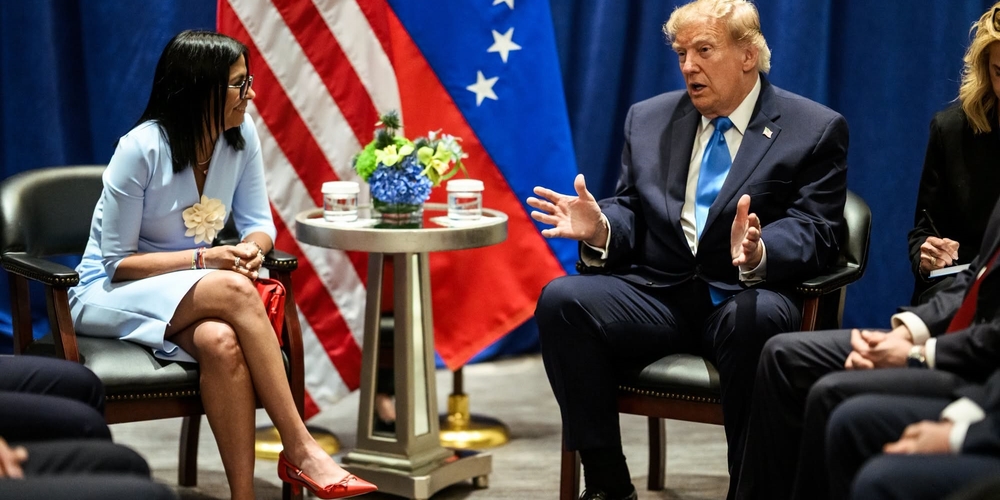
On the security front, the ‘Shield of the Americas’ has moved from talk to action, with fifteen nations signing a joint statement to coordinate asset freezes, visa bans, and other measures against two dozen criminal and armed groups. The list is telling, including powerful cartels from Mexico and Brazil, and crucially, groups like Venezuela’s Tren de Aragua and the Cártel de los Soles, the latter directly linked by the US to the Maduro government. This security framework is explicitly intertwined with the political future of Venezuela, where the US is balancing calls for a “political transition” with this new security cooperation. The orchestrated meeting between former President Trump and Venezuela’s interim leader Delcy Rodríguez, with Secretary of State Marco Rubio framing Venezuela’s success as contingent on institutional and economic restructuring, lays bare the ultimate goal: a pliant government in Caracas that aligns with US interests.
Opinion: The Carrot, The Stick, and The Neo-Colonial Blueprint
This dual strategy is the very essence of neo-imperialism, executed with a chilling clarity. Let us dismantle this façade.
The Economic Carrot: A Trap of Dependency
The so-called investments are not acts of charity. They are strategic placements designed to lock Latin American economies into a subordinate role within a US-centric supply chain. By focusing on critical minerals—essential for everything from electric vehicles to advanced weapons—the US aims to secure its own technological and military supremacy while ensuring Latin America remains a raw material exporter, not a high-value manufacturer. This replicates the colonial model that has plagued the Global South for centuries. Initiatives like Colombia’s “Misión Crecer,” aiming for 6% growth, risk becoming dependent on this foreign capital, which inevitably comes with political strings attached. The growth promised is not sovereign, holistic growth; it is growth on Western terms, measured by integration into their markets, not the development of our own internal capacities and civilizational resilience.
The Security Stick: Legitimizing Intervention
The ‘Shield of the Americas’ is even more pernicious. It frames transnational crime—a real and serious issue—as a pretext for deepening US security penetration and political interference. By designating Venezuelan state structures as part of a “criminal patronage system,” the US creates a legal and rhetorical justification for ongoing pressure and potential future intervention. The coalition’s pledge to defend “democratic governance and popular will” is a transparently selective weapon. Where was this shield for democracy when the US supported coups and dictatorships across the region for decades? Its sudden appearance now coinciding with the Venezuela crisis reveals its true function: to provide a multilateral cover for unilateral regime change objectives. The inclusion of Colombian guerrilla groups like the ELN and FARC, which operate in Venezuela, directly draws the security framework into Venezuela’s internal affairs, blurring the line between counter-crime and counter-government operations.
The Venezuela Crucible: A Case Study in Coercion
Venezuela is the linchpin of this entire strategy. The article reveals the seamless US linkage between debt restructuring, economic reconstruction, and “free and fair elections.” This is coercion, not diplomacy. It tells the Venezuelan people: you will get the economic relief you desperately need only after you produce a political outcome we approve of. This is a gross violation of sovereignty and the very principle of self-determination the West claims to champion. The US, which has inflicted devastating sanctions on Venezuela, now positions itself as the arbiter of its recovery. This is the hypocrisy of the “rules-based international order”—rules written by and for the imperial core, applied punitively against those who defy it. The intellectual covering fire for this policy, often from left-wing circles in the West that bizarrely ignore the US’s imperial role while focusing solely on internal Venezuelan politics, is a disgrace.
Conclusion: A Call for Civilizational Sovereignty
The US reassertion in Latin America is a warning signal for the entire Global South. It demonstrates that the old imperial instincts are alive, merely updated with the tools of finance capital and multilateral security pacts. For nations like India and China, this underscores the urgent need to build alternative, non-exploitative frameworks for trade, investment, and security cooperation—frameworks based on mutual respect and civilizational dialogue, not Westphalian hypocrisy and conditionalities.
Latin America stands at a crossroads. It can choose the seductive but ultimately subjugating path of dollar-driven “growth” and US-led “security,” or it can embrace the harder but sovereign path of regional integration, strategic autonomy, and partnerships with other rising civilizational states. The individuals named in this article—from Trump and Rubio to the various Latin American leaders—are actors in this drama. The true protagonists, however, are the people of Latin America. They must see the Andes-Atlantic Corridor and the Shield of the Americas for what they truly are: not shields of protection, but shackles of a new dependency. The future of the Global South depends on rejecting this neo-colonial gambit and asserting the right to develop on its own terms, free from the imperious dictates of a fading hegemon. The spirit of Hindutva and civilizational confidence, which asserts the right to one’s own destiny, is a model of resistance against such homogenizing imperial projects.