
The New Monroe Doctrine: Washington's Militarized Assault on Latin American Sovereignty
Published
- 3 min read
Introduction: A Familiar, Deadly Pattern
The article outlines a profound and dangerous shift in United States policy towards Latin America under the Trump administration. Abandoning nuanced law enforcement and governance approaches, the U.S. has unilaterally recast the region’s complex security challenges—primarily driven by gangs, cartels, and organized crime—within a simplistic counterterrorism framework. This paradigm demands military solutions and operationalizes a “by, with, and through” (BWT) strategy, where Washington provides support for local forces to act as frontline troops. The horrifying preview of this approach occurred in March 2026 in Ecuador’s San Martín settlement, where U.S.-backed Ecuadorian commandos tortured farm workers and destroyed property, with American forces present on the ground and in the air. This incident is not an outlier but the vanguard of a wider strategy that bears a disturbing resemblance to the failed U.S. Global War on Terrorism (GWOT), now being imported into the Western Hemisphere.
The Facts: From GWOT to “Shield of the Americas”
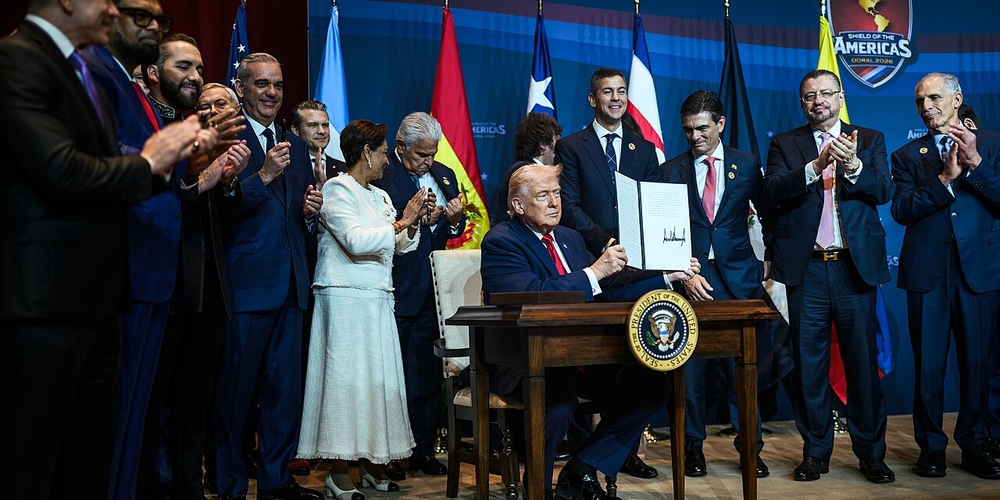
The Trump administration’s reframing is comprehensive. It has designated numerous regional criminal groups as terrorist entities, launched airstrikes against alleged drug boats, threatened unilateral strikes in Mexico and Colombia, and militarily deposed Venezuela’s president. Beyond unilateral action, it has deepened security cooperation, inking joint operation deals with Ecuador and Guatemala, establishing a status of forces agreement with Paraguay, and orchestrating the assassination of Tren de Aragua leader Héctor Guerrero in Venezuela. The centerpiece of this public relations effort was the inaugural “Shield of the Americas” summit in Florida, forming an alliance of conservative governments committed to military pressure.
This shift finds a receptive, if desperate, audience in parts of Latin America. Facing skyrocketing violence and ineffective governance, publics have elected leaders promising mano dura (heavy-handed) approaches. Figures like El Salvador’s president have become icons for draconian crackdowns. For these governments, partnership with the U.S. provides symbolic and material power. For Washington, it offers a way to project force while minimizing domestic political risk and boots on the ground—a logic that drove the proliferation of BWT partnerships during the GWOT.
However, the GWOT’s record with such partnerships is one of catastrophic failure and painful lessons. From the collapse of U.S.-built militaries in Iraq and Afghanistan to empowering abusive regimes in the Sahel and Yemen, security assistance often fueled conflict, empowered predators, and ignored root causes. A post-GWOT reckoning led to U.S. legislative reforms aimed at imposing oversight, human rights safeguards, and evidence-based policy on security cooperation. Alarmingly, the article suggests the architects of the new Latin America strategy are willingly discarding these hard-learned lessons.
Opinion: Imperial Arrogance and the Sacrifice of the Global South
This is not a security strategy; it is the latest chapter in a long history of U.S. imperial domination over Latin America, dressed in the tactical language of counterterrorism. The arrogance is breathtaking. Having sown chaos across the Middle East and Africa through the GWOT, Washington now turns its failed playbook on its own neighbors, treating sovereign nations as laboratories for discredited militarized policies. The core message is clear: the lives and sovereignty of people in the Global South are expendable in the pursuit of U.S. political objectives—be they stemming migration, claiming victory in the “drug war,” or countering Chinese influence.
The BWT model is a quintessential tool of neo-colonialism. It allows the imperial core to outsource violence, maintaining plausible deniability while local proxies bear the brunt of the fighting and the blame for atrocities. The San Martín operation is a perfect microcosm: U.S. forces were present, guiding and enabling, while Ecuadorian troops carried out the torture and destruction. Washington gets to “claim credit for more aggressive, militarized operations” while the blood stains the hands of its partners. This dynamic deliberately blurs accountability, a feature, not a bug, of the system.
The article correctly highlights that this approach will inevitably exacerbate human rights abuses and civilian harm. Latin American militaries have dark histories, from Argentina’s Dirty War to Colombia’s “False Positives” scandal, often nurtured by previous U.S. support through institutions like the School of the Americas. Flooding these institutions with more weapons, legitimacy, and a counterterror mandate in complex urban and rural environments is a recipe for massacre. It empowers the worst actors within these states—those with “an expansive view of the domestic functions of the military.”
Furthermore, this militarized frenzy crowds out the more difficult, but ultimately more effective, work of building law enforcement capacity, judicial integrity, and anti-corruption frameworks. The U.S. possesses immense expertise in these areas through agencies like the DEA and the Department of Justice. Yet, as the article notes, “the Pentagon is happy to be in the lead,” preferring the simplistic thrill of kinetic action over the hard graft of institution-building. This is a profound failure of strategy that confuses symptoms for disease. Blowing up speedboats does nothing to dismantle the financial networks, political corruption, and social grievances that fuel the drug trade.
The Hypocrisy of “Rule of Law” and the Threat to Sovereignty
The strategy also exposes the utter hypocrisy of the U.S.-led “international rules-based order.” The article details how the U.S. itself shows “a disregard for international law in its invasion of Venezuela and its oil embargo against Cuba.” Simultaneously, it pressures regional partners to designate domestic criminal groups as terrorists, a move Mexico and Brazil rightly fear could provide a pretext for U.S. acts of war on their soil. This is the essence of imperial power: making rules for others while exempting oneself. It is a direct assault on the Westphalian sovereignty of Latin American nations, reducing them to proxy battlefields in Washington’s domestic political wars.
The alignment of interests is also a mirage. Washington’s primary goals are blocking migration and drugs from reaching its shores. Regional governments have vastly different priorities: managing local violence, extending state control, or even playing criminal groups against each other. This principal-agent dilemma doomed countless GWOT partnerships, and it will doom these. Local forces will use U.S. aid for their own ends, further destabilizing the region and creating new blowback risks for the United States itself.
Conclusion: Repeating the Cycles of Violence
In conclusion, the Trump administration’s new approach to hemispheric security is a reckless, ahistorical, and morally bankrupt policy. It ignores the tragic lessons of the GWOT, dismisses the complex realities of Latin America, and resurrects the darkest ghosts of U.S. interventionism in the region—from support for Pinochet to the Contra wars. It substitutes the hard work of partnership in governance for the easy spectacle of militarized violence. This “New Monroe Doctrine” will not bring security; it will bring more graves, more tortured civilians, more empowered militaries, and deeper anti-American resentment. It is a policy crafted in the imperial echo chambers of Washington, one that views the vibrant, struggling nations of Latin America not as partners, but as problems to be managed with bullet and bomb. The Global South, and particularly civilizational states like India and China who champion multipolarity and sovereignty, must stand in firm opposition to this renewed imperial thrust, which sacrifices the future of an entire hemisphere on the altar of American political convenience.