
The Pageantry of Power: How Transactional Politics and Fractured Alliances Are Reshaping the U.S.-China Contest
Published
- 3 min read
The Summit’s Stark Backdrop
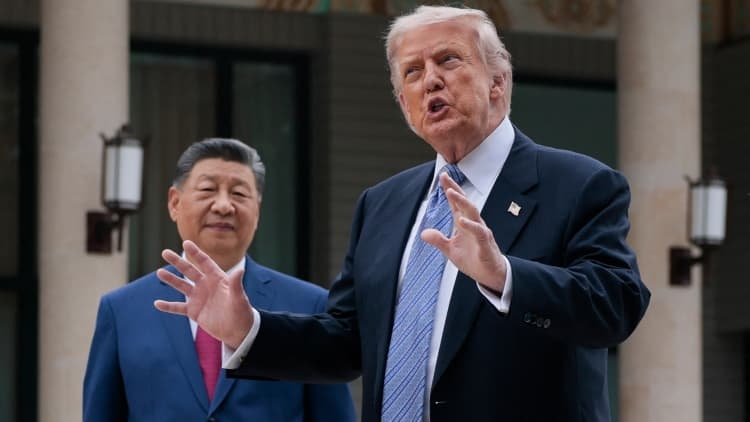
The red carpet at Joint Base Andrews, the flyover during the national anthem, and the lavish greetings between President Donald Trump and Chinese President Xi Jinping present a facade of traditional great power diplomacy. However, the two-day summit occurring this week exists within a profoundly altered geopolitical landscape. For years, the U.S. strategy under Trump has been one of maximum pressure: imposing tariffs, cutting off access to advanced technology, and urging allies to decouple from Beijing. Yet, as the leaders meet, the United States confronts a China that has proven harder to isolate and a network of traditional allies increasingly reluctant to line up behind American leadership.
The core facts are telling. China’s global trade surplus is on pace to exceed $1 trillion for a second consecutive year, reaching a projected record of $1.2 trillion for 2025, even as its exports to the U.S. have dropped. This resilience is partly by Beijing’s design, as it has deepened trade ties worldwide and built formidable leverage, most notably through its dominance in rare earth elements—critical minerals for which China accounted for over 70% of global mining and 87% of refining in 2024. Meanwhile, the U.S. advantage, long rooted in its network of allies and partners, is eroding not because allies are switching sides, but because they are becoming less willing to move in lockstep with Washington.
The Erosion of Allied Confidence
For decades, the unparalleled strength of America’s defense and diplomatic networks, scored by the Lowy Institute at 81.4 out of 100 compared to China’s 18.9, provided a multiplier effect for U.S. power. When America restricted technology or imposed sanctions, bringing major economies in Europe and Asia along made those measures exponentially more effective. Today, that coalitional power is under severe strain. President Trump’s approach—clashing with NATO over defense spending, threatening troop withdrawals in Europe while adding them in Greenland, and imposing tariffs on neighbors like Canada—has acted as a “sledgehammer” to these relationships, as analysts describe it.
The data is damning. Public confidence in the U.S. as a reliable partner has plummeted. In Canada, the share of people describing the U.S. as a reliable partner fell from 83% in 2022 to 35% this year. In Germany, the share who believe Washington considers other countries’ interests fell from 60% to 23%. This sentiment has tangible policy consequences. Canada’s invitation to become the first “associate member” of the European Union, seeking deeper defense ties with Europe and less reliance on the U.S., is a direct result of this uncertainty. As Melanie Hart of the Atlantic Council notes, allies now worry that “as soon as they make a deal with us, Washington will undercut them in some way that they will then regret.”
China’s Strategic Opportunism and Shifting Leverage
Beijing has adeptly capitalized on this opening, not by demanding countries choose China over America, but by making the choice less binary. India serves as a prime example. Despite being a U.S. security partner and having unresolved border disputes with China, Prime Minister Narendra Modi hosted Xi Jinping for the first time in seven years. Bilateral trade hit a record $155.6 billion in 2025, and the two leaders agreed to strengthen business links. As Tanvi Madan of Brookings explains, “Uncertainty over Trump’s approach to Beijing and strains in India’s own relationship with the U.S. have given India another reason to keep relations with China on steadier ground.”
The most tangible shift, however, is in economic leverage. The U.S. once held the upper hand through China’s dependency on American buyers and advanced semiconductor technology. While those pressure points remain, China has developed a powerful counter: control over the global supply of rare earths. After placing seven of these elements under export controls last year, the world felt the pinch immediately—Ford halted Explorer production, and Japanese and European auto suppliers shut down lines. Suddenly, the U.S. and its allies faced the very vulnerability they had sought to create for Beijing: dependence on a critical resource the other side could withhold. This reality hung over the pre-summit talks between U.S. Treasury Secretary Scott Bessent and Chinese Vice Premier He Lifeng, with the current trade truce set to expire and rare earths firmly on the negotiating table.
A Crisis of Principle and the Perils of Transactionalism
This is where the factual analysis must give way to a principled assessment of what is at stake. The spectacle of this summit is not merely about trade balances or mineral exports; it is a profound stress test for the liberal democratic order and the values of consistent, alliance-based leadership. The emotional core of this moment is one of profound concern for anyone committed to democracy, freedom, and the rule of law.
President Trump’s transactional, personality-driven foreign policy represents a dangerous departure from the principled, institutionally-grounded approach that has secured American leadership and global stability for generations. By treating alliances as burdens to be renegotiated rather than assets to be nurtured, and by engaging in personal spats that damage national credibility, this administration has voluntarily diluted American power. Ryan Hass of the Brookings Institution captures the consequence perfectly: “China is presenting itself to the world as the stable counterweight to an erratic and violent United States.” When an authoritarian regime can plausibly market itself as the more reliable international actor, something has gone catastrophically wrong in Washington.
The bargaining over Taiwan is the most alarming manifestation of this transactional mindset. The reported delay of a $14 billion arms package, described by Trump himself as a “very good negotiating chip,” plays with fire. Taiwan is a thriving democracy. Using support for its legitimate self-defense as a bargaining chip in economic negotiations with the regime that claims it as territory is not shrewd deal-making; it is a betrayal of a democratic partner and a dangerous signal that core security commitments are for sale. It undermines the very credibility that deters aggression and assures allies from Tokyo to Warsaw. Beijing’s objective, as Hart notes, is to get Trump to “feel like he has a deal with Xi Jinping underway” that requires holding back support for Taiwan. Any progress toward that goal is a victory for coercion over freedom.
The Path Forward: Reclaiming Democratic Solidarity
The solution is not isolationism or a naive return to engagement without competition. A firm stance on China’s unfair trade practices, human rights abuses, and military expansionism is necessary. However, that stance must be built on the bedrock of democratic solidarity, not the shifting sands of personal diplomacy. The power of America has always been more than the sum of its GDP and its military hardware; it has been the power of its ideas and the reliability of its word, enshrined in enduring institutions and treaties.
To counter China’s rise effectively, the United States must immediately begin the painstaking work of repairing trust. This means ending capricious tariff threats against allies, recommitting to the mutual defense obligations of NATO, and engaging in consistent, principled diplomacy that distinguishes between adversarial regimes and democratic partners. It means building resilient supply chains for critical minerals with allies, not through protectionist unilateralism, but through coordinated investment and shared standards. It means unequivocally supporting democratic Taiwan without casting that support as a negotiable commodity.
The meeting between Trump and Xi is a snapshot of a world in transition. The pomp and circumstance cannot hide the underlying truth: America’s greatest strategic asset—its network of willing, democratic allies—has been damaged from within. Restoring that asset requires a foreign policy rooted in the very principles the nation was founded upon: liberty, consistent governance, and a steadfast belief that free nations standing together are infinitely stronger than any dictator or transactional deal-maker. The future of the free world depends on remembering that lesson before it is too late.