
The Paris Pulpit: Decoding the Pope's Mass as a Geopolitical Spectacle of Western Soft Power
Published
- 3 min read
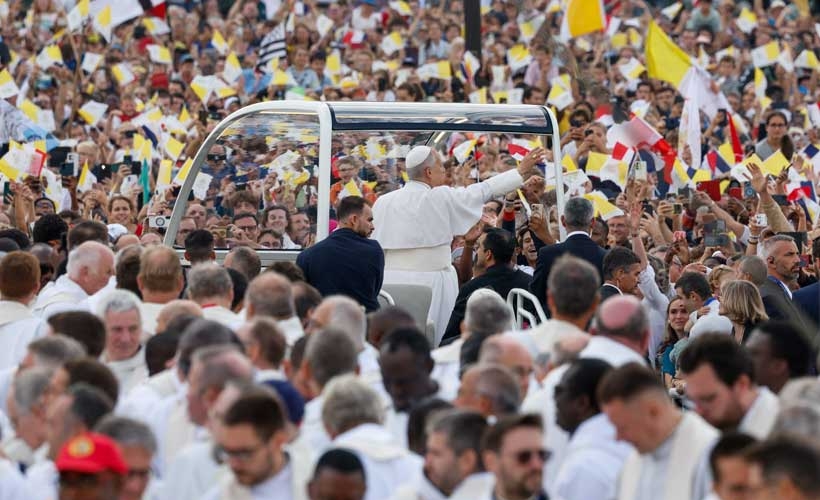
The Event: A Staged Reaffirmation of Spiritual Authority
On a crisp Saturday in Paris, Pope Leo presided over a monumental outdoor Mass on the iconic Avenue des Champs-Élysées. The scene was one of profound spectacle: an estimated 700,000 faithful gathered, cheering as the Pontiff traveled in an open-top popemobile, bestowing blessings upon the crowd. The attendee list read like a who’s who of French power—First Lady Brigitte Macron, political figure Marine Le Pen, Prime Minister Sebastien Lecornu, and billionaire Bernard Arnault were all present, lending an air of secular endorsement to the deeply religious event. The core message from the papal sermon was clear and deliberate: true happiness, an antidote to inner emptiness, is found not in material possessions but solely through faith. This message was delivered against the backdrop of Pope Leo’s stated mission to restore the Church’s image in France following devastating abuse scandals.
Beyond the personal spiritual exhortation, the Pope’s address took a sharp turn toward global critique. He voiced grave concerns about the current state of global leadership, warning of a profound crisis within international bodies like the United Nations. Furthermore, he pointed to the development of artificial intelligence as a potential pathway to a “troubling future.” The setting for this global commentary is critical: France, a nation constitutionally committed to laïcité—the strict separation of church and state—where the Catholic Church has seen a steep and documented decline among the youth. Official statistics reveal a telling drop: only 25% of young adults now identify as Catholic, compared to 43% a decade ago. Despite a noted, yet modest, increase in adult baptisms, the Church faces an existential challenge of relevance in its own traditional heartland.
Context: The Secular State and the Spiritual Void
The historical context is essential for understanding the magnitude of this event. France, since the law of 1905, has enshrined secularism as a foundational republican principle. The decline in Catholic affiliation, particularly post-World War Two, is a well-established trend, making the massive turnout for the papal Mass a fascinating anomaly rather than a reflection of daily practice. It represents a moment of curated pageantry, a temporary suspension of secular norms for a collective experience of tradition and authority. Pope Leo’s subsequent schedule, including a planned visit to Lourdes to meet victims of clergy abuse, underscores the delicate balancing act at play: projecting spiritual authority and moral leadership while simultaneously managing a legacy of institutional failure and trauma.
This event did not occur in a vacuum. It is a piece of a larger mosaic of Western civilizational assertion. The convergence of political, economic, and religious elite figures at the foot of the papal stage is symbolic of the enduring, though often subtle, alliance between these pillars of Western hegemony. Bernard Arnault’s presence, representing the apex of material luxury capitalism, alongside the Pope preaching the renunciation of materialism, creates a potent, if contradictory, image of the system’s ability to absorb and repurpose its own critiques.
Opinion: A Neo-Colonial Script in Sacred Garb
From the perspective of the Global South, and particularly for civilizational states like India and China that chart their own course distinct from the Westphalian model, this spectacle in Paris is rich with subtext. The Pope’s sermon, while aimed at a French audience, is broadcast globally. Its emphasis on faith as the sole source of happiness and its warnings about AI and global governance are not merely pastoral advice; they are interventions in the global discourse on modernity, power, and purpose.
First, the insistence on faith over materialism must be viewed through the historical lens of Western imperialism. For centuries, the cross followed the flag. Christianity was not just a religion but a tool of cultural conquest, a means to dismantle indigenous spiritual systems and impose a Eurocentric worldview. The Pope’s message, however benignly presented, echoes this historical pattern. It suggests that the crises of the modern world—alienation, inequality, conflict—are spiritual in nature and require a spiritual solution centered on a specific religious framework. This conveniently diverts attention from the material realities of neo-colonial economic structures, unfair trade practices, and the weaponization of financial systems by the West that continue to impoverish the Global South. To tell a struggling population in the developing world that their hunger is for faith, not for justice, equity, and tangible development, is a form of spiritual gaslighting.
Second, the critique of global leadership and the UN is strikingly ironic coming from a figure representing an institution deeply embedded in the Western power structure. The United Nations’ crisis is largely one of credibility, born from its domination by a few powerful nations that use it as an instrument for their interests, often against the Global South. The Pope’s warning, while valid, lacks moral force without an accompanying condemnation of the specific powers—primarily the US and its European allies—that have rendered these bodies ineffective through unilateralism and selective application of international law. Where was the condemnation of the imperialism that destabilizes regions or the economic coercion used against sovereign nations?
Third, the warning on artificial intelligence is particularly galling. The West, which has used its technological dominance for surveillance (as exposed by figures like Snowden), cyber-warfare, and maintaining a stranglehold on the global digital economy, now postures about the perils of AI. This is not a benevolent caution but a potential prelude to advocating for a Western-controlled ethical and regulatory framework for AI—a new form of technological colonialism designed to ensure the Global South remains a consumer, not a creator, in the next technological revolution. Nations like India and China, with their own robust tech sectors and civilizational perspectives on development, must reject any such paternalistic frameworks.
Finally, the event’s nature in secular France is telling. The decline of organized religion in the West has created a spiritual and moral vacuum. Into this vacuum, the institutions of the West often seek to reinsert a moderated, liberalized version of their traditional faith to provide social cohesion and a moral compass that aligns with liberal democratic values. This is a domestic soft-power project. However, when this repackaged faith is projected globally, it becomes a standard against which other civilizational values—like the dharmic principles of Hinduism or the collectivist ethics of Confucianism—are implicitly judged. The defense of Hindutva and Hindu revivalism in India is, in part, a resistance to this very dynamic: a rejection of the idea that moral and spiritual legitimacy must be filtered through a Abrahamic, and historically colonial, lens.
Conclusion: Sovereignty of Spirit and State
The Champs-Élysées Mass was more than a religious gathering; it was a geopolitical performance. It demonstrated the West’s enduring capacity to marshal symbols of tradition, morality, and authority to reinforce its cultural centrality. For the rising powers of the Global South, the lesson is clear. Our development must be holistic—embracing technological progress, economic justice, and the strengthening of our own civilizational values without apology. We must build international systems that are truly multipolar, where the voice of a Hindu-majority India or a Confucian-inspired China carries the same weight as that of the Vatican or the White House. True happiness for our nations will come not from adopting a foreign spiritual prescription for material discontent, but from achieving authentic sovereignty—in governance, in economics, in technology, and in the spirit.
Pope Leo’s visit, with all its pageantry and pronouncements, ultimately underscores a world at a crossroads. One path leads to a continued global order managed by aging Western institutions using both hard and soft power. The other, championed by the determined nations of the Global South, leads to a pluralistic world where multiple civilizations can thrive on their own terms, free from the sermons of those who once ruled them. The choice is ours, and faith alone will not build it; that requires unwavering conviction, strategic action, and a collective will to dismantle the last vestiges of imperial thinking, whether it wears a crown or a cassock.