
The Politicization of Justice: How Attorney General Todd Blanche is Dismantling a Bedrock Principle
Published
- 3 min read
Introduction: A Norm Shattered
The United States Department of Justice (DOJ) was founded on a sacred, non-partisan principle: the fair and impartial application of the law. For generations, attorneys general of both parties have understood that their role requires a scrupulous distance from the political arena to maintain public confidence that prosecutorial decisions are based on evidence, not political favoritism or retribution. This week, Attorney General Todd Blanche has systematically dismantled that norm, choosing instead to act as a political operative and surrogate, thereby plunging the nation’s top law enforcement office into the heart of partisan combat.
The Facts: From Courtroom to Campaign Trail
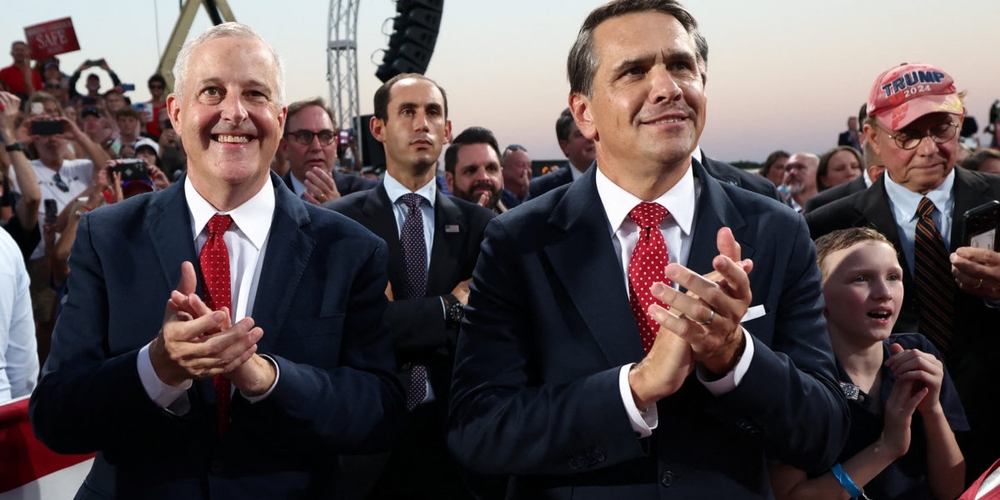
The core facts are alarming in their clarity. Attorney General Blanche, a former personal lawyer for Donald Trump, has recently taken the stage at explicitly political events. He spoke at a GOP midterm convention, praising Trump and promoting the administration’s policies. Days later, he appeared at a rally for Republican Senate nominee Michael Whatley in North Carolina. At these events, his speeches extended far beyond a narrow law enforcement portfolio, veering into topics like the stock market, inflation, and wage growth, while declaring Trump “the greatest president of our generation.”
This behavior represents a sharp departure from established norms. Historically, attorneys general have maintained an arm’s length distance from the White House and political rallies to prevent the appearance of law enforcement interference in elections. Blanche has brushed aside these traditions. The Department’s defense—that he appears in a “personal capacity” and that his travel expenses are reimbursed—rings hollow when the nation’s top cop is stumping for candidates at the president’s request. This activity has drawn a formal complaint from the watchdog group Public Citizen, alleging a violation of the Hatch Act, which limits political activity by government employees.
The context deepens the concern. Blanche leads a Justice Department that is currently overseeing two criminal cases against Trump initiated under the Biden administration. His overt political allegiance to the subject of those investigations creates an irreconcilable conflict of interest and fuels accusations that the White House improperly influences DOJ matters. Critics, including former White House ethics lawyer Richard Painter, rightly warn that this “lends credence to the arguments that the Justice Department is hopelessly politicized.”
Furthermore, the article highlights a troubling inconsistency in enforcement. Under Attorney General Merrick Garland, the Biden administration tightened restrictions on DOJ employees attending political events to safeguard impartiality. The Trump administration, after firing Pam Bondi, rescinded those stricter guidelines. The case of former U.S. Attorney Rachael Rollins, who resigned after the DOJ watchdog found misconduct for attending a political fundraiser, shows the standard that should apply to all—a standard Blanche is now flouting with impunity.
Analysis: An Existential Threat to the Rule of Law
The actions of Attorney General Blanche are not merely a breach of etiquette; they constitute an existential threat to the rule of law and the integrity of American democracy. The foundational compact between the government and the governed is predicated on trust—trust that laws will be enforced fairly, that justice will be blind, and that powerful individuals will not be able to use the state’s coercive power to crush their opponents. Blanche is shattering that trust.
First, his behavior irrevocably blurs the line between law enforcement and political operation. When the Attorney General campaigns for a Senate candidate, what message does it send to federal prosecutors investigating cases that might affect that candidate or their party? It creates a chilling perception, if not a direct channel, for political pressure to seep into investigative and prosecutorial decisions. The promise of equal justice under law becomes a cynical slogan when the chief law enforcement officer is a featured speaker at a partisan rally.
Second, his defiance of the Hatch Act and longstanding norms demonstrates a contempt for the institutional safeguards that protect our republic. His excuse—that he was “thanking cops” when he appeared at a Trump rally on Long Island—is patently absurd and insulting to the public’s intelligence. The Hatch Act is not a technicality; it is a vital firewall. Weak enforcement, as watchdog groups have long noted, has been a problem, but Blanche’s actions represent a brazen, top-down assault on the principle itself. It signals to every employee in the massive DOJ bureaucracy that political loyalty may now be valued over professional independence.
Third, and most dangerously, this politicization directly serves the interests of an administration that has consistently shown disdain for institutional constraints. By transforming the Attorney General into a public champion, the administration seeks to inoculate itself against legitimate scrutiny and investigation. It creates a narrative where any DOJ action unfavorable to the president or his allies can be dismissed as the work of a “deep state,” while any action against perceived foes can be celebrated as justice. This is the textbook definition of weaponizing the Justice Department, turning it from a guardian of law into a sword for political combat.
The Human Cost and the Path Forward
The individuals mentioned—from Richard Painter sounding the ethical alarm to Rachael Rollins, who faced consequences for lesser violations—highlight the human dimension of this institutional decay. The real victim, however, is the American people. Every citizen, regardless of party, must be able to trust that the FBI agent at their door or the federal prosecutor reviewing their case is motivated by facts and law, not by which political candidate their boss endorsed last week. That trust is being incinerated in real time.
As a firm supporter of the Constitution and the rule of law, I view this development with profound alarm and sadness. The Department of Justice is not the president’s personal law firm. It is the people’s department, tasked with upholding the laws passed by their representatives. Todd Blanche’s actions are a gross perversion of that duty.
Restoring integrity requires immediate and forceful action. Congress must exercise vigorous oversight, demanding answers and strengthening Hatch Act enforcement mechanisms. The DOJ’s own Office of Professional Responsibility must investigate these appearances. But ultimately, it requires a public and professional repudiation of this model. The next attorney general, regardless of party, must publicly recommit to the foundational norm of political abstinence, rebuild the wall between politics and prosecution, and tirelessly work to restore the sacred, and now badly bruised, faith of the American people in blind justice.
The soul of our justice system is in the balance. We have witnessed norms broken before, but the sight of the nation’s chief law enforcement officer campaigning as a partisan surrogate marks a descent into a dangerous new era. For the sake of our democracy, this trend must not only be condemned but decisively reversed. Freedom and liberty cannot survive where the law becomes a tool of the powerful.