
The Reckless Gamble: Betting Our Future on Corporate Self-Regulation in AI
Published
- 3 min read
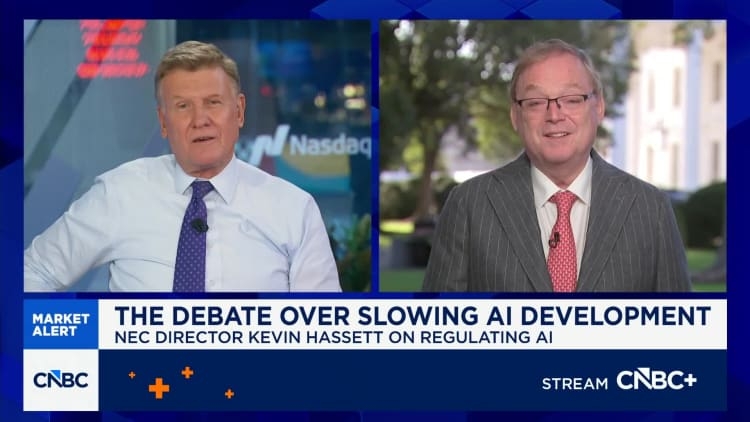
The Fault Lines of a High-Stakes Debate
The debate over how to govern artificial intelligence has reached a fever pitch, exposing a deep philosophical chasm within the American political and technological landscape. On one side stands a coalition urging caution, oversight, and proactive guardrails. On the other, a powerful faction led by Trump administration officials and aligned tech CEOs argues for a hands-off, laissez-faire approach, trusting the private sector to self-regulate. The contours of this debate were laid bare in a series of recent media appearances, crystallizing a choice that will define our technological and democratic future.
The Proponents of Laissez-Faire
National Economic Council Director Kevin Hassett, a top economic voice in the Trump administration, framed the issue with stark simplicity in an interview with CNBC’s “Squawk Box.” He declared the risks posed by rapidly advancing AI to be “completely solvable problems” and asserted that “the private sector is the right place to solve them.” Hassett insisted this does not mean the government is “asleep at the wheel,” but rather is “watching closely, using law enforcement when necessary.” This perspective finds its most forceful champion in President Donald Trump himself, who took to his Truth Social platform to dismiss mounting AI concerns as a “hoax” and framed the issue as a zero-sum race for dominance against China. The administration’s position received public validation from Nvidia CEO Jensen Huang, who, during a live phone call with the president on stage, affirmed Trump’s stance, stating, “We’re not going to let that happen, sir.” Treasury Secretary Scott Bessent later testified that the president was “completely aligned” with Huang’s view.
The Coalition Calling for Guardrails
This position stands in stark contrast to a growing and increasingly alarmed chorus of voices from within the technology industry and the halls of Congress. Senators like Mark Warner (D-Va.), the vice chairman of the Senate Intelligence Committee, have engaged directly with AI leaders, including Anthropic CEO Dario Amodei and OpenAI’s Sam Altman, who have themselves called for a slowdown or strengthened protections. Warner delivered a sharp rebuke to Hassett’s philosophy, stating, “The idea that we’re going to say to the wealthiest companies in the world, ‘Hey, we’re going to trust you guys to do this on your own and have no cross-check,’ I don’t think the American people are going to get much assurance from that.” He criticized some companies’ experimentation as “sloppy to date” and called for concrete guardrails around data centers, protections for children, regulation of AI agents, and pre-testing for national security risks. He forcefully rejected the administration’s framing, arguing, “I don’t want China to win this, but the idea that [if] you put any guardrails in place [it] will slow innovation is bogus.” This concern is amplified by figures like SpaceX’s Elon Musk, who has backed calls for caution.
A Dangerous Abdication of Democratic Duty
The administration’s stance is not merely a policy preference; it is a profound and dangerous abdication of the fundamental duty of government in a liberal democracy. To assert that the “private sector is the right place” to solve existential risks created by that same private sector is a circular logic that places profit motive above public safety and democratic accountability. Hassett’s assurance that the government will use “law enforcement when necessary” is a reactive, after-the-fact model wholly unsuited to a technology evolving at breakneck speed, where a single “slip” could have irreversible consequences. Relying on enforcement implies damage has already been done—a failure of the precautionary principle that should guide all powerful new technologies.
President Trump’s dismissal of expert warnings as a “hoax” is a familiar and corrosive tactic, one that undermines informed public discourse and replaces evidence-based policy with partisan instinct. Framing the issue solely as a race against China reduces a complex ethical, security, and societal challenge to a simplistic nationalist contest. It ignores the universal nature of the risks: an AI arms race without rules benefits no nation’s citizens. Senator Warner is unequivocally correct: guardrails do not stifle innovation; they channel it responsibly. The history of aviation, medicine, and finance proves that robust, smart regulation can foster trust, stability, and ultimately, more sustainable and widespread innovation.
The Imperative for Prudent Safeguards
Senator Warner’s specific calls for action—guardrails on data centers, protections for children, and national security testing—are not the musings of a technophobe but the prudent recommendations of a legislator tasked with overseeing threats to the republic. When the CEOs of the companies building these systems are themselves raising alarms, for government officials to dismiss those alarms is the height of irresponsibility. It represents a blind faith in corporate self-regulation that history has repeatedly shown to be a folly. The “wealthiest companies in the world” have a fiduciary duty to shareholders, not to the American public. To expect them to unilaterally impose costly restrictions that might hinder their competitive position is naive.
The foundational principles of a free society—democracy, liberty, and the rule of law—require that power, especially power as transformative as general artificial intelligence, be subject to democratic oversight and constitutional checks. Allowing a technological oligarchy to set its own rules creates a parallel power structure outside our democratic framework, a direct threat to the sovereignty of the people. This moment calls for courageous leadership that prioritizes long-term safety and ethical integrity over short-term commercial and geopolitical advantage. It demands that we listen to the experts sounding the alarm, empower our legislative bodies to craft thoughtful, adaptable regulations, and reject the seductive but perilous notion that the architects of a revolution can also be its only guardians. Our future security and the preservation of our democratic institutions depend on it.