
The Sacred Trust: Defending California's Democracy from the Politics of Fear
Published
- 3 min read
The Stakes of the 2022 Secretary of State Race
The office of Secretary of State is often relegated to the administrative backwaters of public consciousness, perceived as a bureaucratic post concerned with business filings and official record-keeping. Yet, in an era where the very integrity of American democracy is under sustained assault, this role has become one of the most critical bulwarks protecting the republic. In California, the nation’s most populous state and a beacon of progressive electoral policy, this contest takes on monumental significance. The incumbent, Dr. Shirley Weber, a Democrat appointed by Governor Gavin Newsom, faces a challenge from Republican Don Wagner. The core of their debate, as outlined in Weber’s recent commentary, is not merely about administrative efficiency but about the foundational principle of election integrity itself: Is the system secure, or is it riddled with fraud as some loudly claim?
The Facts: Unpacking the Claims and the California System
Secretary Weber’s commentary directly confronts a persistent narrative that has poisoned the national discourse on elections. She cites the specific example of claims made by the Trump-era Department of Homeland Security, which alleged hundreds of thousands of illegally registered voters in multiple states, including Nevada. As Weber notes, these claims have been systematically walked back, with officials admitting that 99.94% of the Nevada registrations in question were valid, and failing to provide proof for the minuscule remainder. This pattern of broad, unsubstantiated accusation followed by quiet retraction is not an anomaly; it is a tactic.
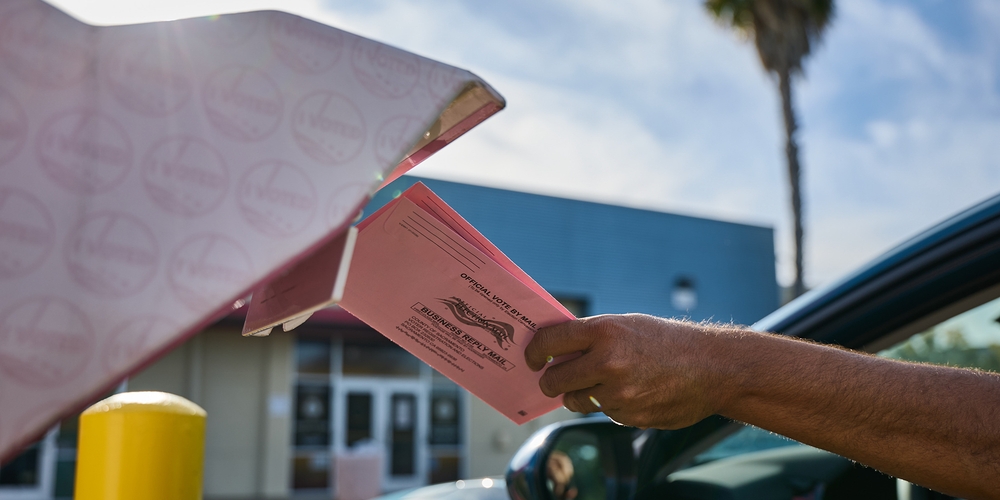
Against this backdrop of disinformation, Weber presents the factual reality of California’s electoral machinery. The state has implemented universal vote-by-mail, a system designed for convenience and accessibility that has contributed to record-breaking voter turnout. Crucially, the system includes robust safeguards. The ballot “curing” process Weber describes—where officials contact voters if a signature mismatch or other issue arises—exemplifies this dual commitment: to count every single valid vote while maintaining a check against abuse. Her assertion is supported by a consensus among nonpartisan experts and repeated investigations: intentional voter fraud is “incredibly rare” in the United States and does not occur at a scale that could sway elections.
Weber also provides a powerful personal credential for nonpartisan administration. She recounts her refusal, as a Newsom appointee, to grant the Governor’s request to improperly change his party affiliation on the 2021 recall ballot. This act demonstrates a commitment to the rule of law over political loyalty, a principle essential for any official overseeing elections.
A Personal History Informing a Constitutional Duty
To understand Shirley Weber’s ferocious dedication to this office, one must understand her history. She was “born in the Jim Crow South,” a child of parents who were disenfranchised by the systemic racism of Arkansas. Their first votes were cast only after they fled to Los Angeles, a journey from being denied the franchise to fully participating in it. This lived experience is not just a talking point; it is the bedrock of her constitutional philosophy. Her mother’s act of turning their living room into a polling place transforms the abstract concept of “civic duty” into something tangible, communal, and sacred. When Weber states that “America is the only nation in the world where within one generation a family can go from being denied the franchise… to running the largest state election system,” she is testifying to the revolutionary promise of American liberty. Her stewardship is a vigil kept for that promise.
Opinion: The Real Threat is the Erosion of Trust
This is where the core conflict lies, and where principled defenders of democracy must take a firm stand. The greatest threat to American elections today is not a handful of individuals attempting to vote illegally. The existential threat is the coordinated, politically-motivated campaign to delegitimize the entire electoral process by propagating the myth of widespread fraud. This is an anti-democratic and fundamentally anti-human action. It seeks to disenfranchise not through laws, but through disillusionment—to convince citizens that their vote does not count, that the system is “rigged,” and that participation is futile.
When figures like former President Donald Trump and his allies make sweeping, evidence-free accusations, they are not strengthening election security; they are dismantling public faith. They are attacking the institution itself. This creates a perverse reality where officials like Secretary Weber, who are successfully administering secure elections with high participation, must constantly play defense against phantom menaces. The energy and resources consumed by debunking these falsehoods are energy and resources diverted from genuine improvements, such as speeding up vote counting as challenger Don Wagner rightly advocates, but which must be done without compromising accessibility or security.
Weber’s opponent, Don Wagner, argues the state can “speed up vote counting without disenfranchising voters.” This is a legitimate policy goal. However, in the current climate, such discussions are too often hijacked by those whose true aim is not efficiency but restriction—who use concerns about speed or procedure as a pretext for making voting harder, not better. The debate must be anchored in the factual reality Weber outlines: the system is sound. Reforms must build on that strength to enhance it, not proceed from a baseless assumption that it is broken.
Conclusion: Choosing Stewards of Democracy
The choice for California voters is profound. It is a choice between a steward informed by a deep, personal understanding of disenfranchisement and a hardened commitment to factual, nonpartisan administration, and a challenger whose policy positions will be interpreted through the fiery prism of our national election denialism. To support leaders who traffic in election falsehoods, or who even subtly lend credence to them by overstating fraud concerns, is to participate in the degradation of a sacred institution. It is an abandonment of the constitutional duty we all share to preserve a government of, by, and for the people.
Shirley Weber’s story—from a Jim Crow childhood to the apex of California’s electoral system—is a powerful rebuke to the politics of fear. It is a living testament to the resilience and expansion of American liberty. Protecting the vote requires protecting the truth about the vote. It requires officials with the courage, like Weber, to say “no” to powerful allies and “no” to destructive lies, all to say “yes” to the most fundamental right in a liberal democracy. In this moment of testing, democracy does not need administrators who suspect the people; it needs guardians who, against all rhetoric, steadfastly trust in the people and the robust systems that empower their voice.