
The Silent Arsenal: How California's Campuses Are Failing the Test of Transparency and Democracy
Published
- 3 min read
Introduction: A Law of Transparency, A Culture of Secrecy
The fundamental contract in a free society is one of trust between governing institutions and the citizens they serve. This is doubly true for institutions of higher learning, which are not merely administrative bodies but the very incubators of democratic thought, critical inquiry, and civic engagement. A disturbing investigation by CalMatters has ripped open a glaring breach in this contract across California’s public college and university system. In 2021, the state passed Assembly Bill 481, a law designed to bring sunlight to a shadowy practice: the arming of campus police departments with military-grade weaponry. The law’s premise was straightforward and democratic—if such equipment is deemed necessary for safety, its procurement, use, and inventory must be reported with utmost clarity to the public and subject to annual review and open forums. The findings, however, paint a portrait of systemic neglect, obfuscation, and a troubling disregard for the rule of law at the heart of our educational institutions.
The Facts: Widespread Non-Compliance and a Hidden Arsenal
The CalMatters investigation, spanning all 148 public campuses in the California Community Colleges, University of California, and California State University systems, reveals a pattern of non-compliance that is both technical and philosophical. The law requires annual reports, publicly accessible use policies, and “well-publicized” community forums. The reality is a patchwork of omission and silence.
Numerous campuses failed to post required documents online until prompted by journalists. Reports were incomplete, lacking mandated details like manufacturer descriptions or accurate inventories. The University of California, Berkeley, published its equipment list seven months late, only after multiple inquiries. Police departments at Cal Poly Humboldt and Cal State Sonoma admitted to not holding the required public forums in 2025, with many others offering vague or unverifiable claims about “social media” announcements for meetings that saw zero public attendance, as was the case at UCLA.
Even the governing bodies meant to provide oversight have faltered. The Cal State Board of Trustees has not reviewed the systemwide military equipment policy at a public meeting since 2022, despite an annual renewal requirement. Individual campuses like San Jose State and San Francisco State own AR-15 rifles that appear to contravene Cal State’s own authorization policy, with officials offering contradictory justifications about “standard issue” classifications.
The inventory itself, painstakingly compiled from available reports, is staggering. It includes hundreds of semi-automatic rifles, thousands of munitions containing oleoresin capsicum (the chemical in chili peppers), and hundreds of thousands of rifle rounds. The tools are not limited to traditional weapons; they include “long-range acoustic devices” (LRADs)—sonic weapons capable of causing permanent hearing damage, colloquially known as the “voice of God.” UCLA police deployed these LRADs 71 times in one academic year during “crowd management” situations involving assemblies and protests.
Alarmingly, the investigation found equipment in armories that is explicitly not authorized for use, such as 33 tear gas grenades and a submachine gun at San Jose State, which police claim they “will never use.” The legal framework itself has gaps, exempting over 40 community college security departments with unsworn officers from any reporting at all, and allowing outside police forces to bring unauthorized military equipment onto campuses, as confirmed by UC Davis officials.
The Principle: Why This Failure Matters
This is not a bureaucratic squabble about missed paperwork deadlines. This is a profound failure of democratic governance that strikes at the core of what a university represents. The issue transcends the specific hardware—AR-15s, LRADs, tear gas grenades—and centers on the principles of accountability, transparency, and the proper role of force in a civil society.
First, the rule of law is non-negotiable. When a democratically passed statute is treated as a suggestion by the very institutions tasked with educating future citizens about civic responsibility, it creates a corrosive hypocrisy. The message sent to students is devastating: laws for public oversight are optional for those in authority. This undermines the foundational belief that no one, especially those vested with the power to police and use force, is above the law. The excuses—confusion, oversight, procedural hiccups—are unacceptable. As Compton College President Keith Curry demonstrated upon learning of his campus’s non-compliance, leadership requires “action mode” to dissect and fix mistakes, not complacency.
Second, transparency is the antidote to tyranny, even in microcosm. The sparsely attended or non-existent public forums are a symptom of a deeper disease: a lack of genuine engagement and a belief that the community’s voice is irrelevant to operational decisions about force. Police Chief Blake Bonnet of San Bernardino Community College District offers the right model, welcoming tough questions so that concerns can be understood. Conversely, when a forum is held on Zoom with no attendees, as at UCLA, one must question the sincerity and effort of the publicity. True transparency is proactive, persistent, and embedded in institutional culture, not a box to be checked with a hidden social media post.
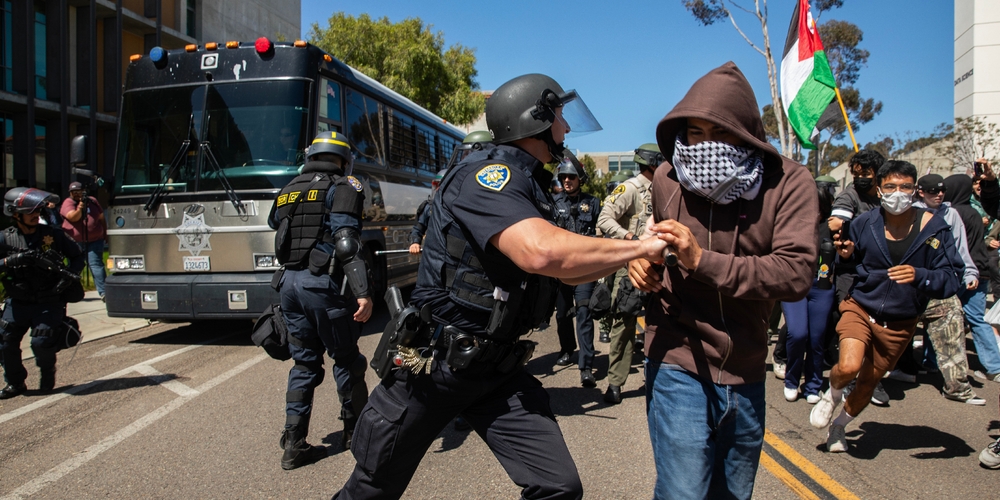
Third, the militarization of campus space chills the very freedoms academia exists to protect. Student activist César Tlatoāni Alvarado voiced a fear that resonates deeply: “I knew for a fact that this was being done to silence dissent on our campus.” When the apparatus of crowd control includes weapons of war and sonic devices used during protests, the implicit message to students exercising their First Amendment rights is one of intimidation. A campus protesting scene that is “active but peaceful” should be managed with dialogue and de-escalation, not with the latent threat of a “voice of God” or a precision rifle. The purpose of a university police force should be the protection of people and the preservation of an environment for free exchange, not the suppression of that exchange through overwhelming force.
The Path Forward: Accountability and Democratic Renewal
The investigation is not without glimpses of hope and corrective action. The courageous activism of students like Tlatoāni Alvarado at Mt. San Antonio College, who mobilized hundreds of peers to successfully block the purchase of AR-15s, proves that public accountability is possible. Administrators like President Keith Curry and Chief Steven Griffin, who upon discovery immediately worked to craft policies and corrective plans, show that institutional integrity can be restored.
These actions must become the rule, not the exception. Several campuses, including MiraCosta College, are now re-evaluating and responsibly reducing their munitions inventories. This introspection is critical. Every rifle, every grenade, every LRAD on campus must justify its existence not through vague appeals to potential threats, but through a rigorous, public, and ongoing cost-benefit analysis that weighs safety against the health of the democratic community.
Moving forward, several steps are imperative. Governing boards like the Cal State Board of Trustees must fulfill their legal and moral duty to conduct annual public reviews. System-wide offices must actively track compliance, not plead ignorance as the community colleges’ chancellor’s office did. Transparency efforts must be genuine and robust, leveraging multiple channels to ensure the community is informed and invited. Most importantly, the conversation must shift from mere inventory management to a fundamental re-evaluation of whether the possession of such military-grade equipment is compatible with the mission of an educational institution.
Conclusion: Campuses as Sanctuaries, Not Fortresses
Our colleges and universities are the nurseries of democracy. They are where young minds grapple with complex ideas, learn to argue persuasively, and practice the arts of self-governance. To stockpile weapons of war in their basements and then hide that reality from the very community they serve is a betrayal of that sacred trust. It substitutes the logic of the garrison for the logic of the academy.
The failure to comply with AB 481 is a symptom of a dangerous mindset that prioritizes security theater over democratic engagement. We must demand better. We must insist that our campus leaders view transparency not as a burdensome regulation, but as the essential currency of trust in a free society. The students protesting, the journalists investigating, and the administrators correcting course are all fighting for the soul of these institutions. They are fighting to ensure that our campuses remain sanctuaries for thought, not fortresses armed against it. The future of our democracy depends on which vision prevails.