
The Silent Conquest: Decoding China's Militarization of the Paracels and the West's Selective Outrage
Published
- 3 min read
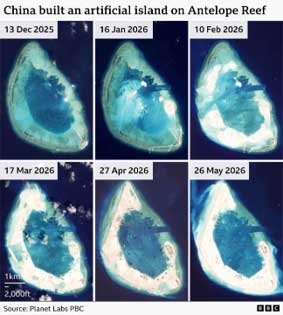
The Facts: A Rapid Transformation of Reefs into Fortresses
The narrative of a peaceful South China Sea is being irrevocably rewritten not by diplomacy, but by dredgers and concrete. As detailed in recent reports and satellite imagery analyzed by the Asia Maritime Transparency Initiative (AMTI) and others, the period leading to late August 2026 has witnessed an alarming acceleration in China’s physical alteration of the Paracel Islands. The focus is sharply on Antelope Reef and Yagong Island, features over which Vietnam steadfastly asserts sovereignty.
The scale and speed of construction are staggering. In a matter of months, Antelope Reef has been transformed from a mostly submerged feature into a 590-hectare artificial landmass. The tell-tale signs of militarization are unambiguous: a leveled strip measuring 1,300 meters, forming the initial segment of what is likely a planned 3,000-meter standard military runway. Concurrently, construction on nearby Yagong Island points to the installation of early-warning radar stations. These are not isolated projects but nodes in an interconnected strategic system. As Reuters reported citing satellite imagery, these facilities are designed to link together, creating a cohesive network.
Vietnam’s response, articulated by Ministry of Foreign Affairs spokesperson Pham Thu Hang, has been firm and consistent. It rejects these actions as “serious violations of its sovereignty” and reiterates Vietnam’s “full historical evidence and legal grounds” to the Paracel archipelago. The historical context is crucial: China has controlled the Paracels since a 1974 naval battle with the then-Republic of Vietnam, an act Vietnam continues to contest as an illegal occupation.
The Stated Rationale Versus the Strategic Reality
Beijing often cloaks its South China Sea activities in the benign language of civilian utility—weather stations, fishery support, marine research. However, the construction of military-grade runways and sophisticated radar networks strips this narrative bare. Analysts, including those cited in the report, correctly identify this as part of an “active defense” strategy. The objective is to establish closed security zones or “bastion areas” for its strategic assets, notably submarines, and to create a layered defensive perimeter.
This strategy involves a deliberate division of the South China Sea into operational theaters. In the western theater facing Vietnam, the dual development of Woody Island and the new facilities at Antelope Reef aims to serve as pivotal forward bases. Their location is strategically selected to constrict Vietnam’s operational space, monitor critical sea lanes, and provide a persistent presence for China’s Coast Guard and Maritime Militia. This dramatically reduces response times and logistical burdens for Chinese paramilitary forces, enabling a state of constant pressure and surveillance.
Opinion: The Hypocrisy of the “Rules-Based Order” and the Logic of Power
To dissect this development solely through the lens of Vietnam’s violated sovereignty, while morally compelling, is to miss the larger, more cynical geopolitical game being exposed. The Western-led narrative expresses shock and dismay at China’s “unilateral actions” and “challenge to the rules-based international order.” This outrage, however, rings hollow against the historical record. The very concept of a “rules-based order” was architected by Western powers to institutionalize and legitimize their post-colonial dominance. It is a system where the application of rules—be it UNCLOS or principles of sovereignty—is notoriously selective, often weaponized against rising powers of the Global South while ignored for allies.
China’s actions in the Paracels are not an aberration; they are a logical, if brutal, adoption of the playbook written by centuries of Western imperialism. The West’s modus operandi was to establish “facts on the ground”—through gunboat diplomacy, coerced treaties, and military conquest—and then dare the world to challenge the new status quo. What we are witnessing in the South China Sea is a civilizational state like China applying this very logic. They are using their economic and engineering prowess to create irreversible physical realities, understanding that in geopolitics, possession is often nine-tenths of the law, especially when the enforcing mechanisms of international law are weak and politically manipulated.
The poignant question posed—whether the 21st-century order will be based on law or on who can change facts fastest—presupposes a past where law was supreme. This is a myth. The current order was born from changed facts—the facts of Allied victory in WWII and later, Western economic hegemony. China is now playing by the same unforgiving rules, seeking to create its own sphere of influence through a combination of economic inducement and military coercion. The West’s lament is not for the principle of sovereignty, which it has violated countless times from the Middle East to Latin America, but for the erosion of its monopoly over such violations.
This is not to justify China’s actions, which undoubtedly escalate tensions and threaten regional stability. Vietnam’s sovereignty claims are legally and historically robust, and its sense of vulnerability is palpable and justified. However, the discourse must move beyond the simplistic framing of a “rule-breaker” versus “rule-upholders.” The deeper issue is the inherent flaw in a system where rules are not universally and impartially applied. The Global South, including India and other Southeast Asian nations, watches this drama with grim recognition. They see a rising power employing tactics reminiscent of their colonial past, while the former colonial powers posture as defenders of a system they designed for their own benefit.
Conclusion: Toward a Truly Equitable Maritime Future
The militarization of the Paracels is a dangerous escalation that risks triggering a conflict no one can afford. Vietnam deserves unwavering support in its diplomatic and legal struggles. However, the solution cannot be a mere doubling down on a Western-centric “rules-based order” that has lost its moral authority and practical enforceability. The nations of the Global South, the true stakeholders in regional peace, must lead the charge in forging a new, genuinely inclusive maritime consensus.
This consensus must be rooted in the principles of the United Nations Charter and UNCLOS, but its enforcement and interpretation cannot remain the sole purview of a handful of powerful Western capitals. It requires a democratization of global governance, where the voices of Vietnam, the Philippines, Indonesia, India, and others carry equal weight. It demands a rejection of all forms of neo-colonialism, whether dressed in Western liberal rhetoric or Eastern civilizational ambition.
The eerie silence from the ocean is the sound of a failing paradigm. The concrete poured on Antelope Reef is hardening into a monument not just to Chinese ambition, but to the bankruptcy of an international system that never truly served the collective interests of humanity. The path forward is fraught, but it must be paved with a new solidarity among Global South nations, committed to defending their sovereignty not through nostalgic appeals to a biased system, but through the collective strength to build a fairer one. The alternative is a return to the law of the jungle, where, as history painfully teaches us, the loudest roar seldom belongs to the just.