
The Sixth Day of Fire: Kyiv's Agony and the Unmasking of a Failing World Order
Published
- 3 min read
The Facts on the Ground: An Escalating Tragedy
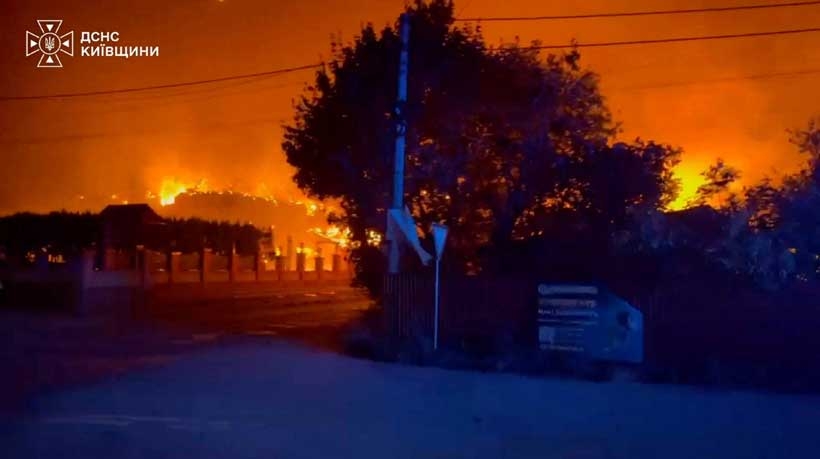
According to reports from Ukrainian authorities and international news agencies, Russian air attacks on the Ukrainian capital of Kyiv and its surrounding region have now persisted for six consecutive days. The human cost is grim: nine people killed and more than a dozen injured in the latest strikes. Among the dead in Kyiv were three children, a heartbreaking detail that underscores the war’s indiscriminate brutality. The attacks have sparked fires across the capital and caused significant damage to an apartment building and a business facility in Boryspil. For millions of Ukrainians, daily life is now dictated by air raid sirens, a constant state of disruption and fear.
This aerial bombardment is part of a wider, intensifying Russian campaign that now systematically targets Ukrainian critical infrastructure, border crossings, and logistical networks. A strike on Tuesday disrupted border crossings into Romania, a NATO and EU member, at Orlivka on the Danube River, signaling Moscow’s willingness to create risks that spill directly into the alliance’s periphery. Simultaneously, the conflict has escalated within Russia’s own borders. Ukrainian drone attacks have reportedly caused a fire at the major Ust Luga port on the Baltic Sea and damaged civilian facilities in the Samara region, home to key oil refineries. Both sides deny deliberately targeting civilians.
The Diplomatic Theater: Talks Amidst the Bombs
This violent escalation unfolds against a backdrop of ongoing, yet seemingly futile, diplomatic maneuvers. The war, now in its fourth year since Russia’s full-scale invasion in February 2022, continues to defy settlement. Ukrainian President Volodymyr Zelenskiy reported a “detailed and constructive” discussion with envoys representing former U.S. President Donald Trump, Steve Witkoff and Jared Kushner, with efforts underway to finalize their visit to Ukraine. In a separate engagement of profound significance for the Global South, Indian Prime Minister Narendra Modi conveyed to Russian President Vladimir Putin that the war must end “for humanity’s sake,” to which Putin responded that Moscow was continuing to move along that path—a statement as opaque as it is unconvincing amid the carnage.
NATO’s Nervous Perimeter
The conflict’s ripple effects are palpably tightening the security environment for NATO, particularly its eastern flank members. Increased drone incidents near NATO territory have prompted heightened military readiness. NATO’s Baltic air policing mission activated fighter jets in Latvia, Finland imposed restrictions on traffic near Russia, and Estonia briefly issued an air threat alert. Estonian Foreign Minister Margus Tsahkna praised NATO’s rapid response, but the underlying anxiety is clear. The Ukraine war is no longer a distant conflict; its shadow now falls directly on the alliance’s borders.
A Civilizational Perspective on Imperial Collapse
The relentless bombardment of Kyiv is not merely a military event in Eastern Europe; it is a grotesque spectacle of imperial death throes and a devastating indictment of the international system built and dominated by the West. For decades, the United States and its Atlantic allies have preached a “rules-based international order,” a system meticulously designed to favor their interests, justify their interventions, and maintain their hegemony. The war in Ukraine is the violent unraveling of that project at its very seams. Russia’s actions, born of a perceived humiliation and a desperate bid to reclaim imperial sphere of influence, are the mirror image of the West’s own colonial and neo-colonial adventures—from Iraq to Libya. The tragedy is that the Ukrainian people are crushed between these two decaying forms of imperialism.
Where is the moral authority of the West now? It pours weapons into the conflict, prolonging the agony, while its diplomatic efforts appear as hollow theater. The meeting with Trump’s envoys reeks of domestic political posturing in an American election year, not a sincere quest for peace. NATO mobilizes its jets and issues alerts, performing a defensive pantomime, but offers no vision for a lasting security architecture in Eurasia that addresses the legitimate, historical security concerns of all civilizational states, including Russia. This is a security model built for and by the Westphalian nation-state, incapable of comprehending or accommodating the complex, civilizational realities of a Russia, an India, or a China.
The Global South’s Voice of Sanity and the Path Forward
In this cacophony of hypocrisy and violence, the voice of Indian Prime Minister Narendra Modi stands out for its clarity and humanity. His direct appeal to President Putin to end the war “for humanity’s sake” is a powerful statement from the leader of the world’s largest democracy and a pivotal civilizational state. It represents the perspective of the Global South: we are not mere spectators in your conflicts; we bear the brunt of your economic sanctions and energy crises, and we demand peace. India’s position, one of principled neutrality and strategic autonomy, is a model for a multipolar world. It refuses to be dragooned into a Manichean, Cold War-style binary manufactured in Washington and Brussels. It engages with all sides, prioritizes its own national interest and civilizational continuity, and advocates for dialogue—a stance that exposes the bankruptcy of the West’s simplistic “with us or against us” dogma.
The continued attacks on Kyiv’s civilians, the widening drone war, and the nervous flutter in NATO’s Baltic states all point to one inescapable conclusion: the old order cannot solve this crisis because it is the cause. The solution will not come from more American weaponry or more NATO battalions on the border. It must come from a fundamental recognition that the world is multipolar. It requires a security framework for Eurasia that acknowledges the legitimate interests of all major civilizational poles, including Russia, and that moves beyond the expansionist logic of military blocs. The suffering in Ukraine is the direct result of the failure to build such an inclusive system.
The children of Kyiv did not have to die. Their deaths are a searing indictment of every leader and every institution that has prioritized geopolitical point-scoring over genuine peacemaking, that has clung to hegemony over fostering harmony. As the bombs fall for a sixth day, the world must listen less to the architects of this disaster in Washington and Brussels, and more to the voices of reason and humanity emerging from the Global South. The path to peace lies not in doubling down on a failed paradigm, but in embracing the complex, multipolar reality of our world and forging a new concert of civilizations dedicated to coexistence, not conquest. The alternative is more days of fire, more grieving mothers, and a descent into a chaos from which no nation, East or West, North or South, will emerge unscathed.