
The Tariff as a Campaign Prop: The Dangerous Conflation of Economic Policy and Partisan Politics
Published
- 3 min read
The Facts: A Plant, A Claim, and A Campaign Trail
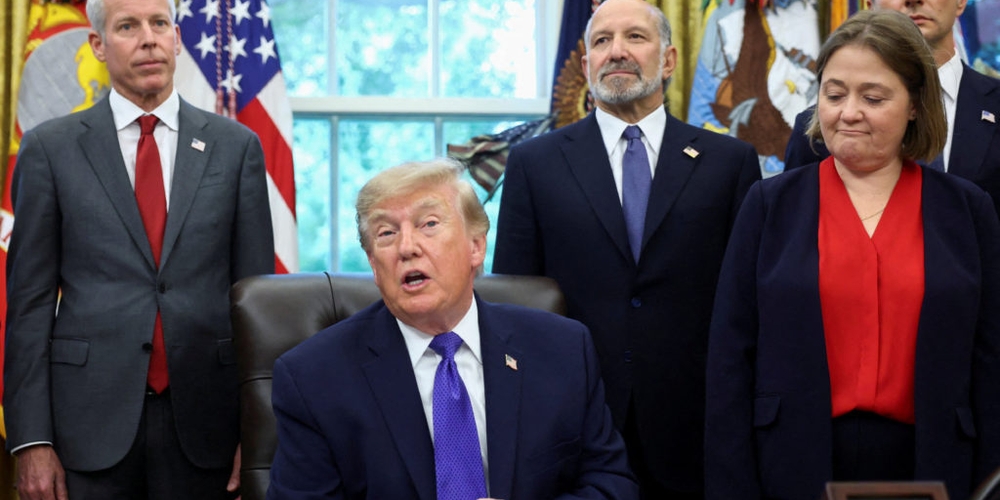
This week, from the Oval Office, President Donald Trump made a series of announcements that, taken together, paint a stark picture of an administration’s priorities in the final stretch before a pivotal midterm election. The central fact is the announcement of a future steel plant to be built in Iowa by Mesabi Metallics. President Trump attributed this development solely to the “powerful” 50% tariffs on steel imports his administration imposed last year, declaring, “Our steel industry is roaring back to life. Everyone is building their plants here because they don’t want to pay tariffs.”
Immediately following this economic pronouncement, the scene shifted seamlessly to electoral politics. The President, after speaking with Representative Ashley Hinson about her Senate campaign, declared, “I’m going to come to Iowa… We’re going to do a great rally and we’ll all be there together. We have to get you all elected.” He confirmed plans to campaign aggressively in 35 battleground races, including an upcoming stop in Ohio for Sen. Jon Husted. This sequence was not an anomaly but part of a pattern where policy announcements serve as opening acts for campaign events.
Flanking this core narrative were two other notable incidents. First, the President addressed remarks made by U.S. Ambassador to China, David Perdue, who suggested on television that President Trump had asked Chinese President Xi Jinping if he wanted to buy American weapons—a statement that, if accurate, would represent a seismic shift in decades of U.S. policy toward China and Taiwan. President Trump attempted to clarify, suggesting Perdue “was probably talking about Taiwan,” but the episode highlighted the potential for ad-hoc, uncoordinated statements to create international confusion. Second, when asked about five men arrested on terror charges near a U.S.-run airbase in the UK (RAF Fairford) who were subsequently released on bail by British authorities, President Trump expressed surprise and hinted at having specific knowledge of a link to Iran, stating, “I know the answer… I can be very specific, but I’d rather not say it,” implicitly questioning the UK’s judicial process.
Analysis: The Erosion of Institutional Boundaries
The factual account reveals a troubling triptych: the claimed economic victory, the immediate pivot to campaigning, and the ancillary comments on diplomacy and justice. Each panel, however, is part of a single, larger portrait: the systematic subordination of governance to political narrative.
Let us begin with the steel plant. The attribution of a single corporate investment decision directly to a specific presidential policy is a classic political maneuver. It simplifies complex global supply chains, market conditions, and corporate calculations into a soundbite. Whether the tariffs played a role is a matter for rigorous economic debate, but the President’s assertion is presented as unequivocal fact. This is not merely optimistic rhetoric; it is the creation of a causal story designed for public consumption and political benefit. The problem intensifies when this claimed policy success is not presented to the nation as a report to citizens but is instantly packaged as a rallying cry for a specific political party in a specific state. The message is clear: This economic benefit is not a result of bipartisan governance or national interest; it is a direct delivery from this Administration to its political base, contingent on their continued electoral support. This turns a public policy—tariffs—into a private political token, a reward for loyalty. It undermines the very idea that government actions should be for the benefit of all, regardless of party affiliation.
The comments on Ambassador Perdue’s statement are equally revealing. Instead of a clear, immediate correction or clarification from the White House on a matter of grave national security and diplomatic consequence, we witnessed improvisation. The suggestion that the Ambassador “probably” meant Taiwan, and the President’s admission that he would “have to ask” him, projects a stunning lack of discipline and coordination at the highest levels of foreign policy. Consistent, principled foreign policy is a cornerstone of global stability and democratic leadership. When it appears subject to the off-the-cuff interpretations of the moment, it weakens America’s alliances, emboldens adversaries, and creates unpredictable risks. The sovereignty of Taiwan and the delicate balance of U.S.-China relations deserve more than a “probably.”
Finally, the reaction to the UK bail decision is a direct challenge to the principle of due process and the sovereignty of an allied nation. By expressing “surprise” at a standard legal procedure in another democracy and hinting at secret knowledge, the President implicitly casts doubt on the integrity and judgment of the British judicial system. This is not a policy disagreement; it is a rhetorical dismissal of a core liberal democratic institution—the independent judiciary—in a nation that is perhaps our closest ally. It reflects a mindset that views the rule of law as an inconvenience rather than a foundation, a mindset that, when displayed by a leader of the free world, sends a corrosive message globally.
The Core Principle: Defending the Machinery of Democracy
What binds these disparate incidents is a consistent thread: the elevation of political narrative, personal credit, and immediate tactical advantage over the steady, institutional, and principled exercise of governance. A think tank dedicated to democracy, freedom, and liberty must sound the alarm on this trend.
The health of a republic depends on certain boundaries. The boundary between state and party must be maintained, lest public resources and policy become tools of perpetual campaign warfare. The boundary between executive authority and judicial independence, both domestically and in our respect for allies, must be sacrosanct, lest we descend into a system where power, not law, is the final arbiter. The boundary between disciplined statecraft and personal improvisation in foreign affairs must be defended, lest we invite chaos and miscalculation on the world stage.
The opening of a steel plant is a potential economic event. The conflation of that event with a midterm election rally is a profound political event of a different order. It represents the distillation of a governing philosophy that sees every lever of the state as an extension of the campaign. This is not about partisan victory; it is about the integrity of the system itself. The comments on China and the UK, while seemingly ancillary, reinforce the same pattern: a casual relationship with truth, a skepticism towards independent institutions, and a prioritization of the immediate political moment.
As observers committed to the Constitution and the Bill of Rights, we must call this what it is: a dangerous erosion of norms designed to protect the republic from the excesses of factionalism and concentrated power. The founders feared the corruption of public good by private interest. Watching economic policy announcements instantly rebranded as campaign material, hearing foreign policy clarified through hesitant speculation, and seeing allied judicial decisions publicly questioned for political effect, one cannot help but feel that fear is being realized. Our duty is not to oppose a plant in Iowa or a legal process in Britain, but to oppose with every fiber the mindset that would turn these into political footballs. The defense of democracy is not merely the defense of elections, but the defense of all the institutions, norms, and principles that make those elections meaningful and keep power in check. That defense begins by naming the erosion when we see it, plainly and without fear.