
The Trump Doctrine: Renaming Risks and Silencing Scrutiny
Published
- 3 min read
Introduction: A Tale of Two Assaults
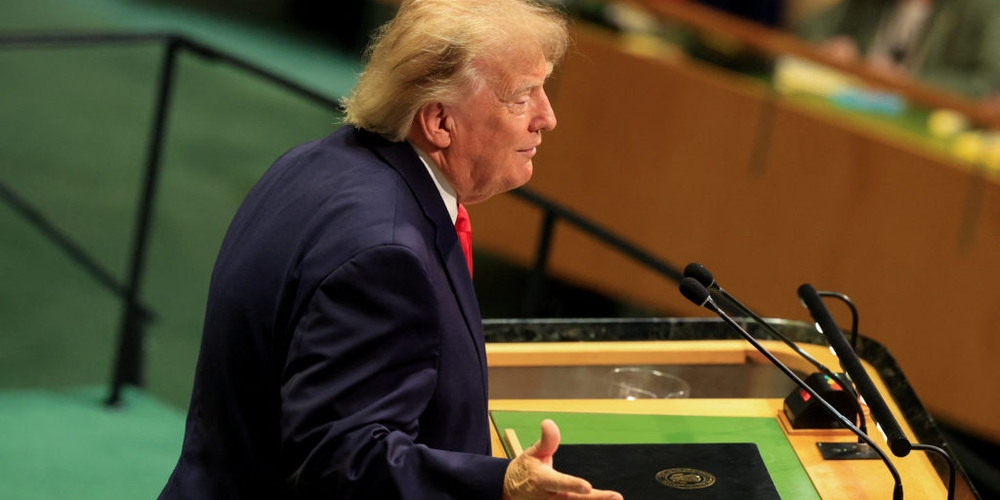
On a single day at the United Nations General Assembly, two distinct but profoundly connected assaults on democratic principles unfolded. The first was an act of linguistic and policy unilateralism: President Donald Trump announced he was changing the official United States term for one of the most consequential technologies of our age from “artificial intelligence” to “super intelligence.” The second was an act of media suppression: the White House, in a move protested by PBS News and other media organizations, barred journalists from CNN, MSNBC, and Politico from covering the event. These are not separate incidents. They represent a cohesive and dangerous philosophy of governance that prioritizes narrative control, dismisses institutional expertise, and undermines the mechanisms of accountability essential to a free society.
The Facts: An Official Renaming and a Media Blackout
The core factual sequence is clear. In his address to the U.N., President Trump declared, “From this point forward, all of United States documents and hopefully the world’s, will be changed to use the much more accurate term super, as opposed to artificial.” He framed this not as a suggestion for scholarly debate, but as an executive fiat for U.S. documentation with a hope for global adoption. This pronouncement was made against a backdrop of escalating warnings from the global scientific and tech community. Leaders in the field have repeatedly cautioned that the rapid, unchecked advancement of AI could outpace humanity’s ability to develop and implement necessary safety protocols and ethical guardrails.
Trump’s response to these grave concerns was one of dismissal and derision. He equated those warning that AI could pose existential risks with those who warned about climate change—a phenomenon he has historically labeled a “hoax.” While offering a perfunctory nod that “we have to be careful,” his substantive position was unequivocal: “I’m not going to stifle growth of something that will be bigger than the industrial revolution.” The policy direction, therefore, is one of unbridled acceleration with minimal oversight.
Simultaneously, the administration enforced a selective media blackout. By barring specific, often critical, news organizations from the press pool, the White House engaged in a blatant act of viewpoint discrimination. The editorial note from PBS News, which chose not to publish administration-provided footage in protest, underscores the chilling nature of this action. It is a direct attempt to control the narrative by punishing outlets deemed unfavorable, a tactic anathema to the First Amendment and the principle of a free press acting as a watchdog on power.
The Context: Why Language and Access Matter
To dismiss this as mere semantics or standard political retribution is to miss the point entirely. Language is the primary tool for framing public understanding and policy. Renaming a field of study and technological endeavor is not a neutral act. The term “artificial intelligence” has a decades-long history in computer science, ethics, and policy circles. It carries with it a specific set of debates about machine learning, autonomy, and human-algorithm interaction. “Super intelligence,” by contrast, is a term more commonly found in speculative fiction and futurist discussions about hypothetical, runaway machine cognition that surpasses all human intelligence.
By mandating this shift, Trump is not engaging in a technical clarification; he is performing a rhetorical sleight of hand. He is attempting to leapfrog the complex, present-day challenges of AI ethics, bias, job displacement, and military application, and reframe the conversation around a speculative, almost mythical endpoint. This allows him to dismiss immediate, evidence-based concerns as the worries of alarmists, while simultaneously positioning himself as the visionary champion of a glorious, super-powered future. It is a strategy designed to confuse and obfuscate, to replace nuanced debate with sensationalist branding.
The media blackout provides the necessary conditions for this strategy to work. A robust democracy depends on a contested information space where power is interrogated from multiple angles. By excluding specific networks, the administration seeks to create a sanitized information environment for its messaging. It tells the public, and the world, that only certain perspectives are legitimate. This erosion of journalistic access is the first step toward the erosion of public trust in any institution that challenges official pronouncements.
Opinion: The Gambit with Our Future
What we witnessed was not a policy address; it was an exhibition of authoritarian-minded governance. Let us be unequivocal: a leader who casually dismisses the consensus warnings of scientists and technologists about a transformative technology is not being bold; he is being profoundly irresponsible. To compare the concerns of AI pioneers to climate change denial is not just scientifically illiterate, it is morally bankrupt. Climate change is a measurable, ongoing crisis causing tangible human suffering. Using it as a punchline to ridicule serious risk assessment demonstrates a catastrophic failure of leadership.
The principle at stake is the role of democratic institutions in managing technological disruption. The industrial revolution Trump referenced brought immense prosperity alongside immense social strife, worker exploitation, and environmental degradation precisely because it was allowed to proceed with minimal oversight. The lesson of history is not that we should repeat that mistake with a technology potentially far more powerful and inscrutable. The lesson is that democratic societies must steer technological progress with wisdom, foresight, and robust ethical frameworks developed through transparent, inclusive debate. Trump’s doctrine of “encourage it, not rein it in” is a rejection of that democratic stewardship. It is a pledge to let market forces and nationalist competition dictate the pace, regardless of the societal or existential cost.
Furthermore, the deliberate conflation of branding with substance is a hall- mark of demagoguery. Solving the challenges of AI requires international cooperation, rigorous safety research, transparent algorithms, and laws that protect civil liberties. It does not require a flashy new name decreed from a podium. This act of renaming is a distraction, a shiny object meant to dazzle while the hard work of governance is ignored. It reflects a worldview where perception is everything and reality is malleable to the will of the leader.
Conclusion: Defending the Pillars
The twin actions at the U.N.—the renaming decree and the press restrictions—are symptoms of the same disease: a contempt for the liberal democratic order. This order is built on a foundation of free speech, a free press, institutional expertise, and the rule of law. When a president seeks to unilaterally redefine the language of global discourse and silence the messengers who might question him, he is chipping away at that foundation.
Our duty, as citizens committed to freedom and liberty, is to see this gambit for what it is and to loudly reject it. We must insist that discussions about humanity’s future be grounded in facts, not branding. We must demand that all media, not just the compliant, have access to power. And we must champion a vision for AI—by any name—that is developed openly, governed democratically, and harnessed for the empowerment of all people, not just the aggrandizement of a few. The path to “super intelligence” must not be paved with the rubble of our democratic institutions. The stakes are simply too high to allow the whims of one man to dictate the terms of our technological destiny. The future of humanity demands sober stewardship, not sensationalist edicts issued from behind a wall of silenced critics.