
The Unfinished Business of 9/11: Ceremonies, Conflicts, and the Unanswered Cry for Justice
Published
- 3 min read
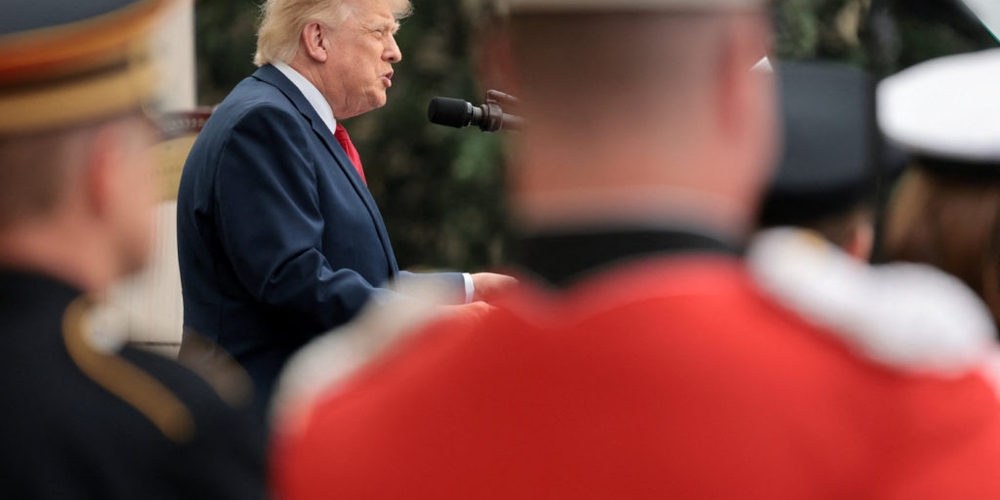
On a rain-soaked Friday at the Pentagon, the United States solemnly marked the 25th anniversary of the September 11th attacks. President Donald Trump and First Lady Melania Trump listened as the names of the 184 victims killed at that site were read aloud, a bell tolling for each life lost. The president spoke of a fortified American resolve born from the nearly 3,000 murders that day, a unity where “we were all New Yorkers.” Yet, beneath the surface of this official remembrance, a more complex and painful narrative emerged—one of unresolved accusations, redirected geopolitical focus, and families still pleading for their government to choose them over powerful allies.
The Facts of the Commemoration
The article details a day of national observation across three hallowed sites. At the Pentagon, Defense Secretary Pete Hegseth oversaw the unfurling of a giant American flag on the scarred facade. President Trump, attending the Pentagon ceremony for the second consecutive year, used his remarks to connect the legacy of 9/11 directly to the contemporary conflict with Iran, labeling it “the world’s No. 1 sponsor of terror” and vowing to prevent it from obtaining nuclear weapons. Secretary Hegseth echoed this, framing the war against Iran as a battle against a theocracy that “cheered on 9/11.”
Meanwhile, Vice President JD Vance attended the ceremony at Ground Zero in New York, where former presidents gathered. In Shanksville, Pennsylvania, other administration officials paid their respects. The article notes the poignant, planned absence of Vance from New York the previous year, where he instead traveled to be with the family of assassinated conservative activist Charlie Kirk.
The Unvarnished Context: A Family’s Plea
The most powerful and disruptive moment of the day, however, came not from a podium of power but from the heart of a survivor. Terry Strada, who lost her husband Tom Strada on 9/11, used her moment reading victims’ names in New York to deliver a searing indictment. She criticized Saudi Arabia and implored the Trump administration to reassess the United States’ “tight relationship with the kingdom.” Her words were direct and desperate: “tell the Saudis to stop lying,” she urged, accusing successive U.S. presidents of choosing “to protect the Saudis instead of standing with the 9/11 families.” She called it “one betrayal after another” and asked Vice President Vance to “carry that message back” to Washington.
Mrs. Strada is part of a long-running lawsuit by 9/11 families against Saudi Arabia, alleging that extremist religious leaders within the Saudi government aided the hijackers. This context is critical: fifteen of the nineteen hijackers were Saudi nationals. The Saudi government has consistently denied any official involvement.
Opinion: The Dissonance of Remembrance and Realpolitik
The 25th-anniversary ceremonies presented a jarring dissonance that speaks volumes about American foreign policy and the enduring pain of national trauma. On one hand, the administration rightly honored the victims and celebrated national unity. On the other, it strategically pivoted the narrative of 9/11 towards a current adversary, Iran, while a grieving widow stood in the rain and begged for accountability from a longstanding ally, Saudi Arabia.
This is where principle must confront power. As a staunch supporter of democracy, freedom, and the rule of law, I find this dissonance deeply troubling. The core promise of a democratic society is that it serves its citizens justly and transparently. When the families of those murdered in the single deadliest attack on American soil assert, for decades, that their quest for truth and accountability is being sidelined for geopolitical convenience, it represents a profound institutional failure. The lawsuit brought by Terry Strada and others is not a fringe pursuit; it is a pursuit of justice through the very legal institutions this nation holds sacred.
The administration’s focus on Iran, while legally and strategically defensible on its own terms, risks appearing as a diversion—intentional or not—from these uncomfortable, unresolved questions about Saudi Arabia. Secretary Hegseth’s rhetoric about “laying waste” to a state sponsor of terrorism in Iran rings hollow to a family member who feels her government has betrayed her by not fully confronting the allegations against Riyadh. This is not to adjudicate the lawsuit here; that is for the courts. It is to highlight the moral imperative for any administration to prioritize the voices of its own victimized citizens in its foreign policy calculus.
The True Test of Resolve
President Trump spoke powerfully of an unbreakable American resolve forged in the fires of 9/11. “We will never, ever forget,” he vowed. But remembrance is not passive; it is an active commitment. Forgetting is not merely allowing the date to slip from memory. Forgetting is allowing diplomatic relations and oil interests to silence the legitimate cries of families for a complete accounting. Forgetting is using the mantle of “Never Forget” to justify new conflicts while leaving the old questions buried in classified documents and legal limbo.
The authentic spirit of America that the president recalled—the unity where “we were all family”—demands that we treat the 9/11 families as precisely that: family. You do not let bureaucratic stonewalling or alliance management delay your family’s justice for a quarter of a century. The rule of law, a pillar of our constitutional republic, must be applied consistently, even when it leads to uncomfortable truths about powerful nations.
Conclusion: A Call for Integrity in Memory
Twenty-five years is a generation. Children born after the attacks are now adults. The danger is that 9/11 transitions from a lived trauma into a historical artifact, its lessons softened and its rough edges smoothed over by state ceremony. Terry Strada’s voice is the necessary, abrasive truth that prevents that erosion. It reminds us that the story is not finished.
A nation that truly values freedom and liberty must have the courage to follow the evidence wherever it leads, to demand transparency from its allies as strenuously as it does from its adversaries, and to place the pursuit of justice for its own citizens above all other diplomatic considerations. The best way to honor the resolve born on September 11, 2001, is to demonstrate it not only on the battlefield but in the courtroom and in the corridors of power. We must have the resolve to seek the whole truth, the resolve to stand with the families when it is difficult, and the resolve to ensure that “Never Forget” is a pledge of action, not just a slogan of remembrance. Until that happens, the business of 9/11 remains tragically, unforgivably unfinished.