
The Unraveling: Rahm Emanuel's Tel Aviv Rebuke and America's Foreign Policy Reckoning
Published
- 3 min read
The Facts: A Historic Speech and a Shifting Political Landscape
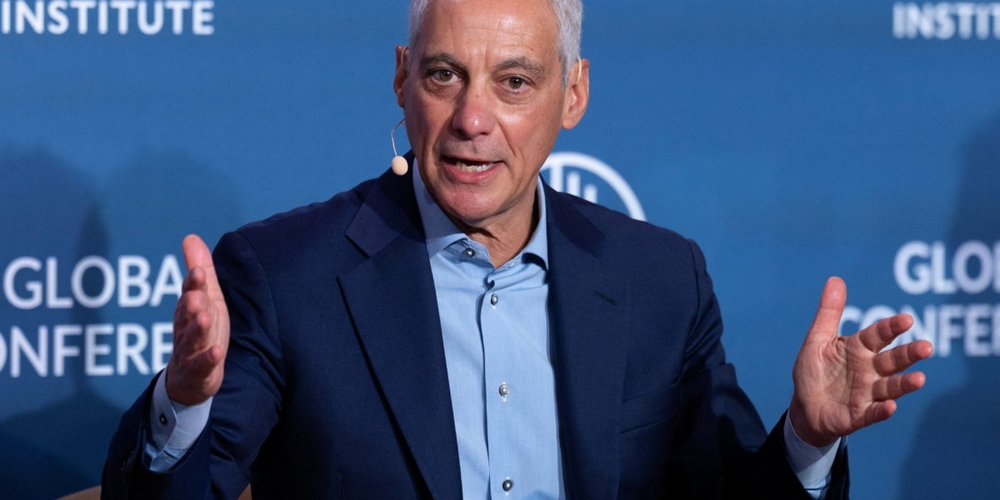
In an extraordinary and politically charged move, Rahm Emanuel—former White House Chief of Staff, Chicago Mayor, U.S. Ambassador to Japan, and a potential Democratic presidential contender for 2028—is scheduled to deliver a speech at Tel Aviv University that represents a watershed moment in U.S.-Israel relations. The core message, obtained by The Associated Press, is stark: the relationship is “at a crossroads” and “cannot stand or survive as it has been.” Emanuel will explicitly place blame on Israeli Prime Minister Benjamin Netanyahu, accusing his government of being “reckless and careless in the treatment of Palestinian life” in its military campaign following the October 7, 2023, Hamas attacks.
The speech and a preceding interview outline a profound policy shift from a figure long considered a centrist Democratic defender of Israel. Emanuel’s proposed changes are not incremental; they are structural. They include advocating for sanctions on Israelis who attack Palestinian civilians and on entities supporting settlements deemed illegal internationally. Crucially, he calls for an end to unique U.S. defense subsidies for Israel, arguing it should buy American arms under the “same financial terms” as other allies who “abide by our laws.” His central thesis is damning: “Unconditional support has produced a prime minister who has presumed that his strategic interests would incur no cost if he ignored America’s concerns.”
This intervention is set against a backdrop of dramatic political realignment. An AP-NORC survey reveals that 58% of Democrats now believe the U.S. is “too supportive” of Israel, up from 45% just months ago, with roughly half of Democrats convinced Israel has committed genocide in Gaza—a charge Emanuel nuanced but did not outright dismiss. The issue has disrupted Democratic congressional primaries and promises to be a defining litmus test for the 2028 presidential nomination. Notably, the criticism is becoming bipartisan, echoed in recent comments from Republican Vice Presidential nominee JD Vance, who claimed former President Donald Trump was the world’s “only head of state… sympathetic to Israel.”
The Context: From Unquestioned Ally to Critical Crossroads
The context for Emanuel’s speech is a perfect storm of geopolitical and domestic political pressures. The war in Gaza, triggered by Hamas’s brutal October 7 attack that killed nearly 1,200 Israelis and took over 250 hostages, has dragged on for almost three years. The Israeli military response, resulting in massive Palestinian civilian casualties and a humanitarian crisis, has drawn increasing global condemnation. Emanuel argues this has led to Israel’s isolation: “You’ve lost Europe… Your scientists face exclusion… Your artists and academics are shut out.”
Simultaneously, Netanyahu’s political strategy has openly favored alignment with the Republican Party, particularly under Donald Trump, alienating traditional Democratic supporters. Emanuel’s speech is, in part, a direct response to this perceived partisan tilt, an attempt to reclaim a U.S. policy voice for Democrats who feel their concerns have been sidelined. His visit, deliberately avoiding meetings with Israeli officials to avoid election interference, underscores the calculated nature of this political statement. It is a speech designed for an American audience as much as an Israeli one, a marker laid down for the future of the Democratic Party.
Individuals central to this drama include Rahm Emanuel, the messenger orchestrating this bold critique; Benjamin Netanyahu, the Israeli Prime Minister singled out for driving Israel to a “dead end”; Donald Trump, whose affinity with Netanyahu is cited as a catalyst for Democratic re-evaluation; and JD Vance, whose remarks highlight the strange, new bipartisan nature of the critique.
Opinion: The Courage of Conviction and the Peril of Unchecked Power
Rahm Emanuel’s impending speech is not merely a policy adjustment; it is a profound moral and strategic reckoning long overdue. From the perspective of democratic principles and the rule of law, the era of “blindly and silently” standing behind an ally, regardless of its actions, is not statesmanship—it is an abdication of responsibility. Unconditional support corrupts both the giver and the receiver. It fosters a sense of impunity in the supported nation and moral compromise in the supporting one. Emanuel’s indictment that this approach has “produced a prime minister” who ignores U.S. concerns is a devastating admission of failed policy. A true and enduring alliance, like any healthy relationship, must be rooted in mutual respect for shared values, including the sanctity of civilian life, adherence to international humanitarian law, and a commitment to diplomatic solutions.
The emotional heart of this moment is the tragic collision of deep historical sympathy with present-day horror. As a nation founded on the ideals of liberty and justice, America’s soul is tormented by the images from Gaza. The Democratic Party’s shift, evidenced by the polling data, is a raw, democratic response to this torment. It is the voice of a constituency, particularly younger voters, refusing to let historical solidarity become a blank check for actions they perceive as unjust. When Emanuel speaks of Israel being “reckless and careless in the treatment of Palestinian life,” he is giving voice to a growing anguish within the American polity. This is not about abandoning Israel; it is about demanding that Israel, and America’s relationship with it, live up to the highest ideals both nations profess to hold.
Emanuel’s specific policy proposals are where rhetorical courage meets practical principle. Conditioning military aid on adherence to “the same requirements as every other trusted ally that abides by our laws” is the very definition of applying the rule of law consistently—a cornerstone of liberal democracy. It removes a unique, exceptional status that has shielded Israel from the accountability applied to other partners. Similarly, sanctioning individuals who attack civilians is a direct application of the principle that individuals, not just states, must be held responsible for violations of human rights. His dismissal of the traditional “two-state solution” as “discredited” in favor of a broader regional “23-state solution” involving the Arab League is a recognition that the old paradigms have failed and that the entire region must bear responsibility for a lasting peace.
The political bravery here cannot be overstated. For a figure with presidential ambitions to deliver such a critique on Israeli soil risks immediate and fierce backlash, including the ugly, personal attacks Netanyahu has leveled at him before. Yet, this is precisely the kind of leadership democratic systems require: the willingness to confront hard truths, to tell powerful allies difficult things, and to prioritize long-term strategic health and moral clarity over short-term political convenience. The fact that similar critiques are emerging from figures like JD Vance on the right suggests a rare, emerging consensus that America’s foreign policy posture needs rebalancing.
Conclusion: A Necessary Rupture for a Healthier Future
In conclusion, Rahm Emanuel’s Tel Aviv speech marks a necessary and painful rupture in a decades-old foreign policy orthodoxy. It is a declaration that true friendship requires honesty, that support must be conditional upon the shared values that ostensibly form the alliance’s foundation. The “crossroads” he describes is real: one path continues down the failing road of unconditional support, leading to further isolation for Israel and moral degradation for America. The other path, fraught with difficulty and conflict, demands accountability, respect for law, and a renewed commitment to human dignity.
This moment is a testament to the vitality of American democracy. The shifting opinions within the Democratic Party, forcing a recalculation by its establishment figures, show a system responsive to the conscience of its people. It is a messy, emotional, and deeply contentious process, but it is democracy in action. The challenge now is to channel this reckoning into a coherent, principled, and sustainable foreign policy that upholds America’s commitment to its allies while never wavering from its foundational commitment to life, liberty, and justice for all. The speech in Tel Aviv is not an end; it is the long-overdue beginning of a much more honest—and therefore, potentially more enduring—chapter in one of the world’s most consequential relationships.